

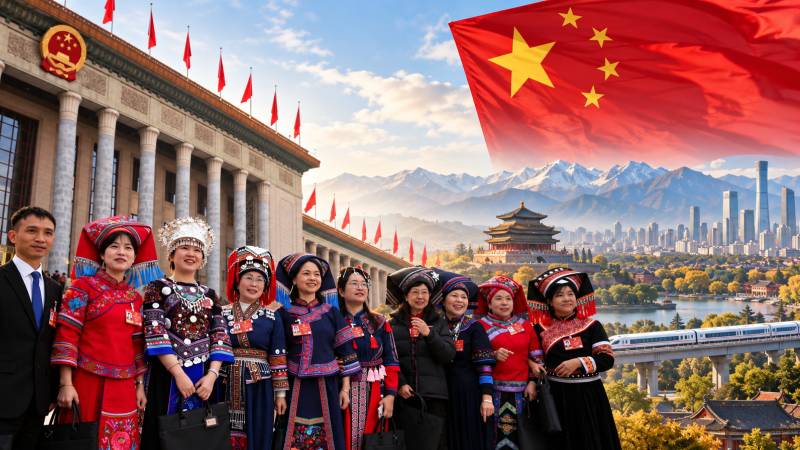
On 1 July 2026, China’s Law on Promoting Ethnic Unity and Progress entered into force, giving legal form to one of Beijing’s most consequential approaches to governing a vast and complex multi-ethnic state. Much Western commentary has presented the legislation principally as a vehicle for assimilation and cultural erasure. That interpretation captures one area of legitimate debate, but it misses the broader strategic calculation behind the law. Beijing is attempting to institutionalise a proposition that has shaped its ethnic policy for years: diversity can remain a permanent feature of China without becoming a basis for political fragmentation. The new law therefore represents less a new beginning than the codification of a long-developing strategy built around national cohesion, economic integration, linguistic accessibility and territorial integrity.
China’s approach cannot be separated from its history. It is an ancient continental polity whose borders and population have evolved through centuries of political consolidation and interaction among different peoples. The country officially recognises 56 ethnic groups, with minority communities concentrated across extensive and strategically important frontier regions. Since 1949, Beijing has tried to reconcile this diversity with the needs of national reconstruction, first through regional ethnic autonomy and later through a stronger emphasis on a shared Chinese national identity.
By the twenty-first century, that balance faced significant pressures. Regional economic disparities, separatist movements, religious extremism and cross-border militant networks demonstrated how ethnic grievances could intersect with security threats. The 2009 Urumqi riots and subsequent terrorist attacks between 2013 and 2016 reinforced Beijing’s conviction that ethnic policy could not be separated from national security, development and social stability.
The 2026 law accordingly does not emerge from a vacuum. It translates earlier policies into a more comprehensive legal framework. Its provisions promote a shared sense of belonging to the Chinese nation, encourage interaction and integration among ethnic communities, pursue common economic development and prohibit ethnic discrimination. It also gives legal weight to the state’s objective of strengthening national unity while establishing responsibilities for institutions, organisations and individuals. The logic is straightforward. For Beijing, political cohesion cannot depend indefinitely on administrative arrangements or temporary campaigns. It requires a common civic framework through which citizens can participate in the same education system, labour market and national institutions. The law seeks to turn that principle into durable state policy.
Xinjiang remains the most contested test of this approach. From approximately 2014 onwards, authorities conducted an intensive campaign against what Beijing called the “three evils” of terrorism, separatism and religious extremism. Western governments, human-rights organisations and the United Nations have raised serious concerns about detention, coercive practices and restrictions on cultural and religious life. Beijing rejects the characterisation of its policies as systematic repression and argues that they must be assessed against the violence and security threats that preceded them.
China has made its choice: it is seeking to replace episodic ethnic management with permanent legal architecture, linking national cohesion to development, a common language, social integration and territorial integrity.
Yet the subsequent security and developmental trajectory is also part of the record. Major terrorist violence in Xinjiang declined sharply after 2017, while infrastructure investment, poverty alleviation and employment initiatives expanded. Official census data show that the Uyghur population increased in absolute terms between 2010 and 2020. These indicators do not resolve every dispute over state policy, but they demonstrate why Beijing regards security, development and integration as interconnected rather than competing objectives.
Language policy illustrates the trade-off most clearly. Mandarin is given a central role in education and public administration. At the same time, the new law also states that minority languages should be respected, protected and supported, including through standardisation and digitisation. Beijing’s argument is fundamentally developmental: proficiency in a common national language expands access to higher education, employment, administration and the wider Chinese economy. France, Turkey, Indonesia and other states have likewise used language policy to strengthen national cohesion, although their historical circumstances differ considerably.
The counterargument is equally clear: linguistic integration can threaten cultural continuity. That tension should not be dismissed. The durability of China’s model will depend partly on whether formal protections for minority languages translate into meaningful opportunities for their preservation and use. Beijing has nevertheless made its choice: integration is to be prioritised without formally abandoning minority cultural identity.
The law’s provisions concerning activities originating outside China raise a further sovereignty question. Article 63 provides for legal responsibility where organisations or individuals outside China engage in conduct directed against China that undermines ethnic unity or creates ethnic division. Its practical enforcement beyond Chinese jurisdiction is necessarily constrained, but its political message is unmistakable. Beijing considers external support for separatism or ethnic division a national-security concern. Critics see potential implications for diaspora activism, research and journalism; Chinese policymakers frame the provision as protection against foreign interference in domestic affairs.
For Pakistan, the implications are particularly practical. A stable Xinjiang strengthens the security and economic foundations of the China-Pakistan Economic Corridor, supports connectivity with Central Asia and reinforces the wider regional architecture built around the Shanghai Cooperation Organisation. Pakistan’s longstanding emphasis on territorial integrity, stability and non-interference provides a natural basis for understanding Beijing’s approach. For Islamabad, Xinjiang’s stability is not simply an internal Chinese matter; it is an important condition for secure borders, trade, connectivity and the expansion of China-Pakistan economic cooperation.
China’s model is not necessarily transferable to every multi-ethnic state. Its political system, geography, history and development trajectory are distinctive. But there is no compelling reason to assume that every diverse state must manage identity through the same institutional formula. Large states confront different combinations of history, security pressures, economic inequality and geography. Their policies must be assessed in light of those realities.
The ultimate test of the 2026 law will therefore be its long-term consequences. If economic opportunity continues to expand across ethnic communities, if extremist violence remains contained, and if minority languages and cultural practices retain meaningful space within the wider national framework, Beijing will have strengthened its argument that integration and diversity can coexist within a unified political order.
China has made its choice. It is seeking to replace episodic ethnic management with permanent legal architecture, linking national cohesion to development, a common language, social integration and territorial integrity. The objective is neither to deny that China is diverse nor to allow diversity to become a foundation for political fragmentation. It is to construct a shared national community large enough to contain those differences. That is the deeper significance of the new law. Its success or failure will ultimately be determined by practice, not rhetoric. But its central proposition is unmistakable: in a continental power of China’s scale, national unity is not merely a political preference. It is a strategic necessity, and Beijing has now chosen to make that necessity part of the law.