

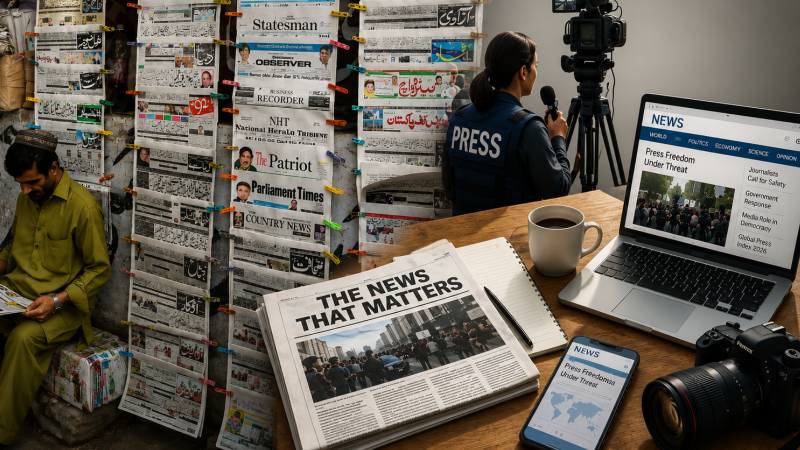
An interesting week for journalism as newspapers collectively revealed an important shift in the way the economy is being discussed. As I have noted in previous reviews, economic reporting has largely revolved around the daily cycle of announcements: another IMF review, another export target, another meeting of the ECC, another increase in petroleum prices, another promise of investment, another privatization plan. Journalism has remained an extension of official press releases. This week, however, several reporters and commentators moved beyond announcements and began asking questions about institutions, incentives and implementation. The movement is tentative, uneven and incomplete, but it needs to be encouraged.
Economic Journalism
Perhaps the best example was Profit's continuing coverage of the wheat market. Rather than simply reporting farmers' protests or government responses, it used economic logic to discuss the sequencing required to liberalize a market. Merely eliminating procurement did not automatically create competitive markets because farmers still lacked storage facilities, warehouse receipt systems, commodity finance, transparent price discovery and effective competition among buyers. The result was a strengthening of intermediaries rather than markets, leaving farmers exposed to precisely the uncertainties that the supply chain was supposed to minimize. Thus the newspaper demonstrated something that Pakistani journalism rarely manages: policy reform is not merely a knee-jerk policy change without understanding the institutions that must exist if the market and supply chain are to work.
Profit continues to distinguish itself because its reporting reflects an understanding of economics rather than merely business news. Its coverage of the power sector is a good example. The immediate news was that distribution companies were seeking another tariff adjustment, but the newspaper looked beyond the regulatory hearing to explain the underlying problem. As more households and businesses switch to solar, the fixed costs of the old electricity system are spread over a shrinking number of grid consumers. Capacity payments remain locked into long-term contracts, pushing tariffs even higher and encouraging still more consumers to leave the grid. What they missed was what research has repeatedly shown: that the power sector is controlled by the bureaucracy, which does not allow a deregulated market-based system to emerge after 20 years of commitments.
Several newspapers correctly highlighted the impressive inflow of worker remittances of over three and a half billion dollars during July, recognizing its importance for Pakistan's external position. Yet remittances are only half of a much larger story. During the same week, reports also noted the continuing outflow of skilled and semi-skilled Pakistani workers seeking employment abroad. Rising remittances undoubtedly ease balance-of-payments pressures, but they may simultaneously indicate an economy increasingly dependent upon exporting labor because it struggles to create sufficiently productive employment at home. Research on the brain drain has regularly shown that this skilled migration coincides with our continued reliance on foreign consultants as well as the erosion of domestic capacity. This link was missed.
The announcement that the Special Investment Facilitation Council intends to accelerate the regulatory guillotine has the potential to become one of the year's most important economic stories. None of them knew that while domestic research was available, there is a foreign consultant leading the effort. Domestic research has also pointed out simpler methods for doing such deregulation, while the consultants' efforts are to keep the process going for a long time. Unless newspapers maintain such institutional memory, even deregulation risks becoming another slogan whose success is measured by announcements rather than outcomes.
Merely eliminating procurement did not automatically create competitive markets because farmers still lacked storage facilities, warehouse receipt systems, commodity finance, transparent price discovery and effective competition among buyers.
Overall, the quality of reporting this week was stronger than usual because several journalists displayed an awareness that economies are systems rather than collections of isolated events. Nevertheless, the dominant weakness remains fragmentation. The reports on taxation, electricity, migration, agriculture, regulation and investment were all informative individually, but very few attempted to connect them into a single explanation of Pakistan's long-standing avoidance of reform.
Economic Commentary and Opinion
Opinion pages also improved but remained "siloed" and unrelated to local research. However, these articles were willing to question assumptions that have become deeply embedded in Pakistan's policy debate. The article arguing that Pakistan's power-sector privatization (BR) has the sequence backwards made precisely this point. Ownership changes alone cannot solve problems created by flawed market design. Nor is it wise to hand over monopolies to the usual houses that have grown up on government subsidies or protection. Moreover, privatizing a distribution company while leaving unchanged the tariff structure, contractual obligations, regulatory framework and political interventions that shape its behavior merely transfers an inefficient system from one owner to another. The insight extends well beyond electricity. Pakistan has often treated institutional reform as a question of ownership when the more fundamental issue concerns the incentives created by the rules within which organizations operate.
The taxation debate similarly showed signs of maturing. The article challenging Pakistan's obsession with the tax-to-GDP ratio (BR) argued, correctly in my view, that taxation cannot be evaluated independently of the economy from which taxes are collected. The relevant questions are not only how much revenue is raised but also what forms of economic activity are taxed, what compliance costs are imposed, how investment incentives are affected and how effectively public expenditure converts taxation into public value. Pakistan has gradually allowed the tax ratio itself to become the objective of policy rather than a consequence of economic development.
Dawn also produced reporting that challenged conventional economic narratives rather than simply reproducing official statistics. Its report on Bank of Punjab President Zafar Masud's proposal for a "Welfare GDP" questioned whether aggregate GDP adequately measures improvements in living standards when rapid population growth, unequal income distribution and differing inflation experiences across income groups are taken into account. Whether one agrees with the precise methodology is almost beside the point. The report encouraged readers to think beyond headline GDP figures and towards the relationship between economic growth and actual welfare, a distinction that has become increasingly important in countries where macroeconomic stabilization has not translated into broad improvements in household well-being.
Several commentaries also converged around the question of governance. The continuing debate over creating new provinces prompted thoughtful discussions about whether administrative fragmentation can compensate for institutional weakness (BR and Dawn). These pieces deserve credit for refusing to assume that smaller provinces automatically produce better government. Yet the discussion remained incomplete because it focused primarily upon constitutional arrangements rather than the economics of public administration and fiscal federalism. The debate on provinces has been ignited to defer the longstanding demand for city autonomy through a local government law. Much research around the world has shown that cities are the engines of growth and that city competition for investment and human capital drives investment. Most recent research on China called the growth acceleration in China a product of the "mayoral economy." The debate here missed this point.
Another welcome theme was the treatment of artificial intelligence as part of a broader development ecosystem rather than as an isolated technology. In Dawn, Mahwish Khan's "Before AI Hits the Grid" argued that Pakistan's AI ambitions will be constrained by unreliable and expensive electricity. Business Recorder's "The Real Test of Pakistan's AI Sovereignty" similarly argued that competitiveness depends not only on adopting AI but also on developing domestic technological capability and sound governance. Together, these articles remind us that technology is central to modern life, and technology policy cannot be separated from education, infrastructure and institutions.
Despite these strengths, the opinion pages also revealed a long-standing weakness in Pakistan's economic commentary. Too many articles still end with broad prescriptions rather than specific reforms. We are repeatedly told that Pakistan should improve governance, strengthen institutions, broaden the tax base, increase exports or invest in human capital. Many of this week's pieces, including "Pakistan Needs a Pause" (Profit), "Beyond Tax-to-GDP Ratio" and "Fiscal Federalism in Pakistan" (Business Recorder), correctly identify the country's structural weaknesses, but they often stop at that level. The more difficult questions are left unanswered. Which regulations should be abolished? Which agencies should lose authority? Which subsidies should end? Which markets need new institutions? Which decisions should move from ministries to cities, schools or firms? Institutional reform happens at this level of detail, not at the level of aspiration. Until economic commentary moves from diagnosis to institutional design, calls for better governance will remain persuasive but incomplete.
Another notable omission across much of the week's commentary was the limited engagement with Pakistan's own research community. International institutions continue to dominate public debate. World Bank reports, IMF assessments and multilateral publications receive detailed discussion while Pakistani economists, universities, think tanks and researchers who have spent decades examining precisely these questions are never cited. Economic journalism would become considerably richer if it routinely placed domestic scholarship alongside international work, allowing ideas to compete rather than assuming that intellectual authority must always arrive from abroad.
A Common Narrative Emerging but Granularity Missing
Taken together, the week's reporting and commentary point to a narrative that few articles state explicitly. Pakistan has made measurable progress in restoring macroeconomic stability, yet the institutions that generate sustained growth remain largely unreformed. Weak cities, over-centralized administration, thin markets, regulatory accumulation, financial systems geared toward government borrowing rather than enterprise, an unreformed power sector, dysfunctional agricultural markets and continuing reliance on migration and IMF support are not separate problems but different manifestations of the same political economy. The encouraging development is that Pakistan's economic press is beginning to move beyond reporting announcements toward examining the systems that produce these outcomes. The next step is to connect those systems into a coherent explanation of why the same economic crises continue to recur using available research and not just IFI and donor prescriptions.