

The middle class constitutes the vibrant core of modern society, comprising individuals and households who maintain steady, reliable incomes and possess the economic resources necessary to live comfortably, meet essential needs, and plan for the future. Although they lack the immense fortunes and sweeping economic influence characteristic of the upper class, they far outnumber both the upper and lower strata, forming the demographic majority. This segment acts as a vital harmonizing bridge and primary socioeconomic stabilizer, mitigating class polarization. Furthermore, a rapidly expanding middle class serves as a reliable barometer of overall economic growth and institutional health, driving upward social mobility that continually facilitates the transition of individuals from lower economic tiers into positions of greater security and prosperity.
The World Bank, along with researchers at the Brookings Institution, has often used a framework to categorize developing nations. They define the “middle class” in these economies as individuals earning between $10 and $50 a day (World Bank Document). Using the $10–$50-per-day benchmark, the corresponding monthly income range is $300–$1,500, assuming a 30-day month. At an exchange rate of approximately Rs. 275.91 per US dollar, this translates into a nominal monthly income range of approximately Rs. 82,773–Rs. 413,865 in Pakistan. For comparison, applying the same dollar-based benchmark in June 2019, when the exchange rate was approximately Rs. 150–160 per US dollar, would have produced a considerably lower nominal range of around Rs. 45,000–Rs. 240,000 per month. However, these nominal conversions do not account for changes in domestic prices or the actual purchasing power of the Pakistani rupee. For this reason, Purchasing Power Parity (PPP) provides a more meaningful basis for assessing middle-class economic status, as it accounts for differences in the cost of goods and services across countries.
Increased indirect taxes are placing additional pressure on households, making it harder for them to save, invest, or even maintain their current living standards. As a result, many middle-income families find themselves in a precarious position, with fewer resources available to ensure long-term stability.
The World Bank’s latest Pakistan Poverty & Equity Brief further indicates growing economic pressure on Pakistani households: 40.5% of the population was below the $3.65-per-day poverty line in FY2024, while an estimated 2.6 million additional people fell into poverty during that year. The report also highlights declines in real wages in sectors including construction, trade, and transportation, suggesting that rising nominal incomes have not necessarily translated into improved purchasing power or living standards. The World Bank highlights the significant impact of the cost-of-living crisis on Pakistan’s poor, vulnerable, and aspiring middle-class households, which spend approximately 42–48% of their household budgets on food, leaving less income available for other essential needs.
According to the World Bank’s Poverty and Inequality Platform, 23.0% of Pakistan’s population lived below the $3-per-day poverty line (2021 PPP) in 2024, while 87.1% lived below the $8.30-per-day threshold. The platform also reports a prosperity gap of $7.20 per day, considerably below the World Bank’s $28-per-day prosperity standard (Poverty and Inequality Platform). Income inequality further highlights the economic challenges facing Pakistani households. The World Inequality Report 2026 estimates that, in 2024, the top 10% of Pakistan’s population received approximately 42% of total national income, compared with around 19% for the bottom 50%. The report indicates that income inequality remains high, with limited progress over the past decade (World Inequality Report 2026). Together, these indicators suggest that Pakistan’s middle class continues to face considerable economic pressure from rising living costs, widespread poverty, and persistent income inequality.
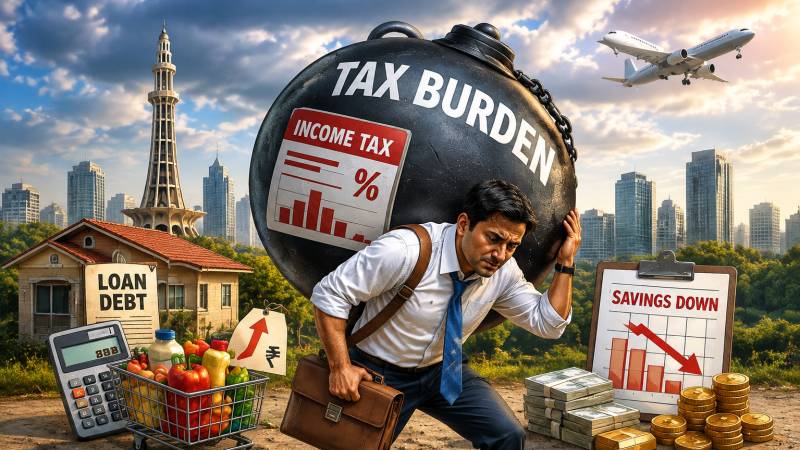
Pakistan’s middle class is feeling the heat as economic pressures mount due to rising living costs, stagnant wages, currency depreciation, increased taxes, and a lack of good job opportunities. While the number of middle-class households might not be decreasing, their financial stability and purchasing power have taken a significant hit. According to the World Bank, families are spending a staggering 42–48% of their budgets on food, leaving them with little income for essentials such as housing, education, healthcare, and transportation. Rising prices of food and energy, coupled with falling real wages in industries such as construction, trade, and transportation, have significantly reduced disposable income. At the same time, the depreciation of the currency has made imports more expensive, forcing families to spend a larger portion of their earnings on basic necessities. Moreover, sluggish economic growth and a shortage of well-paying jobs are making it difficult for people to move up the economic ladder. Increased indirect taxes are placing additional pressure on households, making it harder for them to save, invest, or even maintain their current living standards. As a result, many middle-income families find themselves in a precarious position, with fewer resources available to ensure long-term stability.
In summary, while Pakistan’s middle class is not vanishing, it is certainly being squeezed from all sides. Ongoing inflation, high housing costs, declining real wages, and limited job opportunities are pushing some families closer to poverty while preventing others from advancing into the middle-income bracket. The real issue is not just the size of the middle class; it is whether its economic security, quality of life, and purchasing power are on a steady decline.