

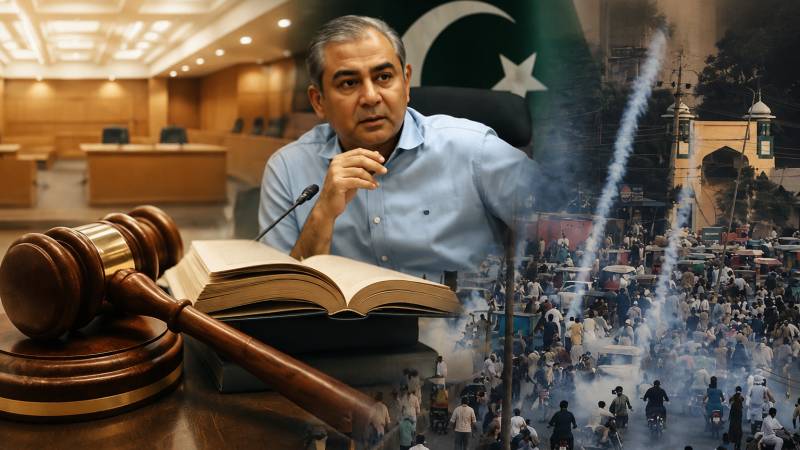
Federal Interior Minister Mohsin Naqvi’s recent pronouncement that the “system” has collapsed is hardly surprising. The people of Pakistan have known this for years. In drawing rooms, tea shops, and roadside stalls, they may use more colourful vocabulary to describe their frustration, but the underlying sentiment is the same: ordinary Pakistanis have been living with a system that increasingly fails to provide security, justice, reliable public services, and economic opportunity. Naqvi’s statement deserves attention precisely because it did not come from an opposition party or media commentator but from an influential cabinet minister of the current governing party.
But in reality, the system has worked remarkably well for a small group of elites that includes the ruling class of politicians, military brass, members of the judiciary, officials of law-enforcement agencies, senior bureaucrats, senior officials of myriad government agencies, and just about anyone else who wields some degree of authority. These people have been able to use or abuse the system to extract high levels of compensation and a slew of privileges from the government coffers for their “services” and live lavish lifestyles in an impoverished country. This is the central paradox of Pakistan’s governance crisis: the system may be dysfunctional for the public while remaining highly functional for those who benefit from it.
Naqvi did not clearly define what he meant by the “system,” but it is reasonable to understand the term as referring broadly to Pakistan’s system of governance. That system is not unique. Pakistan inherited a Westminster-style parliamentary framework from the British colonial period, as did several other South Asian countries, including India and Bangladesh, although each country has developed its own constitutional and political practices. The structure itself is not inherently incapable of delivering good government. Institutions work when political leaders and state actors respect constitutional limits, accept accountability, and use public power for the public good.
For more than half a century, the country has been ruled, directly or indirectly, by the military establishment and a handful of powerful political families now in their second and third generations. They consider it their birthright to be part of the ruling class. Over the years, institutions that should provide checks and balances have been weakened by interference, politicization, patronage, incompetence, mismanagement, and corruption.
Elections have become meaningless. The current government is widely regarded as illegitimate, brought in through rigged elections. Ordinary people who barely knew how to vote by selecting the party symbol of a candidate on a ballot now know what Form 47 is and how easily it can be forged to produce the desired election result. Once political legitimacy is weakened, nearly every other institution suffers. A government that is preoccupied with surviving politically has less capacity to undertake difficult reforms.
In reality, the system has worked remarkably well for a small group of elites that includes the ruling class of politicians, military brass, members of the judiciary, officials of law-enforcement agencies, senior bureaucrats, senior officials of myriad government agencies, and just about anyone else who wields some degree of authority.
The economic consequences of a collapsed system are equally serious, and they have resulted in severe hardships for ordinary people. In many areas, public services are nonexistent. There is a shortage of essential services such as clean water, sanitation, electricity, gas, and petrol. Inflation is persistently high and has eroded purchasing power. Unemployment, particularly among young people, has created a hopeless future for them, and many are trying to leave the country. Foreign investors are staying away due to political uncertainty, and domestic investors are reluctant to make long-term investment commitments under a collapsed system. The law-and-order situation has gone from bad to worse.
In his speech, Naqvi alluded to the need to reconfigure Pakistan’s administrative map by creating more provinces or other manageable regions in response to population growth and demographic change. While there may be merit in looking into this proposition, this factor alone cannot be regarded as the cause of institutional failure. Any proposal for the reconfiguration of administrative regions should be carefully weighed against the additional cost of more assemblies, more ministries, more judges, more bureaucrats, and more opportunities for corruption. Without stronger accountability, decentralization can simply reproduce the same problems at a larger number of administrative levels.
To use a computer-system analogy, the system crashes when critical operating-system processes become incompatible, system files are corrupted, or one program interferes with another. A reboot of the system usually resets the corrupted files to their previous working configuration, and the system again operates in normal mode. Pakistan’s governance system has suffered from a similar problem: institutions that should operate within defined constitutional boundaries repeatedly interfere in one another’s responsibilities. The result is not cooperation but conflict, paralysis, and uncertainty. A reset will require each stakeholder to understand their role as described in the constitution, respect each other’s responsibilities, and stay in their own lane.
A genuine reset therefore requires more than replacing a government or changing a few officeholders. It requires restoring the constitutional division of responsibilities. The military establishment must remain within its constitutional domain. Political leaders must accept that electoral victory does not place them above the law. Parliament must perform its legislative and oversight functions rather than becoming a rubber stamp. The judiciary must administer justice independently and consistently. The bureaucracy must serve the state rather than individual politicians or power centres.
What, then, can be done to revive the collapsed system, and who can do it? The first requirement is political legitimacy. A government widely viewed as lacking a credible electoral mandate will struggle to persuade the public to accept painful reforms, however necessary those reforms may be. The immediate priority should therefore be to create a political environment in which competition is legitimate, release political prisoners, end politically motivated legal proceedings, protect freedom of political participation, and hold genuinely free, fair, and transparent elections.
Once a legitimate political mandate exists, the country can undertake the much harder second stage: institutional reform. That should include strengthening parliamentary oversight, professionalizing the civil service, improving local government, making public spending more transparent, strengthening judicial independence, reforming electoral administration, and setting clear limits on the use of state institutions for political purposes. Economic reform must proceed alongside political reform because neither can be sustained without the other. Investors need predictable rules, citizens need reliable services, and the state needs a tax and expenditure system that is capable of financing those services fairly.
The people of Pakistan have endured enough experiments, interruptions, and promises. They do not need to be told that the system has collapsed; they need to see evidence that it can be rebuilt. The real test of any reform will be whether an ordinary citizen without money, connections, or political patronage can obtain justice, receive public services, find economic opportunity, and have confidence that the vote actually matters. That is what a functioning system should mean. Anything less is merely a better-managed version of the same collapse.