

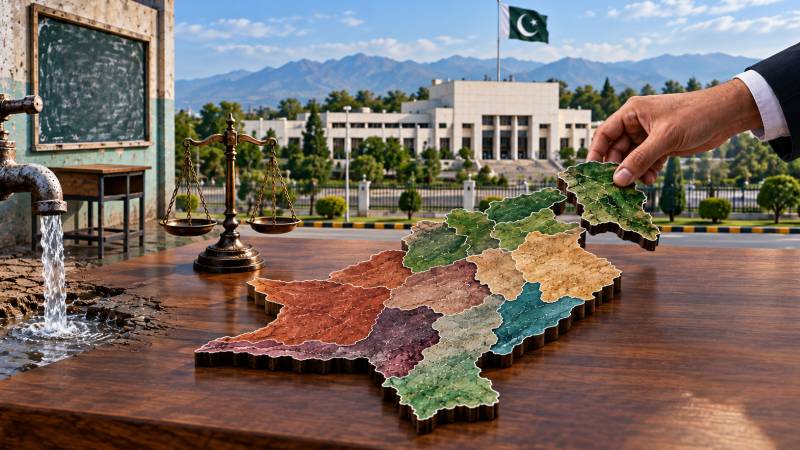
When governments fail to deliver water, education, and justice, they often reach for the map. Pakistan once again stands before that choice with logic best known to people in power: framing territorial division in the attractive language of administrative reform. Yet divide et impera ( divide and rule) is not a conspiracy theory; it is an old grammar of power. Rome used it against tribes; Niccolò Machiavelli treated it as statecraft; Immanuel Kant counted it among the maxims of despotic rule; and the British Raj perfected it in India through the census, the army, and the electoral system. A ruler who fears that citizens might unite around a common demand need not defeat them in argument; it is enough to make their solidarity costly. By sorting fluid identities into official boxes and attaching offices, seats, and patronage to them, the centre acts as what Georg Simmel described as tertius gaudens, the third party who benefits from the quarrels of others.
The British Raj understood this method well. After the 1857 rebellion, colonial administrators feared that Hindus and Muslims might again unite in resistance. Lord Elphinstone stated the principle with candid clarity: divide et impera was an old Roman maxim, and now it would be theirs. Then came the paperwork. Beginning in the 1870s, the decennial census transformed religion into a rigid political category, forcing fluid identities into administrative compartments and turning numbers into political weapons. In 1905, the partition of Bengal was justified as an administrative necessity; a province supposedly too vast to govern, yet the line engineered a Hindu-majority west and a Muslim-majority east. The Indian Councils Act of 1909 deepened this cleavage with separate electorates, structurally incentivizing politicians to become communal brokers rather than builders of a shared vision of people.
Pakistan inherited its own version of this dilemma: how to prevent the largest unit from permanently outvoting the rest. In 1955, the answer was not more provinces, but no provinces at all. Sindh, Punjab, the North-West Frontier Province, and Balochistan were merged into "One Unit." Cloaked in the rhetoric of administrative economy and national integration, its actual political purpose was to manufacture parity with East Bengal and subordinate the smaller western provinces to a Punjab-dominated centre. Sindh experienced One Unit not as administrative efficiency, but as a deep wound to its political identity, representation, and autonomy. It collapsed as a development model and was abolished in July 1970, surviving as an indelible historical memory.
Following 1971, the 1973 Constitution balanced demographic dominance through the Senate and the Council of Common Interests. Decades later, the Eighteenth Amendment of 2010 and the Seventh NFC Award strengthened this federal compact: the Concurrent Legislative List was abolished, the provincial share of the divisible pool rose from 45 to 57.5 percent, and revenue distribution moved beyond population to incorporate poverty, revenue effort, and inverse density. Yet a critical chapter remained unfinished. Article 140-A mandated empowered local governments, but authority travelled from Islamabad to Lahore, Karachi, Peshawar and Quetta, and stopped there. The provincial capitals hoarded power without devolving it down to districts, cities, and neighbourhoods.
Pakistan’s path to progress lies not in redrawing its territory, but in respecting its constitutional compact and making existing governance finally work for the governed.
Now the maps are back on the table. Federal proposals speak of twelve to fifteen "administrative units" or roughly 160 district governments, floating ideas to partition Punjab, separate Pashtun and Hazara regions in Khyber Pakhtunkhwa, fracture Balochistan and dismantle Sindh. Moreover, the proposition to place revenue engines like Karachi and Gwadar under direct federal control collapses under empirical scrutiny: what federal institution has actually delivered exemplary performance? A basic audit of centrally managed entities reveals chronic dysfunction rather than administrative prowess. From the compounding circular debts and transmission failures of WAPDA, to the fiscal haemorrhage of PIA and Pakistan Railways, to the chronic maintenance deficits of the National Highway Authority (NHA) and arbitrary overreach in the Pakistan Telecommunication Authority (PTA), the centre’s footprint has rarely signalled managerial efficiency. Entrusting commercial gateways and littoral hubs to an Islamabad bureaucracy that has consistently mismanaged national public utilities is not reform; it is an appetite for territorial extraction without accountability.
Yet maps arrive before the law. The Constitution contains a deliberate safeguard: Article 239(4) requires a two-thirds majority of the concerned provincial assembly before any constitutional amendment altering provincial boundaries can proceed. On September 3, the Sindh Assembly invoked this constitutional lock and a lineage of resolutions dating back to 1948 to declare that "Sindh is one and shall remain one," rejecting any division or federal takeover of its cities as the PPP closed ranks and the MQM staged a walkout.
A new province does not automatically generate governance. It brings an assembly, cabinet, secretariat, governor, high court benches, and bureaucratic payrolls that claim NFC funds without delivering a single school, hospital, or drop of irrigation water. Strip away the administrative jargon, and it becomes evident that the drive to carve up federating units is far less about service delivery and far more about resource control. It is an unstated contest over fiscal shares, strategic ports, urban revenues, mineral rents, and river waters. The solution to Pakistan's structural crisis does not lie in redrawing borders, engineering constitutional bypasses, or rolling back the Eighteenth Amendment. The genuine solution lies in the equitable distribution of resources, targeted inclusive development initiatives, improving the quality of governance, and steadfastly respecting the Constitution. While long-standing political demands in regions like South Punjab and Hazara possess their own legislative histories, altering lines on a map cannot substitute for institutional reform.
Disparities that breed regional alienation must be resolved through fair resource allocation, not territorial dismemberment. Crucially, the state must complete the devolution already mandated under Article 140-A through fiscally autonomous local governments backed by a functional three-tier financial system. The British did not need to invent hatred; they only made it the cheapest path to political power. Pakistan’s path to progress lies not in redrawing its territory, but in respecting its constitutional compact and making existing governance finally work for the governed.