

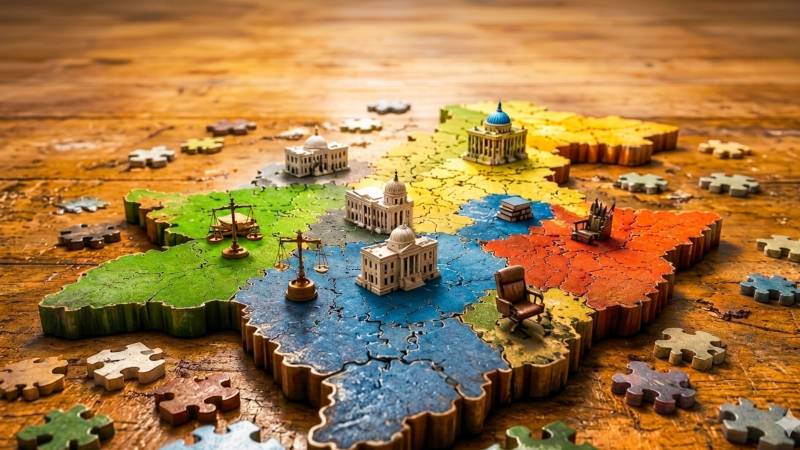
Every decade, Pakistan rediscovers the governance debate. The actors change, the slogans evolve and the proposed solutions differ, but the underlying question remains remarkably unchanged: how should power be organised to govern Pakistan more effectively? The latest proposition that creating new administrative provinces will reverse governance failure appears intuitively attractive. Larger provinces are assumed to be difficult to govern; therefore, smaller provinces should improve administration, service delivery and state responsiveness.
The citizens are both the source and the purpose of state authority. Yet in Pakistan, the citizen remains largely absent from debates on governance reform. The current debate revolves around who exercises power and how that power is shared between the Federation and the Provinces. It rarely asks the more fundamental democratic question: how does power become accountable to the citizen?
Citizens experience governance differently from governments. Citizens are rights holders; public institutions are duty bearers. Governments tend to view governance through constitutional arrangements, political authority and administrative structures. Citizens experience it through the everyday lived experiences. A citizen does not experience the Constitution through its articles or legal guarantees. The Constitution becomes meaningful when a child is admitted to school, a birth is registered without delay, a Basic Health Unit functions, drainage systems withstand the monsoon, police respond impartially, women can access reproductive health services and report violence without fear, and elected representatives possess both the authority and the resources to resolve local problems. Governance therefore begins not in Islamabad or the provincial capitals. Governance is anchored at local level and succeeds when institutions possess both the authority and the accountability to fulfil those obligations. When they do not, citizens experience governance failure and have declining trust in public institutions.
In Pakistan, governance debates are overwhelmingly framed through national politics. Public discussion revolves around Parliament, provincial assemblies, chief ministers, governors and constitutional amendments. Administrative debates ask whether provinces should be divided further, districts reorganized or new divisions created. These questions assume that governance automatically improves when administrative units become smaller and more manageable.
The recent debate is generated by the Federal Interior Minister attributes Pakistan's governance crisis to administrative inefficiency and proposes the creation of new provinces as a corrective measure. The diagnosis, however, risks confusing geography with governance. Pakistan's governance deficit is institutional rather than territorial. The country has experienced repeated constitutional, administrative and political restructuring since independence, yet the relationship between citizens and the state remains characterised by weak accountability, fragmented service delivery and persistent institutional distrust.
Much of the public debate, amplified by sensationalist media narratives, mistakes symptoms for causes. Pakistan's governance challenges are real, but they cannot be understood without recognizing that the country has spent much of its constitutional history oscillating between military-led centralization and civilian political competition. Governance reform has repeatedly been subordinated to political survival. Creating additional provinces may redistribute existing political influence and generate new centers of power, but it will not, by itself, improve governance unless it embeds empowered local governments within its constitutional architecture.
Empowered local governments do precisely that. They redistribute political authority, create new democratic leadership, strengthen fiscal transparency, reduce discretionary patronage, improve administrative accountability and compel political parties to broaden political participation beyond provincial elites. More importantly, they establish a direct institutional relationship between citizens and the state, making accountability visible in everyday life rather than during election cycles alone.
Ironically, local government remains largely absent from the contemporary governance debate despite being central to Pakistan's constitutional and political history.
The popular perception that local government has never taken root in Pakistan is historically inaccurate. The country's experience is not one of absence but of discontinuity. Almost every political regime has redesigned local government institutions, yet none has succeeded in institutionalizing them as permanent democratic structures. General Ayub Khan introduced the Basic Democracies System in 1958 as a model of grassroots participation. In practice, however, it also served as the Electoral College that legitimized the 1960 presidential referendum, paving the way for the 1962 Constitution and the presidential form of government. Administrative authority—particularly law and order, policing and district administration—remained firmly under the civil bureaucracy.
Prime Minister Zulfikar Ali Bhutto promulgated the People's Local Government Ordinance in 1975. Although it recognised the importance of local governance, elections were never held and the proposed institutional framework remained largely on paper. General Zia-ul-Haq revived local government through provincial ordinances in 1979, establishing Union Councils, Tehsil Committees and District Councils. Like the Basic Democracies model, these institutions remained subordinate to provincial governments while executive authority continued to rest primarily with the bureaucracy.
Between 1988 and 1999, democratic governments alternated between Benazir Bhutto and Nawaz Sharif. Despite rhetorical commitments to democratic decentralisation, local government elections were held inconsistently and remained vulnerable to changing provincial political priorities. Rather than becoming permanent democratic institutions, local governments were treated as optional political arrangements.
The most ambitious restructuring came under General Pervez Musharraf through the Devolution of Power Plan 2000 and the Local Government Ordinance 2001. Unlike previous models, district governments exercised significant executive authority under elected Nazims, while administrative powers traditionally held by district bureaucracies were transferred to elected representatives. Unsurprisingly, this redistribution of authority generated resistance from both provincial political elites and the bureaucracy. The model gradually disappeared following the democratic transition in 2008.
The historical pattern is revealing. Military governments viewed local government as a means of cultivating political legitimacy and bypassing provincial elites. Civilian governments, by contrast, often viewed empowered local governments as potential rivals capable of producing alternative political leadership and weakening provincial patronage networks. The recurring redesign of local government therefore reflects not administrative experimentation but the political economy of power.
The Eighteenth Constitutional Amendment (2010) marked a watershed in Pakistan's constitutional history by devolving substantial legislative, administrative and fiscal responsibilities from the Federation to the Provinces. It completed federal devolution but stopped at provincial level. Article 140A requires provinces to establish elected local governments and devolve political, administrative and financial authority to them. Its constitutional intent is unambiguous: local government was envisaged not as an administrative department of provincial governments but as a constitutionally protected democratic tier of the state. Political consensus often exists around the principle of decentralisation but weakens considerably when administrative authority, financial resources and political influence are expected to move beyond provincial capitals.
Since the Eighteenth Amendment, Pakistan has developed four distinct provincial Local Government frameworks, differing in structure, functions and electoral arrangements but sharing one defining characteristic: local governments remain subordinate to provincial governments. Frequent amendments to Local Government Acts, delays in elections, suspension of elected councils, repeated institutional restructuring and, most significantly, the failure to implement meaningful fiscal decentralisation demonstrate that local government continues to be treated as an administrative option rather than a constitutional obligation. Although the Constitution envisaged Provincial Finance Commissions (PFCs) as the primary mechanism for devolving predictable financial resources to local governments, PFC Awards have been delayed, inconsistently implemented or reduced to discretionary provincial transfers. Political authority without financial autonomy is largely symbolic, therefore, local governments remain dependent on provincial governments. Pakistan has institutionalized local government in law, but not in practice, leaving the country with four provincial systems, none of which enjoys the spirit of Article 140A.
This institutional design reflects a deeper political economy. The reluctance to devolve authority is not merely administrative; it is inherently political. Empowered local governments create alternative centres of leadership, redistribute fiscal resources, reduce discretionary patronage and establish new mechanisms of accountability. They produce future parliamentarians, ministers and chief ministers outside traditional provincial political structures. For provincial political elites, meaningful decentralisation is therefore not simply an institutional reform—it represents a redistribution of political power.
This explains why successive governments, regardless of political affiliation, have generally found it easier to legislate local government than to genuinely empower it. Consequently, local government remains one of Pakistan's most contested democratic institutions—not because its value is disputed, but because its success inevitably alters existing political incentives.
The consequences are increasingly evident as Pakistan confronts more complex governance challenges. Climate change, rapid urbanisation, demographic pressures, public health emergencies, technological transformation and internal migration cannot be managed effectively through centralised administrative systems alone. These challenges require institutions capable of responding quickly to local realities while remaining accountable to the communities they serve. For example, the devastating floods of 2022 demonstrated that disasters are not merely humanitarian crises; they are governance tests. The effectiveness of emergency response depends not only on national relief operations but also on whether local institutions possess the authority, resources and preparedness to protect communities before, during and after disasters. Local governments are uniquely positioned, and globally recognized, to lead community-based disaster risk reduction, protection of public infrastructure and coordination of emergency response within clearly defined institutional arrangements.
Local governance is equally important in addressing gender inequality during emergencies. Women, children, persons with disabilities, older persons, refugees, religious minorities and transgender communities experience disasters differently because existing social inequalities intensify during crises. Gender-based violence frequently increases, access to sexual and reproductive health services becomes more limited and protection systems weaken precisely when they are most needed. Local institutions familiar with community dynamics are better positioned to identify vulnerable households, coordinate referrals and ensure that protection and essential services remain accessible.
These contemporary challenges reinforce a broader lesson. Governance is no longer measured solely by administrative efficiency. It is measured by the capacity of institutions to anticipate risks, protect vulnerable populations, deliver public services and maintain public trust under increasingly complex conditions. Those functions cannot be performed effectively through centralised bureaucratic systems alone.
Completing Pakistan's democratic architecture therefore requires more than periodic local government elections. It requires a renewed commitment to democratic decentralisation based on five interrelated principles.
First, local government must be recognised as a permanent democratic institution rather than a temporary administrative arrangement subject to changing provincial political priorities.
Second, political, administrative and fiscal decentralisation must proceed together. Elected councils cannot remain dependent upon provincial governments for every administrative decision and financial allocation.
Third, Provincial Finance Commissions must become functional, transparent and predictable, ensuring equitable transfers and greater fiscal autonomy for local governments.
Fourth, local governments should be fully integrated into national and provincial planning on climate resilience, disaster risk reduction, digital governance, public health, education and localisation of the Sustainable Development Goals. The challenges confronting Pakistan increasingly require governance solutions that begin where citizens live rather than where policies are formulated.
Finally, political parties themselves must democratise internally. Strong local governments cannot flourish within political organisations that remain highly centralised and candidate-driven. Democratic decentralisation is ultimately as much about political culture as institutional design.
Pakistan's governance debate has remained trapped between two questions: who should exercise power and where should that power reside? Democratic governance asks a different question altogether: how does power become accountable to citizens? Democracy is measured not by the number of provinces or administrative units a country creates, but by the responsiveness, accountability, transparency and effectiveness of its public institutions. The reason is simple: governance is not produced by administrative geography; it is produced by institutions. New provinces may improve administrative convenience, but they cannot, by themselves, restore public trust or strengthen democratic legitimacy. The institutional reset Pakistan requires is not another administrative reorganisation, but the constitutional integration of empowered local governments as a genuine third tier of governance, exercising meaningful political, administrative and fiscal authority.