

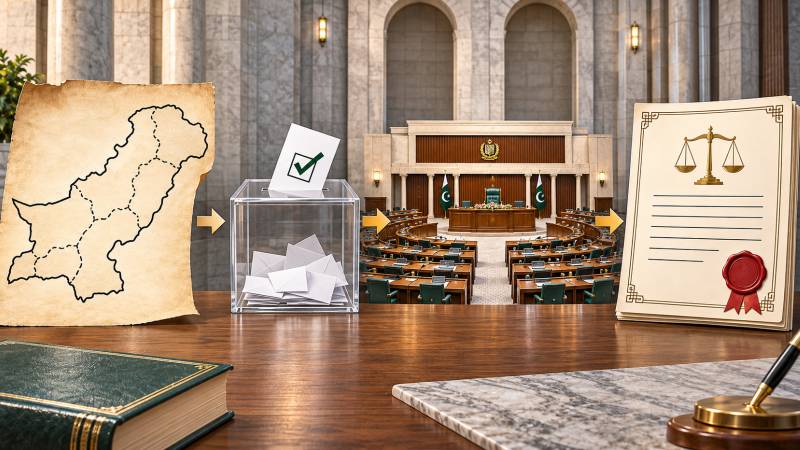
The proposal for a referendum, championed by the Interior Minister and endorsed by MQM-P, with reported support within the national leadership, raises a question few are asking: have Pakistanis already been sold the answer regarding the redrawing of their federation before they have even been told the question, let alone its pros and cons? Pakistan has seen this before. Zia-ul-Haq's 1984 and Musharraf's 2002 referenda used the appearance of popular endorsement to legitimise the continuation of unelected presidential rule. Today, new provinces are being sold as a governance panacea through a referendum, but no one is actually explaining how redrawing boundaries will dismantle entrenched political power and improve governance.
More troublingly, Article 48(6) of the Constitution of Pakistan requires a referendum question to be framed for a Yes or No answer, but to what, exactly no one has been told thus far. A twelve-province structure, and if so, along which boundaries i.e. administrative or ethnic? What would such a restructuring mean for political representation, the distribution of resources and fiscal arrangements? Therefore, it is evident that asking a single binary question would not suffice and could conceal an entire programme of constitutional and territorial restructuring.
Meanwhile, political declarations that the system has collapsed, proposals for twelve provinces and unverified maps circulating on social media are shaping public perceptions before the substance of the proposal has been factually explained. And no one is shedding light on the danger that lies in this sequence: the public is being primed to accept a political conclusion before being given the information to assess it, hence risking the referendum (if held) to become a ratification of a position already embedded in the public mind. When official voices call for an “administrative reset,” the idea is reportedly favoured at the highest levels of the national leadership, and unverified maps flood social media, the result is not public debate but the construction of a narrative.
Through sustained agenda-setting, framing and political priming, public opinion is shaped before any vote is called, laying the groundwork for plebiscitary legitimation i.e. a referendum that would appear to express a popular consensus which was, in fact, cultivated in advance through political messaging. Therefore, through repetition and selective emphasis, a contested constitutional question is reduced to a simple promise, while Article 239 and the requirement of provincial consent quietly disappear from view. When only the benefits are shown, the public is being persuaded, not consulted, which suggests the decision has already been taken and the case is being built after the fact: policy-based evidence rather than evidence-based policy. The real question is not whether Pakistan needs new provinces, but which institutional failures they would fix. Without those answers, Pakistanis are being sold an image of reform, not a framework for it, and any legitimacy built on that image will rest on perception, not consent.
Consider the promise to end corruption. Political economy points to the opposite risk: new provinces could multiply opportunities for rent-seeking rather than reduce them. Each would need its own cabinet, secretariat, development budget, procurement machinery and recruitment drive, and billions would flow into new capitals, land acquisition and civil service hiring long before an anti-corruption establishment, audit office or public accounts committee could function. This is substantiated by robust evidence from Bardhan and Mookherjee who caution that decentralisation does not automatically reduce elite capture; whether it does depends on local inequality and the strength of political competition, both of which are weakest in the very regions where new provinces are being proposed. In southern Punjab, that means the landed and spiritual families who already dominate its politics; in interior Sindh, the ‘waderas’; in Balochistan, the ‘sardars’. Far from Islamabad’s newsrooms and with weak local media, these new provincial capitals would face less scrutiny, not more. The real question, then, is whether new provinces would bring power closer to ordinary Pakistanis or simply give the same entrenched elites smaller, less watched arenas to control. Have policymakers paused to weigh this risk, and to ask what it would mean for the ordinary citizen of Rajanpur or Tharparkar, who was promised accountable government but may simply find a new set of masters closer to home?
Federalism rests on the consent of its constituent units, not on the aggregation of individual preferences into a national majority. Allowing the numerical majority of one province to determine the territorial future of another would undermine precisely the safeguard that Article 239(4) provides.
Creating a province cannot be reduced to a yes-or-no question. It means drawing boundaries, choosing a capital, dividing assets, and reopening the NFC Award and the 1991 Water Accord, all before anyone has shown that the new unit would be financially viable. In Pakistan, these choices are also never merely administrative. Any new map would decide whether Saraiki speakers in southern Punjab, Hindko speakers in Hazara, Muhajirs in urban Sindh or Pashtuns in northern Balochistan gain a province or become minorities within one. Merely renaming the North-West Frontier Province in 2010 provoked deadly protests in Abbottabad. A referendum asking only whether Pakistanis want new provinces would answer none of these questions.
The proposed referendum raises an even more fundamental constitutional question. Article 239(1) to (3) requires a constitutional amendment to secure two-thirds of the total membership of each House of Parliament, and Article 239(4) adds that a Bill altering the limits of a province cannot be presented to the President for assent unless the assembly of each province whose limits would be altered has passed it by two-thirds of its total membership. Since carving out a new province necessarily alters the limits of an existing one, a Bill dividing Sindh cannot become law without the Sindh Assembly’s consent.
This is not a procedural formality but a constitutional safeguard for the federating units. An initiating resolution, a boundary commission and a referendum may be desirable elements of a responsible consultative process, but none is stipulated in Article 239(4). Nor can a nationwide referendum substitute for the provincial assembly’s consent. Article 48(6) allows the Prime Minister, with the approval of a joint sitting of Parliament, to hold a referendum on a matter of national importance, but it provides no route around Article 239. Federalism rests on the consent of its constituent units, not on the aggregation of individual preferences into a national majority. Allowing the numerical majority of one province to determine the territorial future of another would undermine precisely the safeguard that Article 239(4) provides.
One must remember that in a referendum, how the question is framed and what information voters receive can matter as much as the vote itself. Media and social media campaigns can shape both what citizens consider and how they interpret it. As Jürgen Habermas argued, democratic legitimacy rests on reasoned public deliberation, not simply the aggregation of votes. Ultimately, Pakistan should be asking not how quickly new provinces can be put to a referendum, but what institutional failures they would address and what evidence shows they would succeed. If dynastic politics and elite capture are the problems, what safeguards would prevent their reproduction within smaller provinces? If the aim is to bring governance closer to citizens, why is Article 140A, which mandates elected local governments and the devolution of political, administrative and financial authority not being pursued, instead? A referendum conducted amid asymmetric information, strategic framing, endemic corruption and inadequate public deliberation may measure not what Pakistanis want, but how effectively they have been persuaded. A ballot cannot confer meaningful democratic legitimacy without informed consent.