

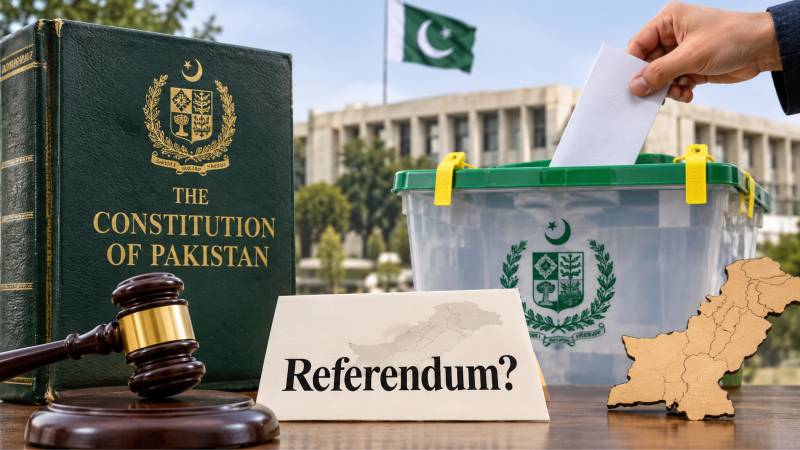
On November 12, Interior Minister Mohsin Naqvi proposed holding a referendum on the creation of new administrative units or provinces as a way of settling the long-running debate over provincial reorganisation. The proposal immediately triggered a vigorous debate in the print and social media giving a new life to the debate. The debate gained further momentum when Defence Minister Khawaja Asif floated the idea of creating as many as 12 new provinces. This development raises two important constitutional questions. First, what does the Constitution of Pakistan actually provide regarding referendums? Second, can a referendum legally be used to determine the creation or reorganisation of provinces?
Pakistan’s history of referendums is deeply controversial and has, at several critical moments, had serious consequences for the country’s constitutional order and democratic development. The referendums held under three military rulers—Ayub Khan, Zia-ul-Haq and Pervez Musharraf—remain among the most contentious precedents in Pakistan’s political history. Interestingly, however, none of these three referendums was conducted under an explicit constitutional provision authorising a referendum.
Each of these referendums was conducted through a presidential order or other executive instrument rather than under an operative constitutional provision. As on all three occasions, the Constitution was not in force in the normal sense. At the time of Ayub Khan’s referendum in 1960, the 1956 Constitution had been abrogated; when Zia-ul-Haq held his referendum in 1984, the Constitution was held in abeyance; and when Pervez Musharraf held his referendum in 2002, the Constitution was again held in abeyance. Thus, none of these three referendums can be cited as an example of a referendum conducted under an operative constitutional provision.
Interestingly, neither the 1956 Constitution nor the original 1973 Constitution, both of which established parliamentary systems of government, provided for holding referendums. However, the 1962 Constitution, introduced under Ayub Khan's presidential system, did recognise the referendum mechanism. The Interim Constitution of 1972 also contained a provision (Article 277) empowering the President to refer a matter of public importance to a referendum. However, this provision was dropped from the original 1973 Constitution.
In 1977, during the political crisis following the disputed general elections, the Seventh Amendment temporarily introduced Article 96A, which empowered the Prime Minister to seek a vote of confidence from the people through a referendum. This provision, however, was limited to that specific purpose and ceased to operate in September 1977. The general constitutional mechanism for holding a referendum on a matter of national importance was introduced into Article 48 through the Revival of the Constitution of 1973 Order, 1985, during General Zia-ul-Haq's military rule. This provision was subsequently incorporated into the constitutional framework through the Eighth Amendment in November 1985. Thus, the constitutional basis for holding a referendum on a matter of national importance originated during a period of military rule rather than under the original parliamentary Constitution of 1973.
Would the numerical majority of the country's electorate be sufficient to override the clearly expressed constitutional position of the Sindh Assembly? Such an outcome would raise profound questions about the protection of provincial autonomy, the rights of federating units and the very nature of Pakistan's federal structure.
The original provision introduced in 1985 vested the President with the authority to refer a matter of national importance to a referendum. However, the 18th Constitutional Amendment (2010) significantly altered this arrangement. Under the present Article 48(6), the President may, on the advice of the Prime Minister, direct that a matter of national importance be referred to a referendum. Such a proposal must first be approved by a joint sitting of Parliament. Furthermore, Article 48(7) provides for legislation to regulate the conduct and procedure of referendums.
Despite the constitutional provision for holding a referendum, Pakistan has yet to develop a comprehensive legal and procedural framework governing its conduct. Although Article 48(7) empowers Parliament to legislate on the procedure for holding a referendum and the compilation and consolidation of its results, no such comprehensive legislative framework has been enacted. More importantly, the Constitution remains silent on the legal consequences of a majority 'Yes' vote in a referendum. Does a favourable popular verdict merely signify public endorsement of a particular policy, or does it confer legal authority on the government to implement that policy? In other words, can popular approval through a referendum provide constitutional legitimacy to an action that must otherwise follow a prescribed constitutional procedure? Moreover, what happens when the Constitution already provides a specific procedure for dealing with a particular matter?
The reorganisation of provinces is a case in point. Article 239(4) explicitly stipulates that any constitutional amendment having the effect of altering the boundaries of a province cannot be presented to the President for assent unless it has first been approved by the concerned Provincial Assembly by a two-thirds majority of its total membership. This raises a fundamental constitutional question: can a referendum held under the general provisions of Article 48(6) override, circumvent or supersede the specific constitutional procedure prescribed under Article 239(4)? Can the popular endorsement of a proposal through a referendum substitute for the constitutionally mandated consent of the concerned federating unit. In my opinion, a referendum held under Article 48(6) cannot, by itself, supersede the requirements of Article 239(4). The two provisions serve distinct constitutional purposes. Article 48(6) provides a mechanism for ascertaining public opinion on a matter of national importance, subject to prior approval by a joint sitting of Parliament. Article 239(4), on the other hand, establishes a mandatory constitutional requirement for amending provincial boundaries, including approval by a two-thirds majority of the total membership of the concerned Provincial Assembly.
The distinction between popular endorsement and constitutional authority is crucial. A referendum may confer political legitimacy on a proposal and demonstrate public support for it, but it cannot amend Article 1 of the Constitution or alter provincial boundaries. The Constitution may provide the people with an opportunity to express their will through a referendum; however, popular sovereignty must be exercised within, and not in place of, the constitutional procedures governing the federation. This brings us to a more fundamental question of constitutional law: can democratic legitimacy and constitutional legality be treated as interchangeable, or must the former always operate within the limits prescribed by the latter?
In a federal system, allowing matters as fundamental as altering the territorial boundaries of a federating unit to be decided merely through a majoritarian national referendum would undermine the very foundations of federalism. It would erode the principles of provincial autonomy, federal consent and the constitutional division of powers between the federal government and the provinces. The implications become particularly serious when one considers that the Sindh Assembly has unequivocally rejected the division of Sindh. In such circumstances, what would it mean if a national referendum produced a majority 'Yes' vote in favour of dividing the province? Would the numerical majority of the country's electorate be sufficient to override the clearly expressed constitutional position of the Sindh Assembly? Such an outcome would raise profound questions about the protection of provincial autonomy, the rights of federating units and the very nature of Pakistan's federal structure.