

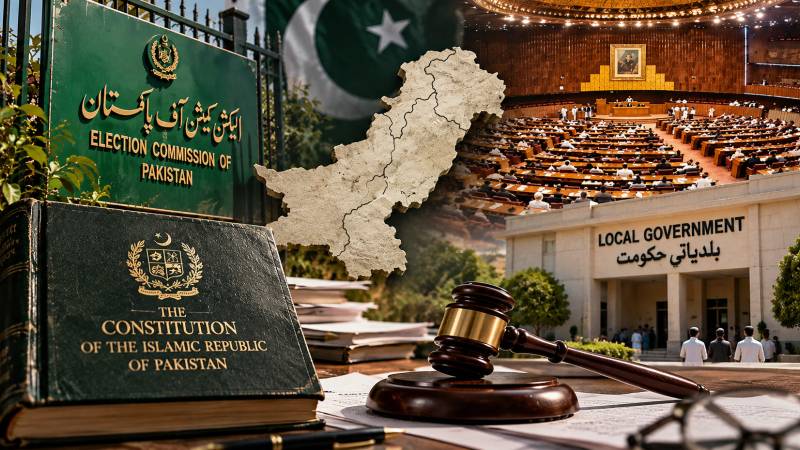
Pakistan’s debate on local government has reached a point where a familiar question is no longer enough: do we believe in devolution? Almost every political party says that it does. The more difficult question is this: why, after nearly a quarter-century of constitutional recognition, does meaningful local autonomy still depend so heavily on the willingness of a provincial government?
That question leads directly to Article 140A. Who designed it? Why was it written so broadly? Why did the Eighteenth Amendment, despite transforming Pakistan’s federal structure, not give local governments the same degree of constitutional protection that it gave the provinces? And why, in August 2025, did a private member’s bill return to Parliament proposing precisely the fiscal and institutional safeguards that the Constitution still lacks?
The historical answer requires an important distinction. The wider devolution system associated with General Pervez Musharraf was designed through the National Reconstruction Bureau, headed by Lt Gen (retd) Tanvir Naqvi. The NRB produced the Devolution Plan 2000, followed by the provincial Local Government Ordinances of 2001. Article 140A came later and was incorporated into the constitutional framework during the Musharraf period. So, if by “architect” we mean the operational model, the answer lies principally with the NRB under General Tanvir Naqvi. If we mean the constitutional insertion of Article 140A, it was a product of the Musharraf-era constitutional arrangements.
There is another qualification worth making. It was not Article 140A alone that made Musharraf-era devolution visible. The 2001 ordinances, administrative restructuring and the political authority of a centralised military regime enabled the provinces to operate a relatively uniform system. District governments, tehsil administrations and union councils were assigned functions, taxation powers and administrative structures under that framework. Yet the system also existed within an unelected federal order. That distinction matters when comparing constitutional principle with administrative delivery.
The real constitutional paradox arrived in 2010. The Eighteenth Amendment is associated with the restoration of parliamentary government and a major transfer of authority from the federation to the provinces. But its treatment of local government deserves closer examination. The amendment replaced the earlier Article 140A with a new Article 140A retaining the requirement that provinces establish local-government systems and devolve political, administrative and financial responsibility and authority to elected representatives. It also added that local-government elections would be conducted by the Election Commission of Pakistan. The present constitutional text confirms that formulation.
This was not simply an accidental carry-over. Parliament had the provision before it and chose its new constitutional form. The Parliamentary Committee on Constitutional Reforms was chaired by Senator Raza Rabbani and represented a remarkably broad political consensus. Its membership included representatives of PPP, PML-N, PML-Q, MQM, ANP, JUI-F and other parliamentary parties. It would therefore be historically unfair to make Rabbani alone responsible for what Article 140A did or did not contain. The Eighteenth Amendment was a collective constitutional settlement. But collective achievement does not place every omission beyond scrutiny.
Article 140A says that powers must be devolved, yet it does not itself define a minimum list of local functions. It speaks of financial authority, but prescribes no constitutionally protected fiscal share. It creates no mandatory Provincial Finance Commission mechanism in the Constitution, sets no local-government tenure and specifies no minimum own-source revenue powers. The current constitutional text remains strikingly brief on these questions.
Devolution cannot ultimately depend upon the goodwill of the very authority that is required to surrender power; unless powers, finances and institutional protections are sufficiently rule-bound, elected local governments can remain administratively and fiscally dependent on the province.
The contrast is difficult to ignore. The Eighteenth Amendment went to considerable lengths to entrench provincial autonomy against federal encroachment. Local autonomy, however, remained dependent to a very large extent on provincial legislation. Was that omission intentional—an attempt by provincial political elites to preserve control over patronage, development spending and administration? That is a legitimate political question, but motive is harder to prove than institutional effect. What can be demonstrated is that the constitutional design left provinces with very wide discretion over the shape, powers and finances of local government.
Devolution Denied: Article 140A was, in practice little more than a constitutional lollipop, it acknowledged devolution while withholding many of the guarantees required to make it meaningful. The result was a form of local democracy that could be kept fiscally dependent, administratively constrained and politically subordinate. Whether by design or by political convenience, the provision was left too weak to ensure that an empowered third tier could emerge as an autonomous centre of democratic authority. What Pakistan received, therefore, was not full devolution, but a constitutionally limited and enfeebled architecture whose effect was to preserve provincial control over the very institutions meant to dilute it.
What happened afterwards deepened the trust deficit. Following the end of the Musharraf-era system, elected provincial governments repeatedly became embroiled in disputes over local elections and the transfer of effective authority. Courts were repeatedly called upon to interpret the meaning and extent of Article 140A. The judiciary was, in effect, being asked to give practical substance to constitutional language whose institutional boundaries had never been comprehensively fixed.
This is where the debate of August 2025 becomes important. On 12 August 2025, four PTI-backed opposition MNAs introduced a private Constitutional (Amendment) Bill proposing changes to Article 140A and the insertion of a new Article 160A dealing with local-government finances. The proposal sought to broaden the constitutional treatment of local government and introduce a specific constitutional framework concerning Provincial Finance Commissions and local-government financing.
Its significance lies less in whether every percentage, formula or structural detail is ultimately accepted than in what it exposes about the present Constitution. Those provisions are open to normal legislative debate. Their deeper relevance is that they attempt to convert devolution from a constitutional aspiration into a rule-bound fiscal and institutional arrangement.
Article 140A establishes the principle of devolution but leaves much of its substance to provincial legislation. The province required to devolve authority therefore retains considerable discretion over the extent, financing and durability of that devolution. That is precisely where the trust deficit resides. When a Constitution tells citizens that authority “shall” be devolved but leaves another tier of government to determine the extent, timing, finances and sometimes even practical survival of that devolution, mistrust is not surprising.
Devolution cannot ultimately depend upon the goodwill of the very authority that is required to surrender power. Unless powers, finances and institutional protections are sufficiently rule-bound, an elected local government may exist constitutionally while remaining dependent administratively and fiscally upon the province. That gap between constitutional promise and practical security is at the heart of the trust deficit.
Provincial governments may argue, with constitutional logic, that local government is a provincial subject and that excessive constitutional uniformity would undermine provincial autonomy. Advocates of stronger constitutional guarantees respond that autonomy cannot mean that devolution ends at the provincial capital. The constitutional question is narrower: should there be a nationally guaranteed minimum floor beneath which no provincial local-government law may fall?
Such a “minimum floor” would not mean Islamabad prescribing an identical local-government model for every province. It would mean that the Constitution guarantees certain irreducible democratic protections—regular elections, secure tenure, clearly defined local functions, meaningful administrative authority, predictable financial transfers and safeguards against arbitrary dissolution or withdrawal of powers. Provinces would remain free to design their own systems above that threshold, but they could not reduce local government below it.
The distinction is fundamental. Provincial autonomy should protect diversity in local-government design; it should not permit the dilution of local democracy itself. The issue, therefore, is not whether the federation should run local governments, but whether the Constitution should protect the minimum substance of elected local government against excessive control by any provincial administration. That is the question Article 140A has postponed for too long.
The irony is striking. A provision born during military rule constitutionalised the language of political, administrative and financial devolution. A democratic constitutional settlement later retained that principle and strengthened the electoral component, but stopped short of defining the machinery that would make devolution durable. Subsequent experience has shown the cost of that ambiguity in litigation, contested finances, administrative dependence and recurring suspicion between provinces and their local governments.
The next stage of Pakistan’s devolution debate therefore turns on constitutional questions that can no longer be avoided: what powers are irreducibly local; what fiscal entitlement follows those powers; how is continuity protected; and what institutional remedy exists when devolution is withheld? Until those questions are settled, Article 140A will continue to promise more than Pakistan’s local governments can safely assume they possess. And the trust deficit will remain not merely political, but constitutional.