

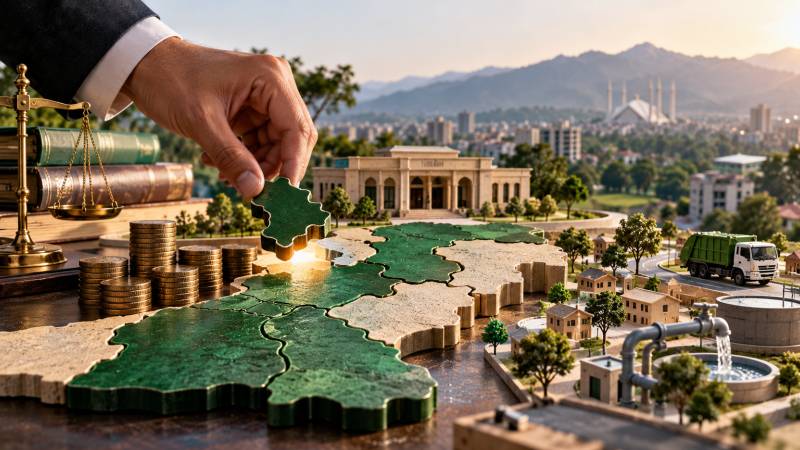
A recent exchange with Syed Mustafa Kamal, Federal Minister for National Health Services, made me revisit an aspect of my recent article in The Friday Times, A Presidential Republic, Devolved To The People. I have written elsewhere about Article 140A and meaningful local government, but Kamal made a pertinent observation about this particular article: if devolution is central to the argument, the constitutional vulnerability of local government deserved more explicit treatment.
His point was straightforward. Article 140A requires the provinces to establish elected local governments and devolve political, administrative and financial responsibility and authority to them. Yet the provision is brief. It does not define the essential functions of local government, give the Provincial Finance Commission the constitutional standing enjoyed by the National Finance Commission, or establish an enforceable fiscal entitlement for local bodies.
In Kamal’s view, this leaves too much room for provincial governments and, in practice, chief ministers to determine how much devolution actually occurs. He argues for clearer constitutional definition of local-government powers and for fiscal arrangements under which the local share cannot effectively be withheld by the province. His suggestion that resources should reach local governments without provincial discretion in his present formulation, directly from the Federation invites constitutional debate. But it would be a mistake to treat the proposal merely as an encroachment upon provincial autonomy. One has first to understand where it comes from.
Kamal’s position is not an impulsive response to my article. In 2021 he argued publicly that Article 140A did not adequately define local-government responsibilities and powers and that resources needed to reach the union-council level. In early 2022, amid controversy over local government in Sindh, he called for a formula-based PFC mechanism so districts would not have to “beg” the province for their financial share. That history matters because constitutional debates are shaped by institutional memory. When the same tier expected to devolve power also controls the law defining that devolution, many municipal departments and the money required to perform their functions, suspicion is hardly surprising. If powers can be withheld, reclaimed, fragmented among provincial agencies or rendered ineffective through financial dependence, demands for guarantees beyond ordinary provincial discretion become understandable.
This is more than political impatience. It is a trust deficit produced by the structure itself. Kamal’s present position can therefore be read as a synthesis of years of incomplete devolution and broken promises: do not merely promise that authority will be devolved; construct the constitutional system so that withholding it becomes difficult. Article 140A contains an important constitutional command. Each province must establish a local-government system and devolve political, administrative and financial responsibility and authority to elected representatives.
But the constitutional architecture supporting local government is far less elaborate than that governing fiscal relations between the Federation and the Provinces. Article 160 does not merely recognise the provinces’ financial claims; it establishes the NFC, prescribes its composition and periodicity, defines its mandate, provides a mechanism for implementation and even protects the provincial share from being reduced below that of the previous Award. Article 140A, by contrast, establishes the principle of political, administrative and financial devolution but leaves much of its substance, institutional machinery and fiscal enforcement to provincial law.
This is more than political impatience. It is a trust deficit produced by the structure itself. Do not merely promise that authority will be devolved; construct the constitutional system so that withholding it becomes difficult.
Local government enjoys no equivalent protection of comparable clarity. This asymmetry has consequences. Pakistan’s devolution debate has traditionally concentrated on Islamabad and the provinces. The Eighteenth Amendment substantially strengthened provincial autonomy. But devolution loses meaning if authority transferred from the federal capital stops at the provincial capital. Power that leaves Islamabad but remains concentrated in the hands of chief ministers in Lahore, Karachi, Peshawar or Quetta has been decentralised only halfway. Citizens experience government most directly through water, sanitation, waste disposal, local roads, transport and neighbourhood infrastructure. If elected local governments lack authority over the functions, personnel and finances required to deliver these services, accountability becomes blurred.
Responsibility without authority produces frustration. Responsibility without money produces fiction. This is where Kamal’s concern becomes a constitutional question. If local government remains substantially dependent upon provincial legislation and political goodwill, what prevents one government from reversing, diluting or circumventing what another conceded? That insecurity cannot be answered with another promise of devolution. Constitutional guarantees become necessary precisely where political experience has made promises insufficient.
The difficult question is how those guarantees should be designed without disturbing the federal structure Pakistan has spent decades trying to stabilise. One option is the direct federal-to-local route Kamal suggests. Its attraction is readily understood. If an objectively determined local share bypassed provincial discretion, elected local governments would no longer depend upon the executive from which they seek greater autonomy. Given the history behind his argument, it would be too facile merely to reject this as interference in provincial affairs. But an equally important question follows: would bypassing the provinces weaken their constitutional position and create a different dependency upon Islamabad? A mechanism designed to overcome provincial centralisation must guard against reproducing centralisation through another route. There may therefore be a constitutional middle path. The existing sequence — Federation through the NFC to the Provinces; Provinces through the PFC to Local Governments could be preserved while making the second stage far more secure.
Provincial Finance Commissions could be constitutionally mandated, with awards required at fixed intervals. Broad principles governing distribution could be protected constitutionally. Once a local share had been objectively determined, its transfer into local-government funds could become automatic and legally enforceable rather than subject to executive discretion. This is no longer merely academic. A constitutional amendment bill introduced in the National Assembly in August 2025 proposed expanding Article 140A and inserting a new Article 160A dealing with Provincial Finance Commissions, formula-based transfers and stronger financial protection for local governments. It has not become part of the Constitution, but its introduction shows that the weakness in the present architecture has entered parliamentary debate.
The Constitution could likewise establish a minimum protected sphere of local functions without attempting to administer municipalities from Islamabad. Provinces would remain free to design systems suited to their geography, population and administrative requirements, but they would operate above a constitutional floor below which meaningful devolution could not easily be reduced.
Constitutional protection need not mean constitutional micromanagement. The Constitution need not list every municipal office or impose an identical structure upon Karachi, Lahore, Peshawar, Quetta and smaller districts. Local government requires flexibility. But flexibility should not become a synonym for vulnerability. The same applies to continuity: local-government elections, elected terms, fiscal awards and functional jurisdictions cannot inspire confidence if their effectiveness repeatedly becomes uncertain. Seen in this light, Kamal’s proposal identifies the anxiety any serious reform must confront: do not ask local government to rely again upon the goodwill of an authority that experience has taught it not always to trust. That sentiment deserves empathy even if one differs over the mechanism proposed to address it.
The resulting insecurity is institutional, not merely personal. It cannot be removed by assurances that provincial governments will behave differently. A durable settlement must remove the structural conditions that produced it. Whether the answer lies in direct federal transfer, a constitutionally entrenched PFC mechanism, or some combination of safeguards remains open to constitutional deliberation. The experience underlying Kamal’s demand should be understood before the mechanism is judged.
That adds an important qualification to my own argument for a presidential republic devolved to the people. Changing the form of government at the centre will achieve little if the architecture beneath it remains centralised. A presidential system can be as centralising as a parliamentary one. The real question is whether authority is distributed vertically as well as horizontally — whether power reaches the institutions closest to the citizen and whether those institutions possess sufficient constitutional security to exercise it.
I have addressed Article 140A and local government more fully elsewhere. But in the context of my recent article, Mustafa Kamal’s observation draws attention to an aspect that deserved greater emphasis. A republic cannot convincingly describe itself as devolved to the people if the tier nearest to them remains constitutionally vague and financially insecure.
Strengthening local government need not mean weakening the provinces. Nor should one centre of control simply be replaced by another. The constitutional challenge is to create a chain of authority in which each tier has a defined sphere, adequate resources and enforceable protections and in which no tier depends entirely upon the political goodwill of another for its institutional effectiveness. Pakistan’s unfinished devolution is therefore not merely a question of administrative design or fiscal distribution. It is also a question of trust. And where that trust has repeatedly been strained, assurances are no longer enough. The debate inevitably moves from the promise of devolution to the constitutional guarantees that make that promise real.