

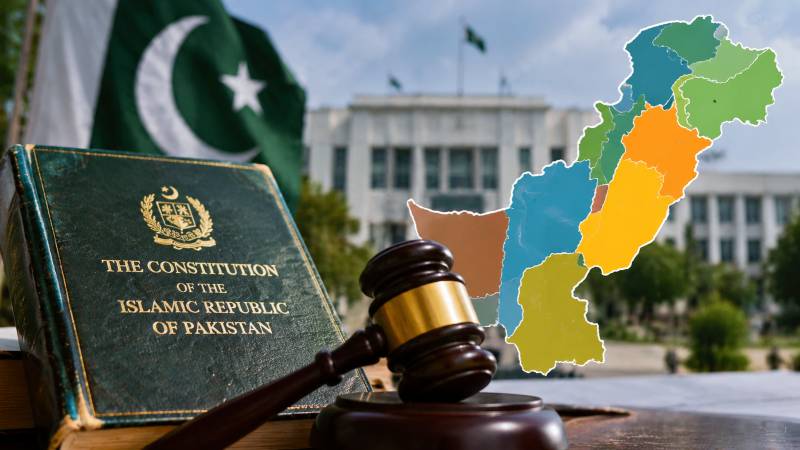
The renewed debate about creating more provinces in Pakistan reportedly through a nationwide referendum followed by a proposed Twenty-Eighth Constitutional Amendment raises fundamental questions about federalism, constitutionalism, and the future of the federation. Presented as an administrative solution to improve governance by bringing government closer to the people, the proposal carries serious constitutional, political, and fiscal implications. Pakistan’s own history offers compelling reasons to reject referendums as shortcuts to political legitimacy.
Pakistan has a troubled history of referendums. Since independence, three major national referendums have been conducted under military regimes, primarily to legitimise personal rule rather than to exercise genuine popular sovereignty. In February 1960, Field Marshal Ayub Khan used approximately 80,000 Basic Democrats as an electoral college to endorse his presidency, with the regime announcing 95.6 per cent approval. General Zia-ul-Haq followed in December 1984, linking support for his Islamisation programme with his continuation as President for five years, claiming 98.53 per cent approval despite an opposition boycott and serious questions about turnout. In April 2002, General Pervez Musharraf combined popular aspirations for democracy, stability, and reforms with extending his own presidency, claiming 97.97 per cent support amid widespread allegations of ballot stuffing and coercion.
These episodes demonstrate how referendums can be transformed from instruments of popular sovereignty into instruments of executive control. When questions are framed to produce predetermined political outcomes and democratic institutions are weakened, overwhelming majorities on paper do not represent the genuine will of the people. Any proposed referendum on new provinces must be examined squarely against this historical record.
More importantly, a nationwide referendum cannot substitute for the constitutional procedure required to create new provinces or alter existing provincial boundaries. Following the Eighteenth Amendment, Article 48(6) of the Constitution provides that a referendum on a matter of national importance requires prior approval by a joint sitting of Parliament, yet it confers no authority to alter provincial boundaries. That matter is governed specifically by Article 239(4), which mandates a two-thirds majority of the total membership of both the National Assembly and the Senate, alongside a separate two-thirds majority of the total membership of the affected Provincial Assembly. This is no procedural technicality; it is a foundational safeguard of Pakistan’s federal structure. The Constitution deliberately ensures that the federation cannot unilaterally redraw provincial boundaries against the wishes of the people represented by their elected provincial legislature. Even if a majority of voters nationwide backed new provinces in a referendum, their collective vote could not replace the constitutionally required consent of the affected provincial assembly.
Sindh’s position on this question underscores why this constitutional protection is vital. Sindh is not an administrative territory whose boundaries can be altered at the discretion of the federal executive, but a constituent unit of the federation with its own historical, political, and constitutional identity. Its opposition to territorial division is therefore an assertion of constitutional rights and the federal compact established under the 1973 Constitution, rather than a mere political reaction to Islamabad. The Sindh Assembly has repeatedly rejected dividing the province through resolutions adopted in 2012, 2013, 2014, 2019, and February 2026. On September 3, 2026, it adopted another resolution unequivocally rejecting any proposal to divide Sindh or detach any of its districts, reaffirming its intention to invoke Article 239(4).
Using a national referendum to overcome Sindh’s opposition would amount to deploying demographic majoritarianism against a federating unit, undermining the provincial autonomy strengthened by the Eighteenth Amendment and deepening the trust deficit between the federation and the provinces. Sindh’s resistance is not resistance to better governance; it is resistance to bypassing the Constitution.
While the people of Pakistan may participate in a national debate on administrative reform, the constitutional authority to approve any alteration of Sindh’s boundaries rests strictly with constitutionally prescribed institutions, including the Sindh Assembly. No federal government, political coalition, or nationwide referendum can legitimately substitute its decision for that of the affected provincial legislature. Using a national referendum to overcome Sindh’s opposition would amount to deploying demographic majoritarianism against a federating unit, undermining the provincial autonomy strengthened by the Eighteenth Amendment and deepening the trust deficit between the federation and the provinces. Sindh’s resistance is not resistance to better governance; it is resistance to bypassing the Constitution.
Pursuing such a constitutional gamble is especially reckless given Pakistan’s acute economic and human development crisis. According to the World Bank’s October 2026 Pakistan Development Update, national poverty has climbed to roughly 29 per cent from 22 per cent in 2018–19, while inflation has again crossed 11 per cent. Roughly 26.2 million children aged 5–16 are out of school. Child malnutrition remains severe: the Pakistan Economic Survey 2025–26 places stunting among children under five at 33.6 per cent nationally, while the National Nutrition Survey 2018 highlights stark rural–urban disparity, with stunting affecting 43.2 per cent of rural children compared with 34.8 per cent in urban areas. Although drawn from different reference periods, these figures underscore the persistent link between child malnutrition, poverty, inadequate healthcare, poor sanitation, and unequal access to safe drinking water—challenges compounded by water scarcity, unemployment, weak public services, and growing insecurity.
Meanwhile, under the Seventh NFC Award, provinces collectively receive 57.5 per cent of the divisible federal tax pool. Any attempt to use territorial restructuring as an indirect mechanism to renegotiate provincial fiscal entitlements would further erode confidence between the federation and its constituent units. An effective constitutional alternative already exists. Article 140A requires provincial governments to establish elected local governments and devolve political, administrative, and financial authority to elected local representatives; an obligation successive provincial governments have largely neglected. Citizens’ everyday concerns like drinking water, sanitation, drainage, waste management, local roads, healthcare, and schools, depend primarily on functional local institutions, not the location of a provincial capital. An empowered elected mayor or councillor, equipped with adequate financial resources and administrative authority, can address these needs far more directly than another provincial secretariat.
Pakistan does not need another political experiment built around institutional restructuring while its core systems of service delivery remain weak. Its immediate priorities are reducing poverty, improving education and healthcare, creating employment, ensuring water and food security, restoring public institutions, and strengthening local democracy. A referendum cannot manufacture constitutional consent, nor can drawing new provincial boundaries automatically deliver better governance. The federation cannot be strengthened by weakening its constituent units; and Sindh’s constitutional right to protect its territorial integrity is a fundamental safeguard embedded in the Constitution of Pakistan that cannot be overridden by a nationwide referendum.