

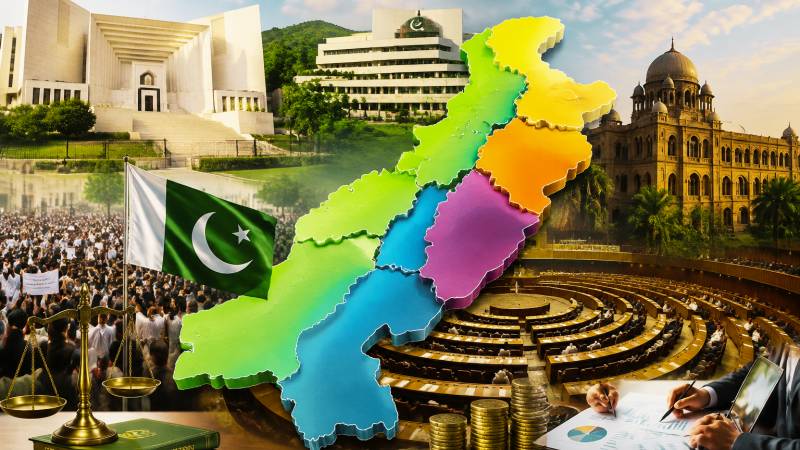
The question of creating new provinces in Pakistan has once again become the subject of intense political and social debate. The issue is particularly sensitive in Sindh, where major political and nationalist forces oppose dividing the province or creating Karachi as a separate province. A recent national conference of Sindhi writers, intellectuals, scholars, and academics also reflected this broader political sentiment. The central question, however, is whether administrative weakness necessarily requires the creation of a new province. Problems such as poverty, unemployment, weak healthcare and education, water shortages, infrastructure, and weak local governments can also be addressed through stronger local institutions, district-level powers, accountability, and fairer resource distribution. Administrative reform and provincial division should therefore not be treated as the same thing.
From a Marxist perspective, political structures cannot be separated from economic foundations. The question is not simply how provinces are drawn, but how wealth, economic power, and the means of production are owned and distributed. Political boundaries are connected with class interests, resources, and centres of power. Therefore, any discussion of new provinces must ask: which class or group would actually benefit economically from their creation? More importantly, would such a change fundamentally improve the lives of workers, peasants, and the lower middle class?
If a new province merely creates additional centers of power for the ruling elite, major commercial interests, landlords, bureaucracy, and political classes, while ordinary people remain trapped in poverty, unemployment, inflation, and inadequate services, then such a change cannot be regarded as a genuine social transformation. The fundamental issue is therefore the transformation of economic power and resources. This perspective is particularly relevant to Karachi. Karachi is Pakistan’s largest economic and industrial centre, with major ports, industries, commercial networks, banking institutions, and corporate capital. Its political and administrative status is closely linked with economic power. Any separate-province proposal must therefore ask who would control Karachi’s land, ports, industries, tax revenues, and urban capital. Karachi’s economic importance, however, should not be used to ignore the deprivation of Sindh’s other regions. Workers, peasants, small traders, and the lower middle class in both urban and rural Sindh face many common economic problems. The tension between Karachi and Sindh must therefore be understood through both linguistic and class dimensions.
Administrative decentralization must therefore be accompanied by economic democratization through public participation in resource distribution and economic decision-making.
Similarly, opposition to new provinces in Sindh should not simply be dismissed as emotional nationalism. Provincial autonomy and territorial unity are deeply connected with Sindh’s political history within Pakistan. Different class interests, however, exist within every national or regional movement. Therefore, defending the territorial unity of Sindh should go together with the question of how that unity can be translated into economic justice for its workers, peasants, and ordinary citizens. Pakistan’s present economic situation makes this contradiction even clearer. Poverty, unemployment, inflation, disease, educational backwardness, and economic inequality remain major problems. If land, capital, the means of production, and economic power remain concentrated in the hands of the same powerful classes, creating a new province will not fundamentally change the economic structure or the system of class exploitation. Administrative decentralization must therefore be accompanied by economic democratization through public participation in resource distribution and economic decision-making.
This does not mean that demands for new provinces are entirely unreasonable. Long-standing grievances over unequal political power and resources deserve serious consideration. However, the solution should be sought through popular consent, constitutional procedures, democratic dialogue, regional agreement, and objective studies—not through political engineering or force. The more important question is not, “How many provinces should there be?” but, “How can power and resources within existing provinces be distributed more fairly?” Strong local governments, district-level authority, fair resource distribution, better healthcare and education, employment, and accountability could address many problems without altering provincial boundaries.
Pakistan’s crisis is not primarily a crisis of the number of provinces; it is a crisis of governance, economic injustice, and federal trust. A smaller province does not automatically become more democratic, prosperous, or developed. Strong institutions, accountable government, rule of law, economic justice, and public participation are essential. A federation is not strengthened by force, but by trust.
What Pakistan needs most today is better governance and economic justice. Hunger, poverty, inflation, unemployment, corruption, disease, educational backwardness, and inequality cannot be solved merely by creating new provinces. They require better economic policies, strong institutions, transparent accountability, equitable distribution of resources, and protection of the economic and political rights of working people. The fundamental question, therefore, should not simply be how many provinces Pakistan should have, but how Pakistan can become a more just, democratic, prosperous, and stronger federation in which ordinary people have a meaningful share in political power and economic resources.