

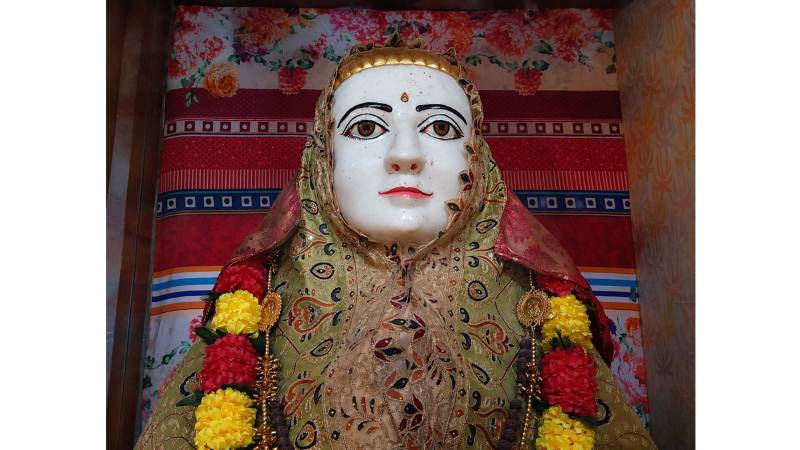
I left Karachi in the early hours of the morning. It was the first week of March 2026, and my destination was Raj Ghat Darbar in Thatta. As the car passed through Saddar, the absence of traffic made its streets appear wider and more beautiful than usual. A cool breeze from the Arabian Sea drifted into the city. It slipped through the streets like a young bride entering her new home, shy but full of joy. The eastern horizon glowed golden. Honey-coloured light fell on the colonial buildings of Elphinstone Street, now Zaib-un-Nisa Street. In the early light, the buildings looked gentle, soft, and warm.
Around Drigh Road, my taxi driver asked if he could play some music. I nodded, but he did not start it.
When we reached the Sassui Toll Plaza on the N-5 National Highway, near Gharo, I asked why he had not played the tape. He explained that he was not sure whether I had given him permission. I told him that I had. He smiled and pressed the button on the CD player.
Sindhi songs filled the car, mostly sung by Sarmad Sindhi and Bedil Masroor. Born Abdul Rehman Mughul, Sarmad Sindhi became a popular voice in the 1980s, known for his romantic and nationalist songs. Bedil Masroor, a poet, singer, writer, and novelist, first came to public attention in the late 1970s through his singing of the poetry of Shaikh Ayaz.
I looked at the order of the songs. The first set belonged to Sarmad, followed by Bedil Masroor. Before we reached Imran Hotel on the National Highway, Sarmad's songs had ended.
After a cup of tea, we resumed the journey. As soon as the car moved, the CD player started again. This time, Bedil Masroor's voice filled the car.
The first song used the poetry of Shaikh Ayaz. If I remember correctly, its words were:
Hee garho jhando masti main, bhale jhooli pehnji wasti main (This red flag, in its ecstasy, flutters proudly in our own settlement.)
The song changed the mood inside the car. The driver became a little serious and kept a steady speed. Still, he seemed to enjoy the music. Another song began soon after. Ayaz remained present, and Bedil Masroor's voice continued to fill the car.
Now the driver seemed completely carried away by the music.
When we crossed the site of Bambhore, I remembered a conversation with an Italian professor, Dr Valeria, about why the Arabs attacked Sindh. She believed that several factors may have influenced the conquest, including Sindh's wealth and strategic importance. Medieval Arabic writings described Sindh as Sindh al-Kabir, or Sindh the Great, and referred to its rich and varied resources.
Soon we reached Makli. After passing the forest office, I noticed the mausoleum of Jam Nizamuddin II on the left side of the road. Widely remembered as Jam Nando, he was one of Sindh's celebrated rulers.
Thatta city was now close.
Arriving at Raj Ghat Darbar
A local journalist had told me that Raj Ghat Darbar stood along a link road beginning near the Shah Jahan Mosque and running eastward. The driver turned onto the road. At first, the track was broken. A few furlongs later, patches of asphalt appeared.
On both sides of the road stood ripe wheat. Farther away, bright yellow sunflowers shone in the sun. Much of the land around us lay bare. Yet, on closer look, the bare earth showed its rich alluvial soil.
We arrived just before lunch, at about 12:45.
As I stepped into the courtyard of the darbar, the smell of frying onions met me. Then came the smell of garlic, spices, and wood smoke. I seemed to be near the community kitchen. Fire crackled under the deghs, the large cooking pots. Brass bartans clanged as people carried them from one place to another.
“Today, people like stories in a straight line, from beginning to end. But wisdom does not always walk in a straight line. It moves here and there, like a village path.”
A man came out of the kitchen. I asked him where I could find Bava Khemchand. He did not reply. He simply raised his hand and pointed towards the houses on the eastern side.
I followed his gesture. There I found two signs written in Sindhi. One pointed to the residential area. The other pointed to a room where the pujari stayed.
I knocked on the door. From inside came a voice:
“Darwazo khuliyal aa” — the door is open.
I pushed it gently. The old Sindhi door caught my eye at once. It was made of seasoned talhi wood, Indian rosewood, and looked as if it had stood there for generations. Its two broad panels carried simple floral and geometric carvings. The places touched by countless hands over the years had turned dark and smooth. The door itself seemed to carry the memory of those who had passed through it.
Inside, the room was plain and quiet. Another door in the eastern wall led to a second room. There was little in the room, but the space had the familiar simplicity of an old Sindhi household.
Bava Khemchand welcomed me.
He was a humble man and spoke in a very low voice, almost a whisper. When he saw that I was struggling to hear him, he waved his hand and asked me to bring my chair closer. I did.
Before I could ask about Raj Ghat Darbar, he suggested that I first hear the stories of its gadinashins, the men who had occupied its spiritual seat.
I asked him to begin with the history of Raj Ghat Darbar. For a while, he said nothing. Then he began, as though the words had been waiting for him.
“Today, people like stories in a straight line, from beginning to end. But they forget dhahap, wisdom. Wisdom does not always walk in a straight line. It moves here and there, like a village path. Sometimes you have to go back before you can move forward.”
He took a deep breath and began.
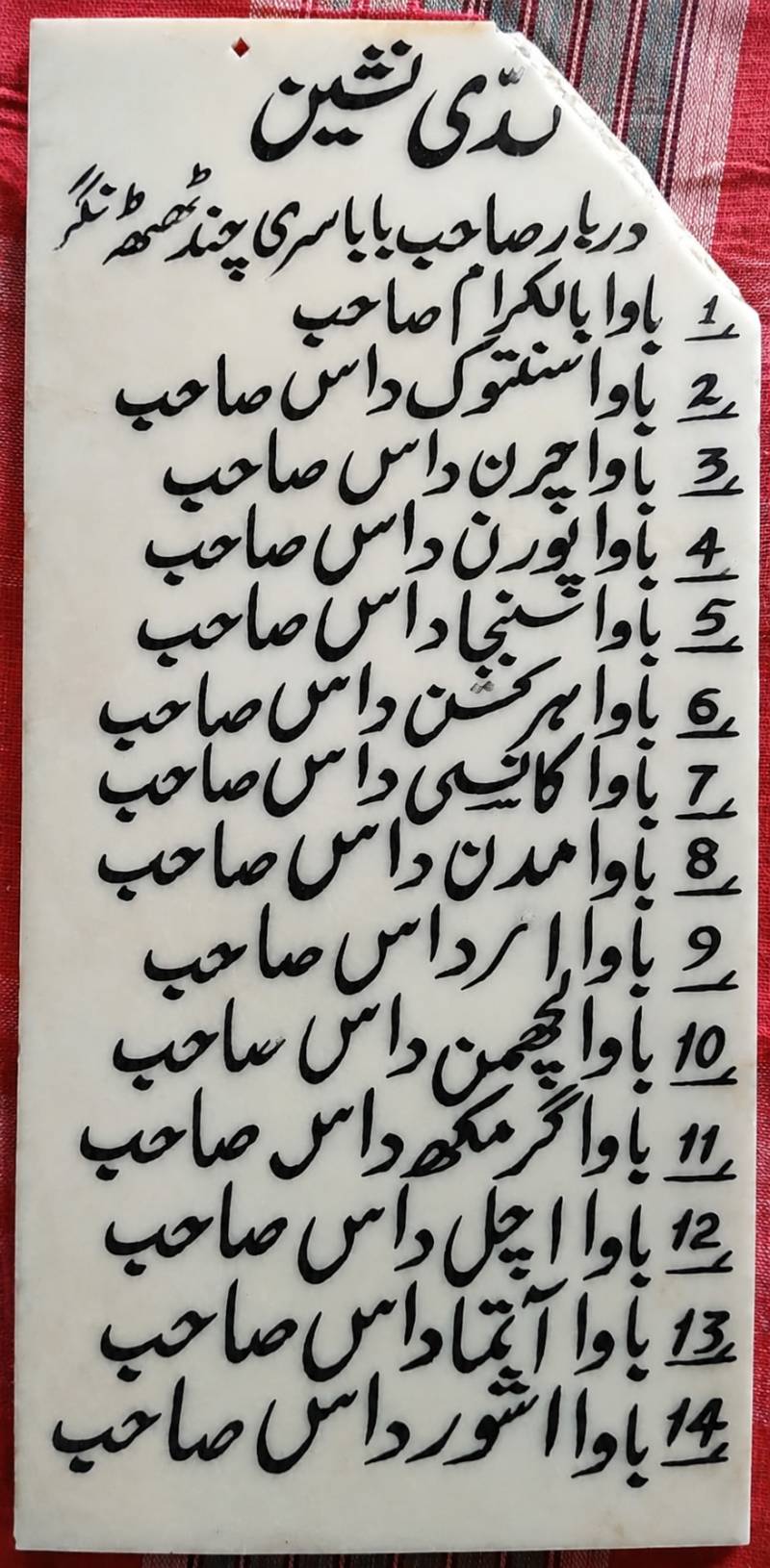
He said that Bava Balakram founded Raj Ghat Darbar. He was born in Jalalpur village in Punjab. Bava Atram, he added, was the fourteenth gadinashin and remained in that position until Partition.
I nodded and asked him to tell me the stories of the gadinashins.
The Boy and the Sacred Fire
He was not ready to begin. The history, he explained, was not yet complete.
He continued.
Once, Hargobind came to have darshan of Shri Chand Sahib. He brought his elder son, Gurdino, with him. When Shri Chand Sahib saw the boy, he sensed something special in him. He asked Hargobind to leave his son with him so that the boy could receive spiritual guidance. Hargobind agreed. He returned home without his son.
The tradition holds that Bava Balakram later received Gurdino’s blessing. He took the dooheen—the sacred fire—with him and came to Sindh sometime in the eighteenth century.
At that time, Thatta was one of the important towns of Sindh.
Bava Balakram settled some distance to the east, not far from the Indus. There he built a landhi, a large rectangular structure made of mud and thatch. Soon he raised a jhanda, a flag, a nishan sahib, and placed a nagharo, a large drum.
Here Khemchand stopped. He looked at me with his quiet, searching eyes.
“Now come the stories,” he said.
The story tells that some Muslims in Thatta became uneasy when they saw more and more people visiting the darbar. A group of men decided to attack the place and kill Bava Balakram. One day, they gathered and set out for the darbar.
But before they could reach it, unexpected news came from Thatta. The brother of their leader had died. Several members of their families had also fallen ill with a strange illness.
Some people took these events as a sign of Bava Balakram’s spiritual power.
Khemchand then told me that the place where Raj Ghat was first established still existed. He got up from his seat and pointed towards the dooheen.
“That is the same sacred fire,” he said. “Balakram brought it from Jalalpur. It is still burning.”
In the last years of the Kalhora rule, he continued, some men came to the darbar claiming to be kardars, revenue officials of the Kalhoras. Their visits brought trouble to the darbar.
There was a story about a talhi tree, the Indian rosewood. Tradition says that Balakram planted a talhi sapling in the courtyard. He said it would grow four branches. Each branch would stand for one of the char yar, the four friends, badshahs. In time, the four branches came to be linked with the four Talpur brothers who ruled Sindh: Mir Fateh Ali Khan, Mir Ghulam Ali Khan, Mir Karam Ali Khan, and Mir Murad Ali Khan.
Khemchand fell silent for a long while. Then he looked at me and said, “Every gadinashin has a story.”
He paused again.
“Some stories are written in books. Others live in the heart. You have to sit, listen, and let them unfold.”
I asked him to continue.
Miracles of the Indus
After Bava Balakram’s death, he explained, Bava Santokdas took his place on the gadi. Many strange stories are linked with him. In Muslim tradition, such miraculous deeds are called karamat.
One story was connected with the Indus. The river had risen, and people feared that the floodwater might reach Raj Ghat. The disciples went to Bava Santokdas and asked him to save the darbar.
The story says that a great stone suddenly appeared in his hand. He threw it towards the Indus. Then he told his disciples not to fear. He had pushed the river back, he said, and the flood would not reach the darbar.
Khemchand saw the survival of Raj Ghat as a sign of the saint’s spiritual power.
Another story concerned Mukhi Tarachand of Hyderabad, who had great devotion to the darbar. Once, he came to Bava Santokdas and prayed for a son.
The bava blessed him. “You will have a son,” he told him, “and he will become a famous man. Name him Hero.”
The boy was later known as Hero Tarachand and, in the tradition of the darbar, became a well-known mukhi of Hyderabad.
After Santokdas came Bava Charandas. Khemchand said that he too had many stories of karamat. Then he looked at me and asked, “Have you heard of the paras patthar?”
I shook my head.
“The stone that turns iron into gold,” he explained.
He then told me the story. A man from Punjab once came to the darbar and offered Bava Porandas a precious stone. Porandas accepted it. He then asked his sevakars, the religious attendants, to walk with him to the Indus.
When they reached the river, he threw the stone into the water.
The man was shocked.
“That stone is precious,” he protested. “It can turn iron into gold. If you do not need it, please give it back to me.”
Porandas smiled and asked him to have lunch first. After lunch, he called the man and walked with him back to the river.
There, Porandas stood quietly and invoked Hazrat Khizr, the mysterious spiritual guardian whom many in Sindh associate with the Indus and its waters.
“Return what was entrusted to you,” he prayed.
For a moment, nothing happened. Then the river moved.
A great wave rose from the Indus. When it broke, the water seemed to glitter with countless precious stones and diamonds.
Porandas turned to the man.
“Take yours.”
The man picked up his stone. Then another great wave rolled across the river. The other stones vanished beneath the water as quickly as they had appeared.
Memories and Melodies
Khemchand returned to the story of the gadinashins.
“From Baba Shrichand to Bava Ashordas,” he said, “there were fourteen gadinashins. Each one has stories of karamat.”
He looked at me and smiled.
“If I tell you all of them,” he said, “your essay will become a book of stories.”
I smiled. He was right. We turned to another subject. I asked him about the religious festivals held at the darbar.
Before Partition, he explained, the community celebrated Cheti Chand every year. In the first month of Chet, a fair was held. Today, religious gatherings are held every week.
I asked what songs and poetry people now sing. He paused.
“Waee, bhagti, and yaktaro,” he said, were no longer heard as they once were. Even devotional poetry was now sung to Indian film tunes. A religious song might be on the lips, but a film song stayed in the mind.
Then he recited a verse:
Ma ma na kar murakh, pehnji Ram khe sanbhar. (Do not boast, O foolish one. Remember your God.)
Even this old devotional verse, he said, was now sung to a film tune.
His thoughts returned to Raj Ghat. The darbar was no longer what it had been before Partition, he said.
Then he put it simply.
“If students stop coming, a school will close. If devotees stop coming, how long can the darbar survive?”
I had no answer. I asked his permission to leave.
Outside, evening had fallen. The last light lay softly over the fields. Behind me, the dooheen was still burning.
The Road Back to Hyderabad
The car turned towards Hyderabad and soon picked up speed. The road ran straight into the night. Beyond the headlights, everything disappeared. There was only the narrow road ahead, the dark fields on either side, and the steady hum of the engine. Then the car climbed the Ongar Hills.
To the left, the sky opened wide. The stars were everywhere. They looked like pieces of glass scattered across a dark cloth. The mountain air was cool and clear. The stars seemed brighter here, almost close enough to touch.
For a while, the world fell silent inside me.
The night seemed to draw earth and sky close. Below lay the road, villages, and fields. Above stretched the same sky that had watched Sindh for centuries. Men had come and gone. Kalhoras had ruled, Talpurs had followed, and Partition had scattered its people. Yet the stars remained, silent witnesses to all that had passed.
I thought of Raj Ghat Darbar Thatto Nagar.
I had gone there to see an old darbar. Instead, I had found a living memory, in its dhuni, its old doors, its stories, its songs, and, above all, in the quiet voice of Bava Khemchand.
But another thought stayed with me.
How long can old stories keep alive the glory of a pre-Partition darbar? Stories can carry memory across generations, but every generation also needs a story of its own. Perhaps Raj Ghat now needs new stories—not to replace the old ones, but to carry them forward into post-Partition Sindh.
The car moved on through the hills. Behind us, Raj Ghat had disappeared into the darkness. But its small fire, like a thread connecting the past with the present, was still burning in my mind.