

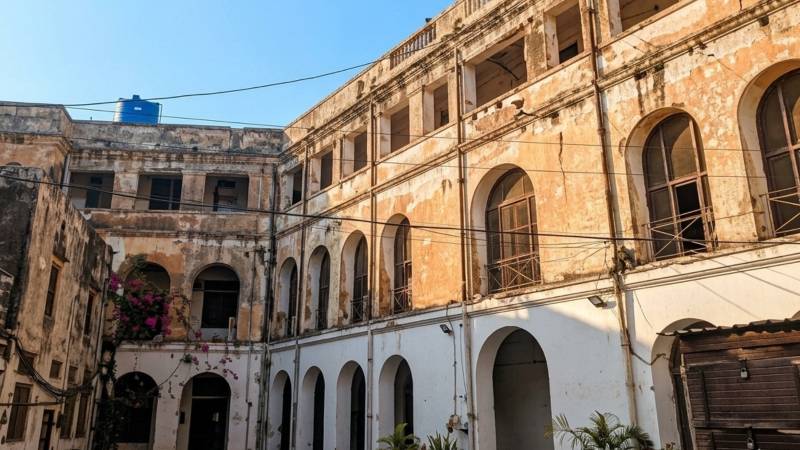
In the dense neighbourhood around Neela Gumbad and old Anarkali, Ewing Hall can easily be overlooked as merely another colonial-era building. Yet its significance extends beyond its architecture. Built for the students of Forman Christian College, the hall offers a window onto the expansion of higher education in colonial Punjab, the growth of residential student life and the political and social worlds that shaped generations of young Lahoris. Through its location, architecture and the experiences of its residents, Ewing Hall connects the histories of missionary education, colonial governance, urban development and political change in early twentieth-century Lahore.
That world began modestly. In December 1849, the Reverend Charles William Forman and the Reverend John Newton opened a small school outside Bhati Gate. Its first class consisted of three Kashmiri boys, and early lessons were reportedly held beneath a tree. A college department was added in 1864 with only eight students, but it was suspended in 1869 after the death of the teacher responsible for it and because suitable staff could not be secured. Seventeen years later, it was revived as Lahore Mission College with twenty-two students and, in 1894, formally became Forman Christian College.
The History of the Forman Christian College: Selections from the Records of the College, 1869–1936 records that the college's progression through a succession of rented premises helps explain the significance of its later buildings. It moved from the old Rang Mahal school to accommodation near Mela Ram Road and then to a bungalow on Court Road before securing a permanent site on Roberts Road, later Bank Square, with the support of Sir Charles Aitchison and a government construction grant. Although the main college building was inaugurated in November 1890, growing enrolment soon demanded further expansion. Kennedy Hall, Newton Hall and, ultimately, Ewing Hall were therefore far more than architectural additions. They provided classrooms, communal spaces and student accommodation, helping to transform a dispersed educational institution into a permanent and cohesive academic community.
The central figure in this transformation was the Reverend Dr James Caruthers Rhea Ewing. Born on 23 June 1854 in Armstrong County, Pennsylvania, he was of Scottish-Irish descent and began teaching while still young. He studied at Washington and Jefferson College, trained at the theological seminary in Allegheny and arrived in India on 1 December 1879. After serving in Fatehgarh, Allahabad and Saharanpur, he was selected to lead the Lahore college, where he took charge on 4 December 1888. He remained principal until 1917, guiding the institution through nearly three decades of growth. Contemporary accounts and later institutional histories portray him as an energetic and disciplined leader whose influence extended well beyond the college.

Under Ewing, enrolment rose from about 130 students in 1890 to 311 in 1900, 426 in 1910 and roughly 600 by 1915. Postgraduate teaching developed in English, mathematics, history and economics, while chemistry and tutorial instruction were strengthened. The college also experimented with psychology, scientific testing and industrial chemistry. It admitted its first woman student in 1902, and two of its students became early science graduates of the University of the Punjab. These developments established Forman alongside Government College as one of the leading institutions of higher education in the Punjab, while the rivalry between the two colleges became an important part of student culture.
Although Ewing was a missionary, college histories emphasise that he did not make conversion a condition of education. Forman’s students included Muslims, Hindus, Sikhs and Christians, and its staff also represented different communities. The college was embedded in colonial structures, yet it created a space in which people of different religious and social backgrounds studied and worked together. This mixed character reflected the layered social life of Lahore, where imperial authority, religious difference and intellectual exchange existed in constant tension rather than in separate worlds.
Ewing Hall were therefore far more than architectural additions. They provided classrooms, communal spaces and student accommodation, helping to transform a dispersed educational institution into a permanent and cohesive academic community.
The recollections preserved in the 1959 Founders' Day booklet offer a more nuanced portrait of Ewing, revealing the man behind the office of principal. Former colleagues and students remembered an imposing principal whose stern expression could make students tremble during disciplinary meetings. Yet they also recalled kindness, humour and close concern for student welfare. He worried about students during examinations, attended important football, hockey and cricket matches, and took particular pleasure in seeing Government College defeated. He followed construction work personally as well. One colleague remembered how proudly Ewing watched the new hostel rise and how frequently he crossed from his house to inspect its progress. His authority rested not only on institutional office but also on his visible presence in everyday college life.
Ewing’s public work extended beyond the campus. After the Kangra earthquake of 1905, Charles Rivaz appointed him chairman of a relief committee whose members included Hindus, Muslims and Europeans. The committee raised and distributed a substantial fund, and Ewing received the Kaiser-i-Hind gold medal. In 1910 he became Vice-Chancellor of the University of the Punjab and served for seven years. The university later awarded him an honorary Doctor of Literature degree, while the colonial government granted him further distinctions.
Ewing Hall was one of the last major projects associated with his principalship. The college leased land at the north-western edge of its estate for a hostel intended to meet the growing demand for residential accommodation. Earlier buildings had largely been planned by college authorities with occasional engineering help, but this time Mr Sullivan, consulting architect to the Punjab Government, was employed. College histories regarded the completed building as one of the institution's finest and believed it set a new standard for student hostels in Lahore. Despite Ewing's objections, the new hostel was named in his honour. It was formally inaugurated in November 1916 by Michael O'Dwyer, then Lieutenant-Governor of Punjab, whose administration later became closely associated with the repressive colonial policies that culminated in the Jallianwala Bagh massacre of 1919.

Its location gave Ewing Hall a character unlike that of a hostel on a secluded campus. It stood close to Anarkali, the Mall, Mayo Hospital, Lahore Medical College and a dense cluster of commercial, religious and administrative buildings. The Report on the Administration of the Punjab, 1916–17 noted that the completion of the hostel formed part of the broader improvement of the Neela Gumbad area and the surroundings of the King Edward Memorial buildings. Students could walk to Government College, the University of the Punjab, markets, hospitals and public offices. This proximity encouraged academic contact, social movement and political awareness. Ewing Hall was woven into the city rather than separated from it.
That urban setting became especially important during the disturbances of 1919. Evidence recorded during the inquiries into the Punjab disturbances of 1919 reveals how closely Ewing Hall and its students were connected to the unfolding events. On 10 April, Forman student Shamji Mohan was sitting with a friend on the tennis court at Ewing Hall when news spread that Mahatma Gandhi had been arrested and shops were closing in a hartal. When a procession approached through Anarkali, he left the grounds to observe it. His later testimony described many young men and boys, an image of Gandhi displayed against black cloth, and slogans raised as the crowd moved towards the Mall. Mohan joined, apparently out of curiosity rather than prior planning. Armed soldiers caused many marchers to turn back, while a smaller group continued towards the Lawrence statue, a prominent symbol of British authority.
The testimony of the principal, the Reverend E. D. Lucas, also recorded during the official inquiries, shows how quickly public unrest entered hostel life. After hearing gunfire and seeing the returning crowd, Lucas tried to direct students safely back and later inspected the hostels. That evening, a Muslim student returned to the hostel with blood on his clothes and said that he had marched near the front and carried an injured demonstrator away from the police. Lucas reported that other students treated him as a hero. This suggests that participation in anti-colonial protest and acts of solidarity with injured demonstrators were admired within the hostel's social world.
In later decades, Ewing Hall remained part of Lahore's vibrant academic world. Drawing on the memories of Ramesh Modi, Dr Arslan Rathore describes the hostel in the mid-1940s as a residence primarily for postgraduate students. Modi recalled its reading room and library, evening tea from Muhkamuddin Bakery, and the frequent movement of teachers and students between Forman Christian College, Government College and the University of the Punjab. These interactions fostered a closely connected scholarly community, making the hostel a place of intellectual exchange as well as residence. This academic world, however, was profoundly disrupted by Partition in 1947. Many Hindu and Sikh teachers and students left Lahore, while Muslim refugees from other parts of northern India arrived in their place. Although the institutions survived, their social composition changed dramatically. Ewing Hall therefore remains a valuable physical reminder of Lahore's plural academic culture before the rupture of Partition.
Ewing retired as principal in 1917 but remained closely associated with Forman Christian College through its governing structures, serving as president of its Board of Directors. He later returned to the United States, where he became president of the Board of Foreign Missions of the Presbyterian Church, and died on 20 August 1925. His family's association with the college also continued. His successor as principal was his son-in-law, and after Partition his son likewise served as principal of the college. By then, the Ewing family's association with Forman Christian College had spanned generations, making the name inseparable from the institution's history.
The history of Ewing Hall, however, extends beyond the story of the man whose name it bears. Over the past century, it has witnessed the expansion of higher education, the everyday lives of students, moments of political protest and the profound changes brought by Partition. Although much of the world that gave rise to it has disappeared, the building continues to anchor memories of that earlier Lahore. Standing today in the heart of the city, it remains not only a surviving colonial-era building but also a reminder that Lahore's historic institutions preserve the layered histories of the communities that shaped them.