

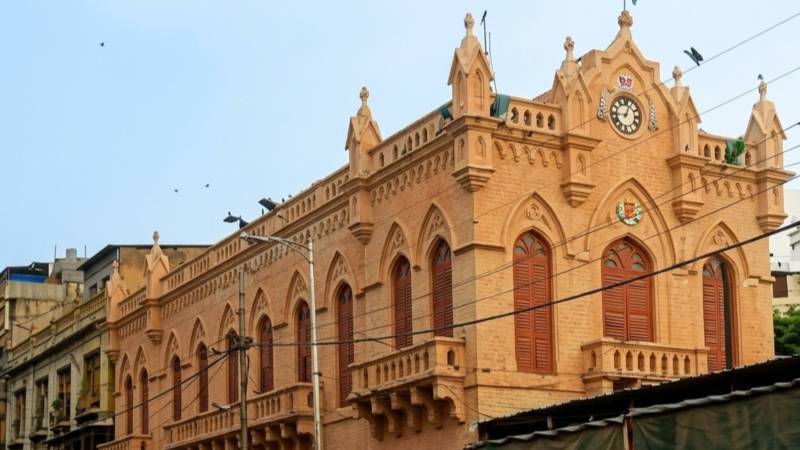
KARACHI: In the crowded heart of old Karachi, where traffic, shops and the noise of daily commerce often overshadow the city’s historical identity, an old landmark quietly tells the story of another Karachi. Standing at the intersection of M.A. Jinnah Road, the Denso Hall is more than a colonial era building. For generations, it represented access to books, knowledge and public life in a rapidly developing Karachi.
Built in 1886, Denso Hall was established as a public library for the local population at a time when many libraries like fareer hall and reading spaces were primarily accessible to British officials and their families. The building was named after Max Denso, a prominent citizen of Karachi who served several times as president of the Karachi Chamber of Commerce and Industry. The building was designed by architect James Strachan and is an important example of Karachi’s Victorian-era architectural heritage.
Its location was significant. By the late nineteenth century, Karachi was rapidly transforming into a major commercial city. The development of railways, the port and expanding trade had brought merchants, professionals, workers and communities from different parts of the region to the city. Buildings such as Denso Hall emerged within this changing urban landscape, providing not only architectural landmarks but also institutions for public life.
What makes Denso Hall particularly important is its original purpose. It was not merely constructed as an administrative building or monument. It was created as a public library, offering local residents a space for reading and learning. A library in nineteenth-century Karachi represented much more than shelves of books. It was a space where people could encounter new ideas, read newspapers, discuss literature and connect with the intellectual life of the city. In many ways, Denso Hall reflected an emerging idea of the modern city one in which public knowledge and education could become part of everyday urban life.
From Heritage Landmark to Neglected Building
Like many of Karachi’s historic buildings, Denso Hall experienced decades of neglect. The building was converted into a government office during the 1980s, according to heritage documents, taking it away from its original public-library function. In 2007, it was handed over to a private party and subsequently remained closed for years. Earlier attempts at restoration, including initiatives in 2010 and cleaning work carried out in 2019, did not result in a complete revival of the building. For a city already struggling to preserve its historic architecture, the decline of Denso Hall was another reminder of how easily Karachi’s past can disappear behind commercial development and urban neglect.
A New Chapter
In recent years, however, Denso Hall has received renewed attention. In December 2023, the Karachi mayor announced plans to restore the building and establish a library and museum there. The restoration was subsequently completed and in May 2025, the renovated Denso Hall was formally reopened to the public. The restored facility includes a library and event hall. The reopening offers an opportunity to return the building to the public sphere for which it was originally intended. But restoration of a heritage building should not end with repairing walls, ceilings and façades. The real success of conservation is measured by whether a historic place becomes meaningful to the people of the city again.
More Than Bricks and Stone
Denso Hall is part of a larger historical landscape of old Karachi, surrounded by markets, streets and other heritage buildings that collectively tell the story of the city. Its revival also raises an important question: What do we want our heritage buildings to become? Should they simply be preserved as monuments to be photographed, or should they once again become active public spaces?
Denso Hall provides an encouraging answer. A historic building can remain connected to its past while serving the needs of a new generation. A library can become digital. A reading room can host discussions. A historic hall can accommodate cultural events. And an old building can once again become part of everyday city life.
Yet conservation also requires continuous care. In 2025, heritage organizations raised concerns about maintenance, waste, encroachments and changes to the restored site, warning that years of preservation work could be undermined without proper management. This is perhaps the greatest challenge facing Karachi’s heritage: restoration is only the beginning while preservation is a continuous responsibility.
Denso Hall has survived more than a century of political, social and urban change. Its walls have witnessed Karachi transform from a colonial port city into a sprawling metropolis. Today, as books return to its shelves and citizens once again enter its doors, the building has an opportunity to become what it was always meant to be a public space for knowledge, culture and community.
Karachi does not need to preserve its heritage merely to remember the past. It needs to preserve it so that future generations can understand where the city came from, how it grew and what kind of city it still has the potential to become. Denso Hall is not simply an old library. It is a piece of Karachi’s memory and a reminder that a city loses something of itself every time it allows its history to disappear.