

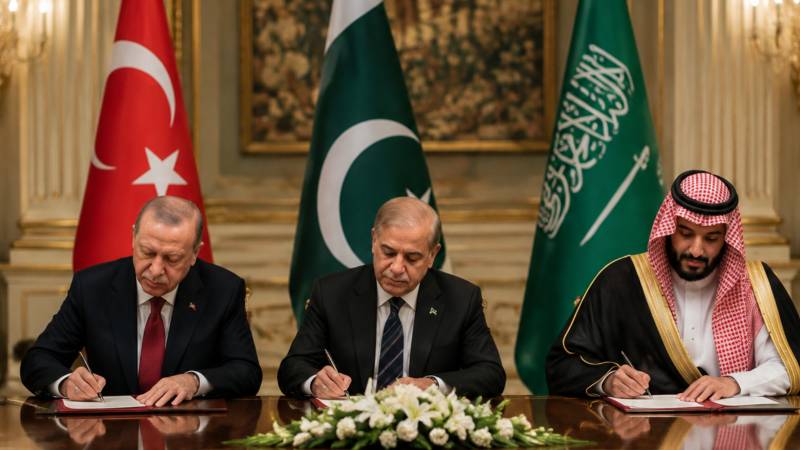
It is being argued that Pakistan has broken out of its South Asian “geographical prison” and positioned itself at the heart of the Middle East. The credit for conceiving, advancing, and successfully executing this Middle East–centric policy is, according to this narrative, due largely to General Asim Munir. After decades in which Pakistan’s human, economic, and diplomatic sacrifices were absorbed by the rocky terrain of Afghanistan, the argument goes, Pakistan has finally made an assertive entry into a region defined by petrodollars, vast investment capacity, and enormous mineral wealth. The emerging defense framework between Pakistan, Saudi Arabia, and Türkiye is being presented as a symbol of this new geopolitical direction.
But does a change in strategic positioning necessarily amount to a change in economic fortunes?
That is the more consequential question. Is Pakistan’s economic statecraft capable of capitalizing on this opportunity? Does the country possess the diplomatic, economic, and institutional machinery required to translate its renewed strategic relevance into investment, trade, technology transfer, defense manufacturing, exports, and employment? Is there a team capable of turning this rare strategic opening into a sustained transformation of the national economy or will Pakistan once again secure strategic dividends without being able to convert them into economic strength? The question matters because Pakistan has never been short of strategic opportunities.
During the Cold War, Pakistan acquired considerable importance for global powers. In successive Afghan wars, it paid an enormous human, economic, and diplomatic price. And later, the China-Pakistan Economic Corridor (CPEC) presented perhaps the clearest recent example of a major geo-economic opportunity. Yet the fundamental question has remained the same: Has Pakistan been able to convert strategic relevance into enduring economic power? That question now hangs over the defense pact involving Pakistan, Saudi Arabia, and Türkiye.
Strategically, the agreement is being described as potentially transformative for both the Middle East and South Asia. Each country brings a distinct asset base. Saudi Arabia possesses capital and access to one of the world's most dynamic regional markets. Türkiye has developed sophisticated industrial and defense capabilities. Pakistan brings military expertise, a substantial human-resource base, geographical relevance, defense-production experience, and a large domestic market. If these strengths can be integrated, the economic possibilities could indeed be substantial. But potential is not performance. And that is where the celebratory narrative must give way to critical examination.
This is not the first time Pakistan and Türkiye have sought to build a broader regional partnership. Decades ago, Pakistan, Iran, and Türkiye created the Regional Cooperation for Development (RCD) framework, envisioning closer economic, technical, and cultural cooperation among the three countries. The concept was ambitious for its time. Geography, shared interests, and political will appeared to provide a strong foundation. Yet the arrangement failed to realize its full potential and was overtaken by the dramatically altered regional environment following the 1979 Iranian Revolution. The RCD experience offers an important warning for the present. Regional agreements do not become durable simply because governments share strategic interests at a particular moment. Their longevity depends on whether those interests are translated into institutions, economic interdependence, commercial stakes, and mechanisms capable of surviving political change. That is precisely the test facing the new Pakistan–Saudi–Türkiye framework. The real question is not how many headlines the agreement generates. It is whether the three countries can embed their defense cooperation within a much broader network of economic interests—interests strong enough to survive changes of government, regional crises, and geopolitical realignments.
The opportunity becomes more meaningful if defense cooperation is treated not as an end in itself but as an entry point into a broader economic relationship. If the partnership remains confined to military training, exercises, and security cooperation, its economic impact will remain limited. But if it expands into defense manufacturing, joint ventures, technology transfer, cybersecurity, artificial intelligence, drones, aerospace, electronics, and advanced manufacturing, the equation changes considerably. Türkiye's defense industry provides an important example of how military capability can evolve into an export-oriented industrial ecosystem. Pakistan already possesses significant experience in defense production, aerospace, missile technology, training, and engineering. Saudi Arabia, meanwhile, has both capital and an ambitious program of economic diversification. The three countries could therefore explore a defense-industrial value chain in which Saudi capital, Turkish technology, and Pakistani industrial and human capacity reinforce one another. But again, the central question is not whether this is possible. The question is whether Pakistan has the institutional capacity to make it happen.
Perhaps this is the most important question in the entire debate. Does Pakistan possess the diplomatic, economic, and commercial leadership capable of developing a comprehensive working plan to capture the benefits of this agreement? Signing an agreement is only the beginning. The difficult part is identifying the opportunities within it, prioritizing them, preparing investment proposals, coordinating institutions, negotiating technology transfer, facilitating private-sector participation, and then measuring whether promised outcomes have actually materialized. The Ministries of Foreign Affairs and Defense cannot accomplish this alone. Commerce, Finance, Investment, Industry, Energy, Minerals, Information Technology, Defense Production, and the private sector would all need to operate within a coordinated Economic Action Plan. Pakistan should establish clearly defined three-, five-, and ten-year objectives with Saudi Arabia and Türkiye. Which sectors should receive Saudi investment? Which defense products can be jointly manufactured and exported? How can Turkish technology be embedded in Pakistan's domestic industrial base rather than simply imported? How can Pakistani firms gain sustained access to Gulf markets? What incentives will attract investment without sacrificing domestic industrial interests? And, crucially, who will be responsible for implementation and who will be held accountable if the targets are missed? This is where Pakistan confronts one of its most persistent structural weaknesses: agreements are often easier to conclude than to implement.
If Pakistan genuinely intends to convert renewed Middle Eastern interest into economic transformation, it must conduct an unsentimental assessment of the CPEC experience. CPEC gave Pakistan's geography a new economic significance. It created infrastructure, attracted investment, and generated expectations of industrial and trade transformation. But the more important question is whether Pakistan succeeded in converting that opening into a corresponding expansion of exports, industrial productivity, technology integration, employment, and domestic value chains. That question should now serve as a mirror for the new Middle Eastern opportunity. If Pakistan could not fully extract the geo-economic dividend from CPEC, it cannot assume that strategic goodwill from the Middle East will automatically produce prosperity. Capital does not transform an economy by arriving at its borders. It transforms an economy when it creates productive capacity inside it. That requires policy continuity, institutional coordination, regulatory predictability, competent economic diplomacy, and meaningful private-sector participation.
Pakistan does not need merely deposits, loans, balance-of-payments support, or temporary financial relief. It needs productive investment. Investment that creates local industry. Investment that transfers technology. Investment that generates skilled employment. Investment that expands exports. Investment that connects Pakistani companies to global value chains. Saudi capital could potentially be directed toward minerals, energy, agriculture, food security, infrastructure, logistics, and technology. Cooperation with Türkiye could extend beyond defense into engineering, manufacturing, industrial technology, digital services, and advanced production. The objective should therefore be clear: Pakistan should seek capital that arrives with technology, market access, and productive capacity—not capital that merely finances consumption or temporarily stabilizes the balance sheet.
The three countries could therefore explore a defense-industrial value chain in which Saudi capital, Turkish technology, and Pakistani human capacity reinforce one another.
Pakistan's mineral resources could become another important component of its emerging Middle East economic strategy. But this is precisely where Pakistan must avoid repeating an old pattern. If foreign investment simply extracts raw minerals and ships them abroad, the country will capture only a fraction of the potential value. Genuine transformation requires investment in processing, refining, downstream manufacturing, and value addition inside Pakistan. The objective should not merely be to export Pakistan's minerals. Pakistan should export the industrial value created from those minerals. That distinction could determine whether mineral wealth becomes another episode of resource extraction or the foundation of an industrial revival.
The new partnership also creates a delicate diplomatic challenge. As Pakistan deepens its strategic relationship with Saudi Arabia, it must preserve a workable relationship with Iran. Islamabad cannot afford to allow its new alignment to be interpreted as participation in a regional confrontation against Tehran. Pakistan's geography makes this particularly important. Likewise, India and Israel will inevitably view the emerging regional configuration through their own security calculations. Pakistan therefore needs to understand that greater strategic relevance brings greater diplomatic responsibility. For that reason, it would be wiser to frame the new arrangement not as an immediate “Islamic NATO,” nor as a military bloc directed against a particular state, but as a broader regional security partnership with the potential to develop economic and technological dimensions. That framing would give Pakistan greater diplomatic flexibility and potentially a much wider economic constituency.
This brings us back to the original assertion: that Pakistan has broken out of its South Asian “geographical prison” and secured a central position in the Middle East. Perhaps Pakistan is indeed entering a new strategic phase. Perhaps its importance in Middle Eastern security calculations is increasing. Perhaps defense diplomacy has created a new opening for Islamabad. But strategic relevance and economic power are not the same thing. Pakistan's real success will be measured not by the number of defense agreements it signs, but by what those agreements produce inside Pakistan: higher exports, productive investment, technology transfer, industrial capacity, skilled employment, and access to new markets.
The RCD experience demonstrates that a regional agreement alone is insufficient. The CPEC experience suggests that investment alone is insufficient. What matters is implementation capacity, the ability of the state to convert geopolitical opportunity into measurable economic outcomes. For this reason, the most consequential document following the defense agreement may not be the agreement itself, but the Working Plan that translates it into economic objectives. Pakistan needs an empowered implementation mechanism with clearly defined targets, timelines, investment pipelines, technology-transfer requirements, export objectives, and annual performance reviews. The emphasis must shift from signing agreements to delivering outcomes. From memoranda to factories. From investment announcements to productive capacity. From strategic goodwill to export earnings. From mineral extraction to industrial value addition. And from defense diplomacy to economic statecraft.
If such a mechanism is established, Pakistan's growing engagement with the Middle East could genuinely evolve into a geo-economic strategy. If not, the country risks repeating a familiar historical pattern: celebrating strategic importance today and discovering several years later that the economic dividends were never captured. The central issue, therefore, is not whether Pakistan has made an assertive entry into the Middle East. The real question is whether Pakistan is institutionally prepared to convert that entry into economic success. And perhaps the most consequential question of all is this: Does Pakistan possess the state capacity, economic vision, and leadership required to convert strategic opportunity into national prosperity—and, this time, change the course of history rather than repeat it?