

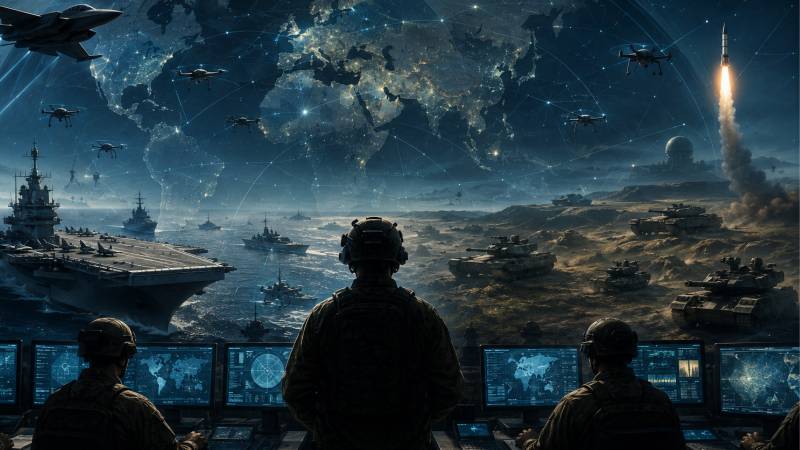
The recent NATO Summit, July 7-8, 2026, in Ankara offers an important window into understanding the changing character of international security. Much of the media attention focused on debates over defense spending, President Donald Trump's persistent demands for greater burden-sharing by European allies, and the Alliance's response to Russia's continuing challenge. Yet the summit also revealed a deeper structural transformation that has received comparatively little attention: the resurgence of the Military-Industrial Complex (MIC) as a defining feature of the emerging global order.
Let me state this upfront, NATO should not be viewed as the Military-Industrial Complex itself. Rather, it increasingly reflects the resurgence of the MIC by providing the institutional framework through which technological innovation, defense industrial capacity, military modernization, and collective security are becoming increasingly integrated. Currently and for foreseeable future, defense production is no longer merely an instrument of national security; it is becoming an essential source of economic competitiveness, technological innovation, and geopolitical influence.
The Military-Industrial Complex entered public discourse through President Dwight D. Eisenhower's farewell address in January 1961. Eisenhower warned Americans about the growing partnership between military institutions, political leadership, and defense contractors. At that time, his concern was that excessive military spending and corporate influence could distort democratic decision-making and encourage a perpetual state of militarization.
More than six decades later, the Military-Industrial Complex has evolved into something far more expansive. It now encompasses advanced technologies, artificial intelligence, cyber capabilities, autonomous weapons, space systems, semiconductor manufacturing, quantum computing, satellite communications, and digital infrastructure. Defense industries have become engines of technological innovation, linking governments, universities, research laboratories, private firms, and venture capital in ways unimaginable during the Cold War.
The Ankara Summit demonstrates this transformation. NATO's thirty-two members reaffirmed their commitment to strengthening collective defense and expanding military capabilities. Equally significant, they accepted the strategic necessity of substantially increasing defense investment. While President Trump has repeatedly criticized European allies for relying excessively on American military power, the outcome has been paradoxical. Rather than weakening NATO, these pressures have encouraged European governments to accelerate military modernization and invest more heavily in their own defense industries.
In my view, this trend reflects a significant shift in strategic thinking. Defense spending is increasingly viewed not simply as an expenditure but as an investment in industrial resilience, technological leadership, supply-chain security, and national competitiveness. Governments now seem to consider that defense manufacturing creates skilled employment, stimulates research and development, strengthens domestic industries, and generates export opportunities. National security and industrial policy are becoming mutually reinforcing objectives. At the same time, this strategic reorientation is reshaping public spending priorities, with growing concerns that investment in defense industries may constrain social sector expenditure while redirecting education, research, and innovation toward technological superiority and strategic competition rather than broader goals of human development, democratic governance, and social welfare. Perhaps the most symbolic moment of the Ankara Summit did not occur during the formal negotiations. Instead, it came at the conclusion of the meeting when Turkish President Erdoğan presented each participating head of government with an engraved Gümüşay .357 Magnum revolver manufactured by Türkiye's state-owned defense company, Makine ve Kimya Endüstrisi (MKE).
Ceremonial gifts often carry symbolic meaning, but this particular gift conveyed a strategic message. Türkiye was showcasing the noteworthy transformation of its defense sector. Two decades ago, the country relied heavily on imported military equipment. Today, it manufactures advanced drones, armoured vehicles, naval platforms, missiles, electronic warfare systems, and increasingly sophisticated aerospace technologies. Turkish defense firms have become internationally competitive, exporting military equipment across the Middle East, Africa, Central Asia, and Europe. The engraved revolver was therefore much more than a ceremonial gift; it symbolized national technological confidence and the emergence of Türkiye as an important defence-industrial power. Ukraine presents another equally important illustration of this broader transformation. Since the Russian ‘special operation’ in 2022, Ukraine has dramatically expanded domestic production of drones, precision-guided systems, electronic warfare technologies, and ammunition. Although Western military assistance remains indispensable, Ukraine's experience demonstrates how prolonged conflict can accelerate indigenous technological innovation and defence manufacturing. What initially emerged as a wartime necessity is rapidly evolving into a long-term national industrial strategy.
The Military-Industrial Complex of twenty-first century is no longer simply about producing tanks, aircraft, or missiles. It is increasingly about controlling innovation ecosystems, securing critical supply chains, protecting digital infrastructure, developing artificial intelligence, and maintaining technological superiority.
These developments are not unique to NATO members or countries directly engaged in conflict. Across the world, governments are reassessing the strategic importance of domestic defence production. Japan is expanding military manufacturing after decades of restraint. South Korea has become one of the world's fastest-growing arms exporters. Poland is investing heavily in defence production. India continues to pursue self-reliance through its "Make in India" initiative. China has systematically integrated military modernization with technological innovation and industrial policy under its strategy of military-civil fusion. Even smaller states increasingly recognize that technological sovereignty requires a robust defence-industrial base.
Underlying these developments is a broader transformation in the nature of warfare itself. The traditional distinction between civilian and military technologies has become increasingly blurred. Artificial intelligence, robotics, quantum computing, satellite navigation, cloud computing, cybersecurity, semiconductors, and telecommunications serve both commercial and military purposes. Consequently, technological competition now shapes economic development, industrial policy, and national security simultaneously.
This explains why defence industries are becoming central to geopolitical competition. The Military-Industrial Complex of the twenty-first century is no longer simply about producing tanks, aircraft, or missiles. It is increasingly about controlling innovation ecosystems, securing critical supply chains, protecting digital infrastructure, developing artificial intelligence, and maintaining technological superiority. Industrial capacity has become a strategic asset equal to military capability itself.
For Pakistan, these global trends carry weighty implications. Defence production can no longer remain confined to conventional weapons manufacturing. National security planning must increasingly integrate research universities, engineering institutions, technology firms, artificial intelligence, cybersecurity, advanced manufacturing, and innovation ecosystems into a comprehensive national strategy. Indigenous technological capability will determine not only military preparedness but also economic resilience and international competitiveness.
The resurgence of the Military-Industrial Complex also challenges traditional understandings of globalization. While globalization continues to encourage economic interdependence, geopolitical rivalry increasingly heightens technological decoupling, industrial self-reliance, and secure supply chains. States are selectively globalizing in trade while simultaneously nationalizing strategic technologies. Defence industries occupy the center of this emerging strategic economy.
The Ankara Summit therefore deserves to be understood as more than another NATO meeting. It signals the consolidation of a new geopolitical reality in which defence industries, technological innovation, and national security have become inseparable. NATO increasingly serves as the institutional framework through which these relationships are coordinated, financed, and fortified.
The core message is clear. The Military-Industrial Complex has entered a new historical phase. Unlike Eisenhower's era, when it was viewed primarily as a source of political concern, today under President’s Trump, Xijin Ping, Putin, Military-Industrial Complex is increasingly watched as a strategic instrument for sustaining technological leadership, economic resilience, industrial competitiveness, and national security. In an era defined by great-power competition, artificial intelligence, autonomous systems, and cyber warfare, defence production is no longer simply preparing nations for war; it is shaping the distribution of power in the twenty-first century. Those states that successfully merge technological innovation with industrial capability and strategic vision will define the future international order.