

The intense three-day war between India and Pakistan in May 2025 shattered a long-held global illusion: never judge a book by its cover. Ignited by India’s unprovoked aggression on the night of May 6, the conflict ended almost as quickly as it began, with Pakistan delivering a strategic masterclass that the RSS-led BJP government will never forget. As conceded by India’s own military leadership, Pakistan unleashed a formidable display of military might that maybe no one expected. India’s fatal miscalculation of underestimating Pakistan's capabilities gave Islamabad the perfect stage to demonstrate its operational lethality. A nation that had loudly proclaimed its inevitable rise as the next global superpower suddenly found itself the subject of international ridicule.
This stinging reality was cemented when a battered New Delhi was forced to seek a ceasefire through its traditional ally, the United States. Witnessing this undeniable shift in the balance of power, India’s longstanding global partners began pivoting their strategic focus toward Pakistan.
Humiliated on the battlefield, India resorted to the shadows. Tasked with destroying Pakistan’s image, New Delhi turned to state-sponsored terrorism, enlisting the Afghan government and the Tehreek-e-Taliban Pakistan (TTP). Kabul willingly sided with New Delhi, threatened by Pakistan’s uncompromising stance against the human rights violations and state-funded terror carried out by the Afghan regime. Honoring its lethal commitment, the TTP unleashed a wave of terror within Pakistan, mercilessly claiming the lives of hundreds of innocent civilians. Coupled with relentless cross-border firing, these provocations demanded a fierce response. Pakistan answered with a series of surgical, devastating operations to eliminate the threat, once again validating its military dominance.
Against the backdrop of shifting regional dynamics and rising Israeli aggression, the geopolitical chessboard moved again. In September 2025, the Kingdom of Saudi Arabia (KSA) entered into a historic Strategic Mutual Defense Agreement (SDMA) with Pakistan. This masterstroke broke the region's decades-old reliance on the US for security assurances. It became a massive diplomatic victory for Islamabad, completely crushing India's hopes of monopolizing ties with Riyadh.
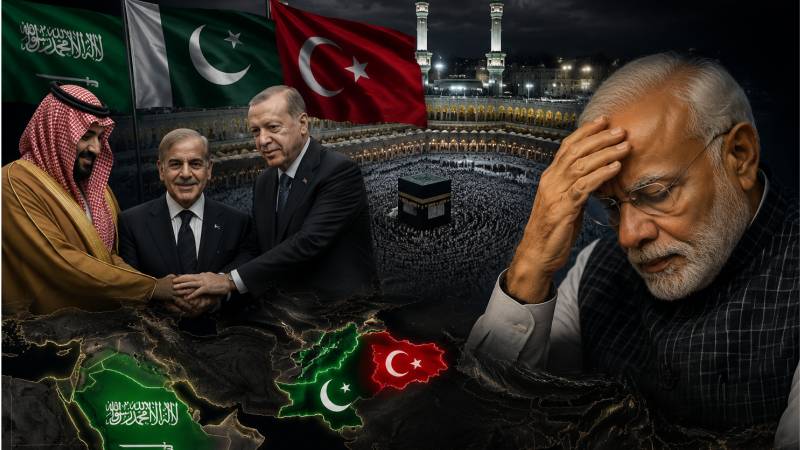
The stage was set for something even grander. Months of rigorous, high-stakes negotiations between Pakistan, Saudi Arabia, and Turkey culminated on August 7, 2026. In the holy city of Mecca, under the sacred shadow of the Ka’aba, Prime Minister Shehbaz Sharif, HRH Crown Prince Mohammed bin Salman, and President Recep Tayyip Erdogan signed the trilateral "Mecca Pact." This is no mere piece of paper. It is an ironclad commitment: an armed attack on one signatory is an attack on all. Framed explicitly as a defensive alliance under Article 51 of the UN Charter, the treaty supercharges collective deterrence and remains open to any nation sharing its principles of mutual respect and peace.
For Pakistan, this pact is revolutionary. It fuses the Muslim world’s sole nuclear power with the Middle East’s reigning economic titan and a NATO heavyweight wielding a highly sophisticated defense industry. Saudi Arabia brings unmatched financial depth, Turkey offers cutting-edge conventional capabilities, and Pakistan brings the ultimate nuclear deterrent backed by a battle-hardened military.
It elevates Pakistan into a collective defense framework of unprecedented scope, bringing immense pride, enhanced deterrence, and expanded horizons.
Regionally, the Mecca Pact births a new era of collective strategic autonomy for Muslim states, acting as a powerful counterweight to global uncertainties. Crucially, it stabilizes West Asia without creating a sectarian or anti-Iran bloc. Tehran was kept fully informed, with officials emphasizing the alliance's strictly defensive intent.
While Pakistan rises, India continues to bleed regional influence. The brief 2025 conflict laid bare critical vulnerabilities in India’s air and missile defense systems. New Delhi's desperate diplomatic campaign to isolate Pakistan completely collapsed; instead, Islamabad emerged with unbreakable partnerships and is rapidly modernizing its arsenal with Turkish drones, Chinese fifth-generation fighter jets, and advanced precision strike systems.
Independent analysts have thoroughly dismantled India’s maximalist claims of success in the prior conflict due to a glaring lack of evidence. Consequently, India’s Gulf partners have diversified their security portfolios. KSA now shares deep defense ties with Pakistan while reducing India to a purely economic partner, and Turkey continues to fiercely defend its historical stance on Kashmir. The Mecca Pact embeds Pakistan flawlessly into West Asia’s security framework, a region vital for energy and trade. India’s global outreach is now choked by the reality that its key partners are militarily bound to its primary rival.
This geopolitical earthquake guarantees sleepless nights for the RSS-backed BJP government. Its entire domestic political survival rests on a carefully curated narrative of projecting strength and strategically isolating Islamabad. The Mecca Pact shatters that illusion. It also lends massive structural weight to Pakistan’s core positions: countering Indian state-sponsored terrorism and spotlighting the unresolved Kashmir dispute.
Pakistan has relentlessly exposed Indian claims of cross-border terrorism as a desperate smokescreen to hide New Delhi’s internal failures and brutal, repressive policies in Indian-administered Kashmir, a region Army Chief General Asim Munir rightfully calls Pakistan's "jugular vein." Islamabad has successfully obliterated the threat of diplomatic isolation, strengthening its power to internationalize the Kashmir crisis. For a BJP government heavily invested in a hardline approach, this massive paradigm shift triggers genuine strategic panic.
The Trilateral Mecca Pact is the ultimate culmination of Pakistan’s battlefield resilience and masterclass in diplomatic activism. It elevates Pakistan into a collective defense framework of unprecedented scope, bringing immense pride, enhanced deterrence, and expanded horizons.
For India, the implications are devastating. The myth of decisive superiority has been crushed on the battlefield and boxed in diplomatically. Confronting a formidable Pakistani deterrent, waning regional influence, and a neighbor that has masterfully converted military performance into a durable security architecture, New Delhi's strategic anxiety is entirely predictable. The path forward for South Asia depends on recognizing this new reality. The Mecca Pact has irrevocably altered the balance of power; ignoring it will only deepen the catastrophic costs of future miscalculations.