

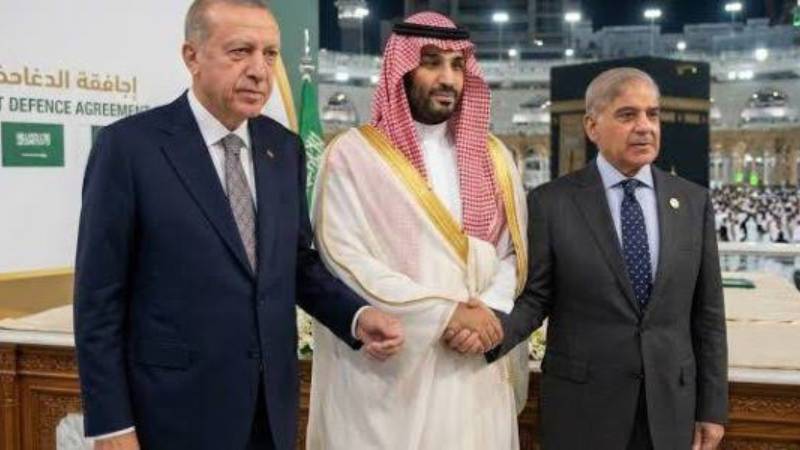
There is a photograph from Mecca, taken on the seventh of August, that will hang in many offices for years. Three men, three flags, one signature apiece on a pact that lifts the most famous promise in the NATO charter and points it at the Muslim world. An attack on one is an attack on all three. It is a stirring thing to read, and I do not blame anyone for being stirred.
Then the lawyer in me went looking for the fine print that is not there. A promise of this sort is easy to sign and very hard to keep, and the distance between the two is where this column lives. Give the pact its due first. Turkey is the reason it is not merely symbolic. A country once refused spare parts by its own allies now sells better than ten billion dollars of weapons a year, flies a home-built stealth fighter in the KAAN, and turns out the Bayraktar drones that have made expensive air forces look suddenly mortal. It is even building its own layered air shield, the Steel Dome, which knocks down cheap drones with lasers rather than missiles that cost more than the drone.
Saudi Arabia brings the money, and there is a great deal of it. An eighty-three-billion-dollar defence budget, oil underneath it, and the means to pay for a long war without anyone in Riyadh feeling the pinch. We bring the soldiers. An army that has actually fought, some 170 nuclear warheads, and a kill chain of our own making in Link-17, proven not at a trade fair but over our own skies. Of the three contributions, ours is the one money cannot buy in a hurry. So the sum looks formidable, and for a short, sharp fight with a regional rival it truly is. Our bomb keeps the worst nightmares away, Turkish factories can keep the guns fed for weeks, and Saudi money can replace whatever runs short by morning. Within that narrow band, the pact does exactly what it says on the tin. The trouble starts when the war does not end in a fortnight.
Here is the thing about NATO that our leaders seem to have admired without quite understanding. The promise in Article 5 is the least of it. What has kept that alliance on its feet for seventy-five years is the dull machinery underneath: one command, weapons that talk to each other, shared depots, and a factory base so wide that no single embargo can shut the guns up. The clause is the roof. Everyone forgets that a roof cannot hang in mid-air. We have not poured the foundation. In places we cannot.
Take engines. The KAAN flies on an American one, cleared for export only last month and revocable the day Washington sours. Our JF-17 flies on a Russian one. Let the West and Russia agree, just once, to close the tap, and both production lines fall silent within months. None of the three can make an advanced microchip, the silicon inside every radar and guided weapon. And not one of us can put a satellite into orbit on a rocket of our own; we rent American, European or Chinese launchers to do it.
Stay with that last one, because this is where wars are now decided, up in orbit, long before anything moves on the ground. Our eyes, our early warning, our encrypted radios, our targeting, all of it hangs from satellites. An alliance that can fly its satellites but cannot replace one that has been jammed or shot down is fighting on borrowed time, and the lender can call the loan whenever it likes. Money does not fix this quickly, whatever Riyadh may wish. Saudi Arabia has spent lavishly for years and still builds barely fifteen percent of its own kit. When the American technicians packed their bags and flew home in March, the Kingdom found out how much of its firepower it does not actually own.
There is a quieter embarrassment as well. The three armies barely speak the same language. The Saudis are wired for Western gear, we for Chinese, the Turks for a bit of each. No common data link, no shared way of telling friend from foe, no joint command. A solemn promise to defend one another that cannot be run through a single command post is a promise still waiting for a translator. Which leads to the question nobody at that handsome ceremony wanted to say out loud. What is this alliance actually for?
An alliance that can fly its satellites but cannot replace one that has been jammed or shot down is fighting on borrowed time, and the lender can call the loan whenever it likes.
Smaller things than the occasion suggested. On its own, at the very most, it can handle regional matters that Washington is willing to bless, or ones that do not step on American toes, and to a far lesser degree those of China and Russia. Try to move past that line and the room shrinks fast. Israel is the plainest example. For as long as Washington stands behind it, and it will, this alliance changes nothing there. Now the part we ought to sit with, because a clause like this cuts both ways. It binds you to other men's quarrels as surely as it binds them to yours. So, two questions. Could we afford to be dragged into a fight with a neighbour that was never ours to begin with? With the borders we keep, the fragile peace we hold at home, and an economy running on fumes, the honest answer is no, or very nearly.
And the harder question, the one we should put to ourselves before anyone else puts it to us. If it were we who went to war, limited or long, with our large eastern neighbour, would Ankara and Riyadh actually come running, or would they discover, quite suddenly, a great many reasons to stay home? A treaty is worth only what it proves on the day it is tested, and for us that day is not difficult to picture. Here is the irony that ought to keep us awake. The biggest winner in all of this may be the United States. Having learned in the recent wars that boots and bases on the ground no longer pay their way, Washington now has an arrangement that lets it keep selling weapons and steering the region without leaving a single soldier behind to be shot at.
None of which makes the pact a mistake. Quite the opposite. It makes it worth taking seriously enough to finish. The cleverest idea in it so far is also the most transactional, turning two billion dollars of Saudi loans into orders for Pakistani-built JF-17s. Clever, and nowhere near enough, and fragile besides, as we saw the moment Riyadh quietly pulled its money out of our arms deals with Sudan and Libya the instant the diplomatic wind shifted. Money that can be recalled on a whim is not a foundation.
A foundation is slower, duller, and worth every rupee, riyal and lira it costs. Build an engine of your own, because an air force flying on someone else's is an air force out on parole. Pool the money and the considerable brains, learn to make the chips and launch the rockets, so you can replace what you lose rather than merely fly what you own. And lay the unglamorous wiring, the data links and the single command, that turns three armies into one.
The men in Mecca have written down an intention, and that is no small thing. Every real alliance starts as one. Whether it grows into something with muscle will not be settled by the handshake or the press release. It will be settled overhead, on the morning these three can send up a satellite of their own to replace one an enemy has burned out of the sky. Until that morning comes, the pact is a fine beginning. And a beginning is all it is.