

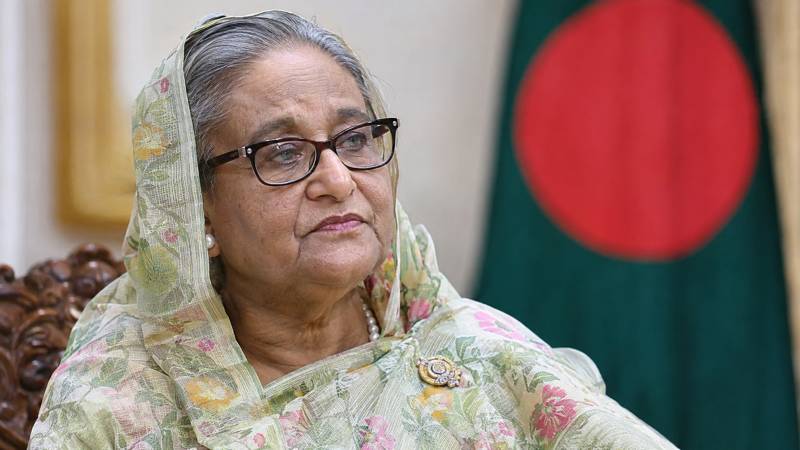
Sheikh Hasina’s reported plan to return to Bangladesh has placed three issues at the centre of regional politics: Bangladesh’s sovereignty, India’s diplomatic influence, and Britain’s role in South Asian politics. Six British parliamentarians have urged their government to seek guarantees that Hasina will not face execution, enforced disappearance, torture, or political violence upon her return to Bangladesh. Their appeal has brought an old but sensitive question back into focus: when does international concern become an attempt to interfere in the internal affairs of a sovereign state?
The six British parliamentarians addressed their concerns to Foreign Secretary Ed Miliband and called for a coordinated diplomatic effort to address Hasina’s situation. Their request included written guarantees against execution, political violence, and torture. They also called for access to legal counsel of Hasina’s choice, independent scrutiny of the judicial process, and a Bangladeshi-led political dialogue involving victims, political parties, and civil society.
The concerns raised by the British parliamentarians are rooted in the circumstances surrounding Hasina’s trial. In 2025, Hasina was convicted and sentenced to death by Bangladesh’s International Crimes Tribunal. The trial was conducted in her absence. Amnesty International said the trial was rushed and unfair. Although Hasina had a court-appointed lawyer, the defence had little time to prepare and could not cross-examine witnesses or challenge contradictory evidence.
However, the British lawmakers’ intervention also raises important questions about the limits of foreign involvement. Bangladeshis did not overthrow a government in 2024 only to have the terms of their political transition shaped by parliamentarians in Westminster. While foreign parliamentarians can legitimately raise concerns about human rights violations, such concerns should not give them the power to dictate the functioning of Bangladesh’s courts or its right to pursue accountability.
Bangladesh, as an independent state, has full authority to manage its own constitution, political institutions, courts, and treaty obligations. It should address the question of Hasina’s return through its legal framework and the extradition treaty between the two countries. For Bangladesh, the real challenge is to exercise its sovereign authority while upholding the rule of law.
Bangladeshi authorities denied issuing a passport or national identity card to Hasina on account of her alleged crimes against humanity. Her return should be handled through the extradition treaty with India. Bangladeshi officials have emphasised that the matter must be resolved through legal procedures rather than emotions. Dhaka has every right to determine the legal route through which the former prime minister returns to the country. If she returns, she must receive the legal protections guaranteed under Bangladeshi law and international human rights obligations. Foreign governments may raise concerns, but they should not have the right to dictate the terms to any sovereign state.
Moreover, Bangladesh should not be expected to offer Hasina political immunity or permanent protection from legitimate legal consequences. No former leader, regardless of how powerful they may be, should stand above the law. What Bangladesh should guarantee is the fairness of the process. This means ensuring protection against torture and politically motivated violence, while retaining access to independent lawyers, the right to appeal, and all the protections afforded by due process. Any punishment must follow a fair, transparent, and legally sound judicial process that meets international standards . Such measures would demonstrate confidence in Dhaka’s judicial system. If Dhaka considers its case legally sound, it should allow transparent proceedings. Respecting the rights of the defence would work in Bangladesh’s favour.
Although Britain’s role has attracted attention, India has a more direct role in determining what happens next. Bangladesh cannot bring Hasina home without India’s cooperation, as she has remained in India since August 2024. Her continued presence in India has also become a source of tension between Dhaka and New Delhi. Bangladesh has urged India to expedite the process, while Indian officials maintain that the request must be handled according to legal procedures. India should consider Bangladesh’s request transparently and in accordance with the treaty, rather than according to political convenience. Bangladesh must also understand that extradition is not guaranteed. The treaty gives India legal grounds to refuse if it considers the charges to be politically motivated. The solution is not to demand that India disregard its own laws, but to ensure that Bangladesh’s legal process is strong enough to withstand scrutiny.
Moreover, Hasina’s return poses another question: would it help normalise relations between India and Bangladesh? Her continued presence in India has strained bilateral ties. If she returns to Bangladesh, it could remove a visible point of tension between the two governments. However, the normalisation of relations cannot rest solely on the extradition issue. It requires mutual respect for sovereignty, predictable border and trade policies, restraint in domestic political interference, and a shared commitment to regional stability. Sheikh Hasina’s return may be a step towards normalisation, but lasting improvement requires broader diplomatic efforts.
Bangladesh should deliver justice through its own courts rather than wait for another country to tell it what to do. It can exercise its sovereignty by ensuring that Hasina receives a fair trial. Dhaka does not need permission from Britain to pursue Hasina’s return. What it needs is to ensure that its own courts are fair and independent. India, too, should be free to pursue its own interests, but it should not expect Bangladesh to remain at the mercy of New Delhi. The relationship between the two countries should be based on equality and mutual respect.