

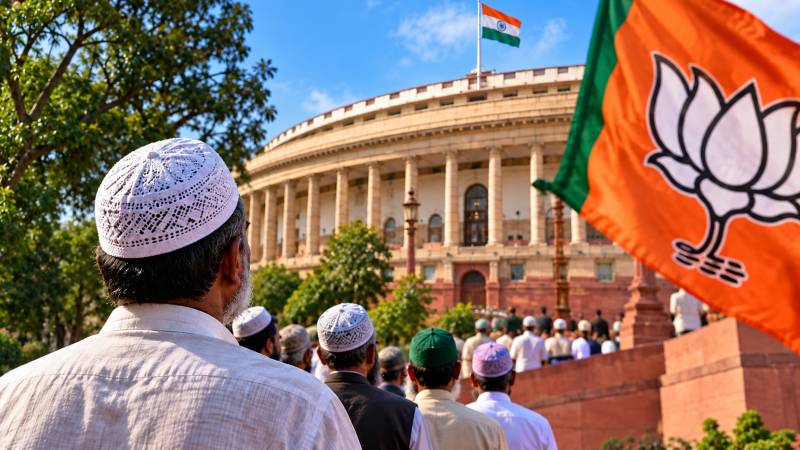
In 2014 the Bharatiya Janata Party won 282 Lok Sabha seats, in 2019 it won 303, and in 2024 it won 240: 825 in all. None went to a Muslim. In 2024, none of the 24 Muslims elected to the Lok Sabha belonged to the ruling party. It is tempting to read that figure as proof of a hostile record on rights, but it is not. Parliamentary arithmetic and equal citizenship are separate questions, and this article keeps them apart.
The zero is usually described as Muslim candidates losing, but the more revealing fact is how few were nominated. In 2014 the BJP fielded seven Muslim candidates out of 482, and all lost. In 2019 it fielded six: three in Jammu and Kashmir, two in West Bengal and one in Lakshadweep. In 2024 it fielded one, Abdul Salam in Malappuram, a seat held by an Indian Union Muslim League stronghold, and he lost. So the question is not why the BJP cannot elect Muslim MPs. It is why a party that has become India's dominant force has given Muslims so few chances to try. Candidate selection is one of the clearest statements a party makes about what it thinks its winning coalition looks like.
The BJP has an answer. A former Union minister told The Wire that the party did field Muslim candidates but got meagre support, so many leaders turned to voters outside the community. Mr Salam said the BJP welcomes minorities. There is also evidence that Muslim voters often back whichever candidate is best placed to defeat the BJP. That explanation is rational, but it describes a loop: few tickets, few votes, fewer tickets. A party that wants to break the loop has to choose to.
The cycle is difficult to break: few Muslim candidates receive tickets, limited electoral support follows, and the resulting losses are then used to justify offering even fewer tickets.
Muslim under-representation did not begin in 2014, and it extends beyond the BJP. The Lok Sabha's highest Muslim representation was 49 MPs in 1980, while the 2024 House has 24, about 4.4 percent of 543 seats. Opposition parties have also nominated fewer Muslims. Congress fielded 19 in 2024, down from 34 in 2019, though it contested fewer seats, and Muslim candidates from major parties fell from 115 to 78. The BJP is the outer edge of a wider deficit, not its sole cause. Nor is the picture all-or-nothing. The zero concerns elected Lok Sabha members, not Muslim participation in BJP-led governments. Najma Heptulla and Mukhtar Abbas Naqvi served as ministers, both through the Rajya Sabha, though when Mr Naqvi's term ended in July 2022, The Wire reported that the party would have no Muslim member in either house.
Whether Muslims enjoy equal citizenship must be tested on its own record. Take demolitions. In November 2024 the Supreme Court held that the executive cannot raze a home merely because its owner is accused or convicted, and it issued pan-India guidelines: a show-cause notice, 15 days to respond, a personal hearing and video recording. The ruling did not find a nationwide policy of targeting Muslims. Rights groups allege discriminatory patterns, while authorities say the drives remove unauthorised structures, and Gujarat told the court its demolition near Somnath applied to all religions. The Court also exempted encroachments on public land, and this year it sent contempt petitions alleging violations of the guidelines to High Courts. Other claims, on the citizenship law, free expression and communal violence, stand or fall on their own records, not on a seat count.
What the number does tell us is that a governing party built three majorities with no Muslim in its parliamentary ranks and almost none on its ballots. That is a question about inclusion, and it matters even to those who believe Muslim voters have rejected the BJP. In a country where Muslims are roughly one in seven, a ruling party whose benches hold none leaves the community's concerns to be carried by others. The 825-to-zero figure is not a verdict on India's record on rights. It is a question for the party that produced it: who do you think belongs on your ticket?