

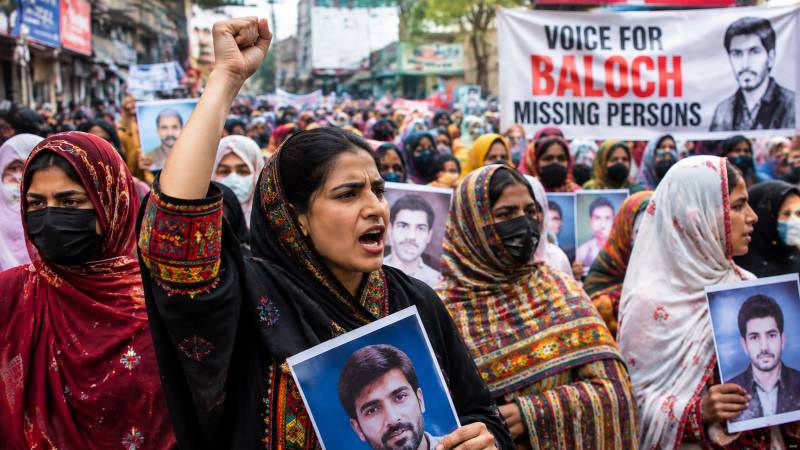
Women joining armed groups in Balochistan are frequently described through the language of exploitation, vulnerability and manipulation. These explanations can matter in individual cases. But when they become the starting point for every discussion, they obscure a question that deserves greater attention: how have women in Makran come to understand the conflict, and why do some choose armed participation? Their political consciousness cannot be understood without the region's history.
As someone from Makran, I find the surprise surrounding women's participation revealing. In conversations within our communities, people discuss relatives and neighbours, including young women, said to have joined armed groups. These conversations cannot establish recruitment figures or confirm every account. They do, however, suggest that the issue is entering ordinary social life. Explaining it entirely through manipulation leaves much of that local experience unexplored.
The political background reaches back through the Musharraf years and the subsequent phases of conflict. Human Rights Watch documented enforced disappearances in Balochistan from that period and beyond. Women searching for missing relatives became visible participants in public protest. A 2023 study of women's activism describes the organising of mothers, sisters, wives and daughters, including through the Voice for Baloch Missing Persons, established in 2009. Their involvement has a history that predates the present attention to female militants.
Searching for a loved one can bring a woman into sustained contact with courts, government officials and political organisations. Through this process, she may develop a deeper understanding of legal procedures, institutional structures and the rights and responsibilities of citizenship. Through that experience, a demand for recovery may develop into questions about citizenship and accountability. Yet personal loss is only one route to political consciousness. A woman can interpret the suffering around her as a collective injustice without having a disappeared relative herself. Solidarity does not require direct bereavement.
Makran's cultural and educational setting also matters. In my experience, parts of the region offer women considerable space for education and political discussion, even as patriarchal restrictions persist. This should not become a claim that Makran is uniformly progressive or free of inequality. A 2024 study of Makran found encouraging female educational participation alongside serious barriers to formal political influence. Political awareness and limited institutional power can exist together. Yet the political potential of women in Makran is often overlooked, particularly when their participation in public and political life is viewed only through the lens of vulnerability or social constraints.
When women are understood primarily as vulnerable individuals influenced by others, their capacity for political interpretation, ideological conviction and independent judgment risks disappearing from the discussion.
The educational backgrounds of some women involved in armed activity challenge explanations centred on ignorance. Shari Baloch, who carried out the 2022 Karachi University suicide attack, was an educated schoolteacher. Her case requires attention to political beliefs as well as recruitment. It cannot establish that every woman joins freely, or that all recruits are educated. Neither education nor its absence determines a person's capacity for political judgment.
My argument is that women's potential for independent political thought has received insufficient attention. Describing them chiefly as emotionally vulnerable can make conviction disappear from the analysis. Recent security commentary has highlighted women’s vulnerability to exploitation and the possibility of coercive recruitment by militant organisations. These concerns deserve serious attention. However, they cannot become the entire explanation for women's participation. When women are understood primarily as vulnerable individuals influenced by others, their capacity for political interpretation, ideological conviction and independent judgment risks disappearing from the discussion. Understanding their participation requires examining both the conditions that may influence or constrain their choices and the political meanings they themselves attach to those choices.
The same problem arises when empowerment is offered without examining what it means locally. Education and employment remain essential. Women also need meaningful influence over public decisions and the freedom to question authority. Some may already possess political awareness while believing that existing institutions cannot address their grievances. That belief requires serious engagement, even when the conclusions drawn from it are unacceptable.
Families' public statements deserve similar care. Through my own field observations, I have noticed instances in which families publicly distance themselves from or disown relatives reportedly involved in militant organisations. Such statements have also generated different interpretations within communities, including the perception that families may be speaking under pressure or out of fear. These interpretations require independent verification. Neither a press conference nor militant publicity should be treated as a transparent account of a family's circumstances or a woman's motives.
Recognising political agency carries responsibility. A woman may exercise judgment while remaining subject to organisational control. Understanding these possibilities requires evidence and listening, rather than choosing an explanation in advance. A credible response would give women space to articulate grievances without treating dissent as a security offence. It would investigate disappearances and alleged abuses, protect peaceful organising, and make dialogue consequential. For Makran, the task is to understand how a generation has interpreted years of conflict. Women's political consciousness is part of that history, as is their potential to shape its future. Any effort towards peace that fails to engage it will remain incomplete.