

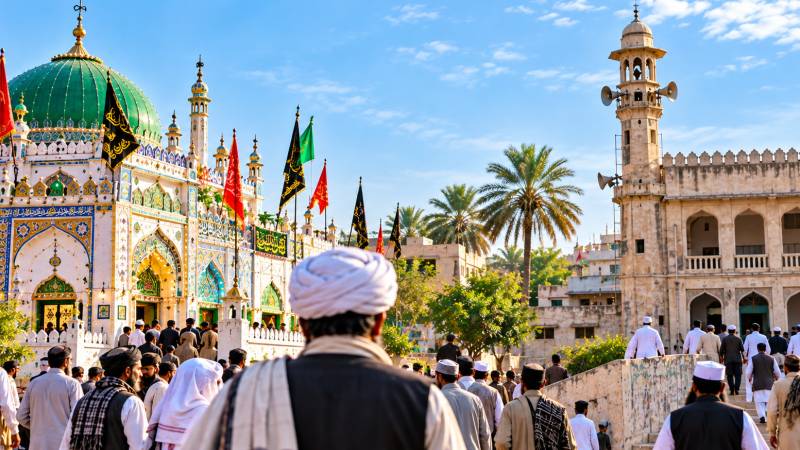
Once, most of the region of South Punjab was peaceful and every sect tolerated others' perspective. The Majalises were held on every Ashura and people from other sects thronged to the gatherings. The region also observed intermarriage among different sects. It was the age of fraternity and respect.
The first Shia-Sunni conflict occurred in December,1970 and then on 26 February, 1972 at Dera Ghazi Khan. While delving into the research to ascertain the causes of the conflict, it is revealed that there was a strife for the political space in the city. Andreas Rieck’s The Shias of Pakistan gives a fairly precise account of what happened in Dera Ghazi Khan in 1970 and 1972. Rieck says that “in 1970 the broader sectarian issue became intertwined with the election campaigns of Sunni religious parties.” The striking feature of the 1970 elections, particularly in NW-88 Dera Ghazi Khan-I, which also included Dera Ghazi Khan city, was that religious political parties dominated the contest.
Jamaat-e-Islami, Markazi Jamiat Ulema-e-Pakistan and Jamiat Ulema-e-Islam together received more than 84,000 votes. It was also a contest among different Sunni sects, particularly the Deobandis and Barelvis, to secure political space. The JUI candidate, Abdul Sattar Taunsvi, who was known for his public diatribes against the Shia community, secured 21,477 votes in the election.
The purpose of this entire discussion is to demonstrate that the conventional explanations based on economic inequality and an inadequate education system do not adequately apply to this case of emergence of militancy in South Punjab. It was rather driven by the ambitious religious political parties to have a share in the pie of politics. They have been vying since British rule. Moreover, it is also a fact that the state, after independence, alternately used one group and then another, while its political game continued unabated.
Ayub Khan got the support of Pirs in his 1965 election against Fatima Jinnah. And a large number of Gadinasheens supported Ayub Khan to maintain their own political clout as well. And the Deobandi sects supported Fatima Jinnah. The shrines were an established political factor and had no prejudice against the minority sects of Islam , it was all embracing. In contrast, the Deobandi school regarded many shrine-related practices as bid‘at (religious innovations) that diverted Muslims from what it considered the correct path of Islam. It is noteworthy that the Deobandi school had been seeking greater political influence in Pakistan since partition. It had already developed a strong organisational network and political presence during British rule.
A tussle between Deobandi , Bralive and Shia had a genesis since partition to gain political influence in the country. The state used this as a tool and significantly the military rulers exploited this political strife among sects for the consolidation of their own power. To deter the populist parties and to consolidate his one nation theory based on Islamic ideology , the Yahya Khan’s regime developed an informal alliance with religious parties particularly with the Deobandi school. Mian Tufail of JI lauded Yahya Khan as a “champion of Islam”. Jamat-e Islami , before partition, had launched a polemic against the creation of Pakistan, but after its emergence JI maneuvered to induce Liaqat Ali Khan to introduce Objective Resolution in the Constituent Assembly of Pakistan.
The conventional explanations based on economic inequality and an inadequate education system do not adequately apply to this case of emergence of militancy in South Punjab. It was rather driven by the ambitious religious political parties to have a share in the pie of politics.
Yahya Khan sought the backing of JI to curb the influence of PPP and Awami League and the former seized the opportunity to assert its political stance against the socialist program of the PPP. This suggests that religious political parties were expanding their political space and electoral support since independence. The Bhutto regime by conceding to the demands of the Sunni sects to declare Ahmedies as non Muslims made the religious political parties more powerful. They had now gained the power to demonstrate their will in the policies of the state.
Their political role became relevant in Zia’s era. He needed his constituency and to counter the influence of the Iranian revolution in the country, he decided to appease the clergy by providing them a political space in 1979. The International Crisis Group states quite directly that Zia’s military regime backed radical Deobandi organisations partly “in response to Shia resurgence domestically in the wake of the 1979 Iranian revolution.” Then came the Afghan Jihad when the Deobandi clerics provided mujhids to fight against the Soviet Union. The Saudis met the needs of the Deobandi sect by providing them with petro dollars to build their madrasas in the country . It was a two edged sword; to deter Iran’s influence and to have a political constituency in the Muslim countries. Ayesha Siddiqa reports that 595 of 972 Deobandi madrasas in Punjab in 1988 were situated in South Punjab, particularly in Bahawalpur, Multan and Dera Ghazi Khan.
Kamran discusses the shift from shrine-centred authority to the influence of ulama and madrasas, including the expansion of Deobandi seminaries in southern Punjab. Tahir Kamran has also brilliantly contextualized the emergence of sectarian militancy in the South Punjab especially. His research is the case study of Jhang as it became the heartland of religious militancy in South Punjab. According to the research, rivalry between the two families Syed and Sial fueled the sectarian strife in Jhang. “These competing kinships, as the sources reveal, deliberately exploited and aggravated the sectarian fault lines in Jhang for local political advantage,” writes Tahir Kamran. Moreover, he highlighted the role of migrants in the rise of militancy and sectarian violence in Jhang. The migrants from East Punjab settled in Jhang had wealth but no political clout. They were mostly local traders and bazaar merchants, “ which [the political clout ] they looked for through unequivocal support and funding for outfits like Sipah-i-Sahaba and Lashkar-i- Jhangvi.” It is interesting to note the role of the middle and lower middle classes for escalation of religious militancy.
Under the influence of the Tablighi Jamaat, schoolteachers also began to oppose the traditional values and cultural practices of society. These were the very values that had held different sections of society together for centuries. As these traditional bonds weakened, the middle class embarked on a quest for a new Islamic identity. Gradually, a desire emerged to translate this religious identity into political power. It is therefore no longer surprising to see a professor at a medical college or an engineering university wearing his shalwar above his ankles and carrying a miswak in his pocket. Moreover, religious revivalist movements brought about a transformation in the cultural identity of the middle class, which, under certain circumstances, provided a social foundation for religious politics.