

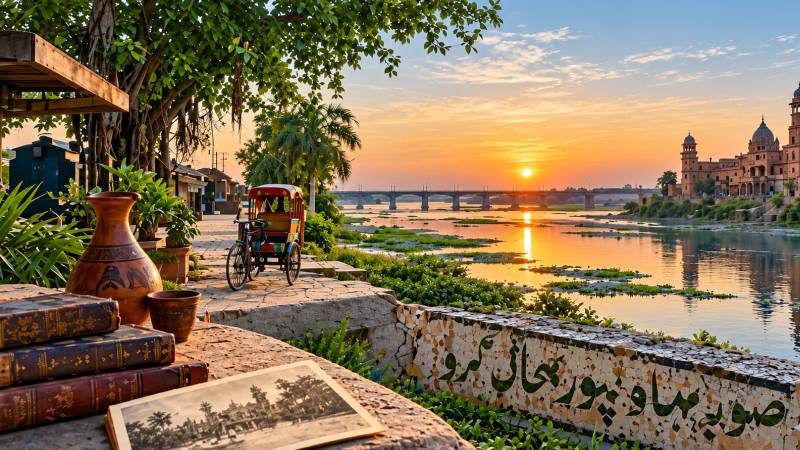
It was a river with two banks
and a heavenly mother who nursed it on drops from the cloud
But they kidnapped its mother
so it ran short of water
and died, slowly, of thirst.
Mahmoud Darwish
In the early 1970s’ when our passenger train, hauled by steam locomotive engine; destined for Jacabad (Sindh) , would reach Bahawalpur railway station, it was a joy to see huge banyan trees, green palm plants in pots, fresh tap water and colorful earthen ewers at the platform. I yearned to roam on that delightful ramp but being too young, I was not allowed to do so by my parents. The pleasant scene was enough to attract me to the streets of the city. “It must be a city of joy”, I would muse.
In May 1980, my prayers were answered and I landed in the enchanted city of my childhood to live there. I still remember that first day in the city. It still had a princely aura. I boarded a cycle rickshaw; an amazing experience as cycle rickshaws were a common feature on the streets of the city in those days. They were later banned by Nawaz Sharif government to facilitate the well wisher who wanted to introduce motor rickshaws in the city pretending to discourage the inhuman ride.
Bahawalpur was a small city located on the brink of Sutluj river and had impressive educational institutions like the Majestic Central Library, Sadiq Egerton College, Sadiq Public School and Sadiq Dane High School. In the era of Z.A Bhutto a medical college, a university and a radio station was established as part of efforts to promote the region’s development. The Radio Pakistan of Multan and Bahawalpur played a major role in promoting the Siraiki language.
Many Saraiki poets have written elegies for the Sutlej, mourning not merely a river but the civilization that grew around it.
The city still had a princely aura.The walls of the city on the Circular road were covered with the slogan ,”Suba Bahawalpur Bahal Karo” ( restore Bahawalpur province). I was a novice and had no political inclination in my early youth. I ignored the slogans but found them on every wall of the city later. I became curious to discover what lay behind the slogans.
The princely State of Bahawalpur acceded to Pakistan in 1947 and subsequently retained a distinct administrative status. In 1955, it was incorporated into the newly created province of West Pakistan under the One Unit scheme. When One Unit was dismantled in 1970, Bahawalpur was not restored as a separate administrative entity; instead, its territory was incorporated into the province of Punjab. It caused a tremor among the people who wanted to get restored the status of a province, whereas, before the scheme it had a status of an administrative unit. Two people were killed in April 1970 and the movement faded after the arrest of the leaders . But the demand for separate province was still tangible on the walls of the city.
The city was built in 1748 by Nawab Sadiq Muhammad Khan I on the left bank of the mighty Sutuluej river . In those days the river was in full flow and had flora and fauna of its own. After the Indus Water Treaty it lost its glory as Indians built a Bhakra Dam on it to irrigate their Rajasthan region. Many Siraiki poets have written elegies for the Sutluej. A well-known elegy is by Jahangir Mukhlis. “Meda Sutluej Saeen/ toun ni wikia/ teddy naal sadian di tehzeeb wikani.” (My beloved Sutlej, it was not you alone that was sold; along with you, your civilization of centuries was sold).
Agricultural settlers had begun arriving in Bahawalpur with the expansion of canal irrigation in the latter half of the nineteenth century, but the large-scale influx of abadkars from Punjab began with the Sutlej Valley Project and the colony settlement scheme launched in 1926–27. The natives describe that period as a colonisation of the Bahawalpur state.
The natives were taken as janglies (untamed). A Punjabi friend of mine conceded to me last month, forgetting that I was a Siraiki speaking myself, about a person who helped them in some matters. “ halankay F… Siraiki hai mgr iss nay saadi mudad zaroor kity.” ( though F…is Siraiki but even then he helped us).
Amid our customs and bonds of love, amid temples and mosques, somewhere our voice was lost, somewhere our prayer went unheard. (Jahangir Mukhlis).