

How wondrously Rohi blooms in beauty,
Where dwells the beloved of this humble soul.
There, lovers are seen in their thousands.
And I alone, a homeless wanderer.
Khawja Ghulam Fareed
The memory of those bright winter days is still fresh and green in my mind, when I would wander on the roads of Bahawalpur along with Muhammad Khalid Akhter; a renowned Urdu writer. He is known as a “writers’ writer”. I would carry an anthology of romantic poets in my hand to read famous poems of great English romantics to Muhammad Khalid Akhter , who would explain to me every line of the poem we were discussing. Those leisurely walks through Bahawalpur were, in their own way, a literary education. The city of those days was quiet and calm . A few cycle rickshaws would pass through with the sound of chimes. It was a pure joy to roam about under the long shadows of sheesham trees.
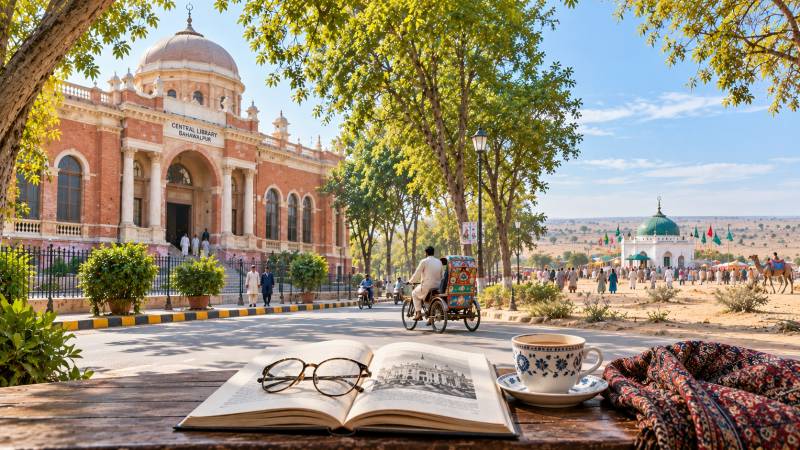
I met Muhammad Khalid Akhter on a rainy day of May 1981 at the Central Library of the city. I was a frequenter to the majestic place to borrow books.In an essay published in The Express Tribune, Arshad Shaheen et al. described the Central Library as: An edifice of Bahawalpur's identity. The imposing architecture of Italian variety lends the building old world charm. The red-brick structure is, in fact, an edifice of Bahawalpur’s identity – a relic of its glorious culture. It had an amazing collection of books and the fiction section was my haunt. I had borrowed Mysteries, a novel by Knut Hamsun that day. Muhammad Khalid Akhter was surprised to see a novel of a Nobel Laureate in the hand of a young man of twenty one.That chance encounter marked the beginning of our friendship. He had retired and chosen to live in Bahawalpur, whereas, his family was settled in Karachi. In 1990 he had to leave for Karachi for good but he always longed for Bahawalpur for he wasn’t happy in the crowded metropolitan city.
Muhammad Khalid Akhter and I were voracious readers and the Central Library was our great refuge since we both were shy of people. Muhammad Khalid Akhter was the heir of the great literary tradition of the city. The city had a rich literary tradition that continued from the days of the great Siraiki poets Khawja Ghulam Fareed and Khurram Bahawalpuri
Another great Urdu writer Shafiq ur Rehman also hailed from the Bahawalpur State. He completed his early education from Bahawalpur city, he later joined the Indian Royal Army in the medical corps. He was a superb conversationalist . He would charm his selected audience, for he was diffident otherwise, and would spell bound his listener for hours together. I had an opportunity to spend two days with him in Haroonabad, his native town, along with Muhammad Khalid Akhter and the Zen Buddhist Rao Riaz ur Rahman. Rao Riaz ur Rahman was the cousin of Shafiq ur Rahman and had penned some brilliant short stories for a literary journal Sawara.
Parties were a common feature of those days, and artists would gather in Ahmad Hassan’s study to chat, drink, and laugh away the fret and fever of life.
In the 1980s, Ahmad Hassan Chughtai’s study in Model Town A was a haven for the city’s artists. He was a connoisseur of art and Dionysus would be the host. There I came across Nadira Alvi who would later become lady Nadira Naipaul. She was a raconteur in her own right, she would bring joy in the room and brighten up the room with her charm. “A happy man or woman is a better thing to find than a five-pound note. He or she is a radiating focus of good-will; and their entrance into a room is as though another candle had been lighted,” says R.L. Stevenson. Back then, she wrote a weekly column for The Frontier Post and had earned acclaim for her witty and informative prose.
The famous Urdu poet Zahoor Nazar had died by then and I never met him. He had been a close friend of Muhammad Khalid Akhter and the charm of Zahoor Nazar’s art of mimicry still lingered with him. Zahoor Nazar was a progressive and enlightened poet whose poetry largely explored the existential enigmas of human life. Deepak raag hai chaht apni kahye sunien tumhien/ Hum tu sulgty hee rahty hain kioun sulgien tumhien
My love is like Raga Deepak—why should I sing it to you?
I myself am forever smouldering; why should I set you aflame too?
His mother tongue was Punjabi, but he composed many poems in Siraiki, revealing his deep affinity with the culture of the land in which he had been brought up.
Chanan pir dey meley waison/ rutrah yaar manyson
We shall go to the fair of Chanan Pir,
and there win back our estranged beloved.
“Channan Pir, located about 65 KM from Bahawalpur, is famous for a Sufi Saint who lies buried here in an open grave covered in a green sheet as he wished. The mela which bears his name is celebrated in the Cholistan desert over seven consecutive Thursdays starting in February every year. The fifth Thursday is the most popular day and also observed as a local holiday. It is a centre of the spiritual and cultural heritage of Cholistan.” The shrine is sacred to both Muslims and Hindus promoting interfaith harmony. Legend has it that the shrine is also a rendezvous for lovers.
At Molvi Akhter Ali House, the abode of Muhammad Khalid Akhter, the celebrated Urdu writer Jamila Hashmi would occasionally visit with her daughter, Ayesha Siddiqa, who later became a distinguished defence analyst and a trusted friend of mine. Jamila Hashmi had married into the well-known Owaisi family, the gaddi nashins of the shrine at Khanqah Sharif, Bahawalpur. Although she lived in Lahore, whenever she returned to her native town, she would visit Molvi Akhter Ali House.
It was there that I met Muhammad Ali Jalwana and Shahbaz Malik. Both were painters and graduates of the National College of Arts (NCA). Muhammad Ali Jalwana was a nephew of Muhammad Khalid Akhter. Shahbaz Malik died young, but during his brief career he earned considerable acclaim for his solo exhibitions in Karachi and Lahore. Muhammad Ali Jalwana, who passed away recently, had also exhibited his work in both cities. His particular passion was abstract art, and he possessed a remarkable gift for composition. Parties were a common feature of those days, and artists would gather in Ahmad Hassan’s study to chat, drink, and laugh away the fret and fever of life. Those were the days!