

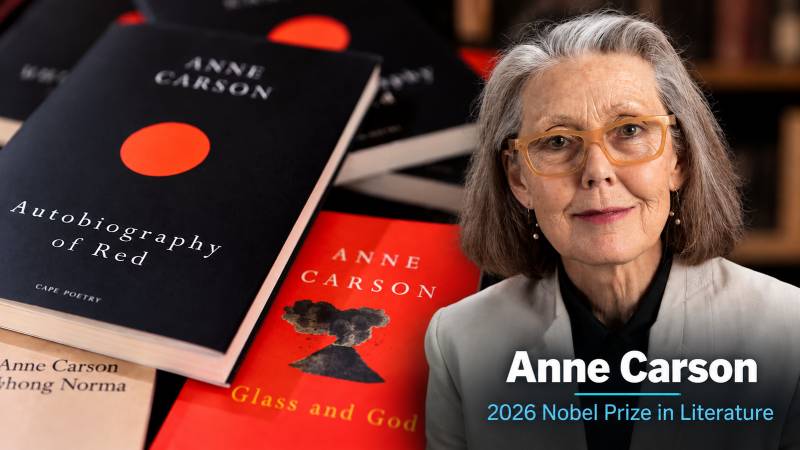
There is a delicious irony in the fact that the 2026 Nobel Prize in Literature has gone to a writer who has spent much of her career refusing to fit comfortably inside any literary category. Anne Carson is called a poet, but many of her poems behave like essays. She is called an essayist, but her essays suddenly become poetry. She is a translator of ancient Greek, yet her translations often seem to acquire lives of their own. She has written verse novels, operatic texts, dramatic adaptations, visual books, criticism and pieces that appear almost deliberately designed to frustrate the librarian who must decide which shelf should receive them. And now Stockholm has supplied the ultimate classification: Nobel laureate. The Swedish Academy awarded the 2026 Literature Prize to the 76-year-old Canadian writer “for her bold and inventive oeuvre” which, through a playful engagement with the classical tradition, has created new forms for contemporary literature.
Carson received the news in Iceland, a place that seems almost suspiciously appropriate for her. The Swedish Academy’s Permanent Secretary Ingrid Carlberg reported that the writer was there “listening to the wind.” Carson herself was rather less ceremonial. Asked how she felt about the Academy’s decision, she reportedly suggested that its members were “all crazy.” She then observed, with characteristic dryness, that at least there would now be a Nobel sticker on the front of her books. For a writer who has spent decades dismantling labels, the world’s most prestigious literary label has finally arrived. It is difficult not to imagine the Greek gods enjoying the joke.
Anne Carson was born in Toronto in 1950. Her encounter with the classical world began unusually early when a teacher agreed to teach her ancient Greek during lunch breaks. It became less an academic subject than an intellectual homeland. She eventually earned a BA, MA and PhD in Classics from the University of Toronto; her 1981 doctoral dissertation bore the wonderfully Carson-like title Odi et Amo Ergo Sum. For decades she taught classics at universities in Canada and the United States, including McGill and the University of Michigan, while simultaneously developing a literary career that made the boundary between scholarship and imagination increasingly difficult to locate. The Swedish Academy’s biobibliographical essay identifies precisely this fusion as central to her achievement: almost everything Carson has written lies somewhere between the philologist’s fascination with words and the poet’s hunger for new meaning. Etymology, she has said, is often where the work begins.
That detail matters, because Carson does not use the ancient world as decoration. Greek mythology is not wallpaper in her books. She enters old texts, moves the furniture around and occasionally knocks down a wall. Sappho, Sophocles, Euripides, Stesichorus and other ancient writers are not treated as museum exhibits preserved behind glass; they become collaborators in contemporary experiments. Her translations include Sappho’s fragments in If Not, Winter, Sophocles’ Electra and Antigone, Euripides’ plays and Bakkhai. The Swedish Academy goes so far as to describe these translations as independent works in their own right. That judgment captures an important feature of Carson’s art: translation for her is not merely transportation from one language to another. It is a form of listening across centuries.
Her first major book, Eros the Bittersweet in 1986, already contained the DNA of much that followed. Beginning from Sappho’s description of desire as simultaneously sweet and bitter, Carson examined eros as a force created by distance: the lover desires precisely because something remains absent, inaccessible or incomplete. Desire requires a gap. Remove the distance entirely and the machinery of longing may stop. It is a compelling idea not merely about love but also about literature itself. We read partly because something remains beyond us. A poem gives and withholds at the same time. Carson would repeatedly return to absence, incompleteness, fragmentation and the strange energy generated by what cannot quite be possessed. The Swedish Academy notes that she often places different voices and historical periods beside one another, producing what she once described as a kind of stereoscopic vision: two perspectives remain active simultaneously rather than one cancelling the other. Thus an ancient Greek poet may suddenly find himself in conversation with Paul Celan, or Thucydides with Virginia Woolf.
Her 1998 Autobiography of Red: A Novel in Verse remains perhaps the most celebrated example of this method. Carson takes Geryon, the red-winged monster of ancient Greek myth whom Herakles kills while completing one of his famous labours, and performs an extraordinary reversal. Instead of concentrating on the hero who kills the monster, she gives the monster a childhood, a camera, a mother, a sexuality, vulnerability and a voice. Her Geryon becomes a sensitive modern young man who falls in love with Herakles—the very figure associated in myth with his destruction. The question beneath the book is both ancient and painfully contemporary: what happens when the person you love possesses the capacity to destroy you? In Carson’s hands, classical mythology becomes a language for sexual awakening, loneliness, power and emotional dependency. The myth survives precisely because she is willing to disobey it.
The Beauty of the Husband, published in 2001, is subtitled “A Fictional Essay in 29 Tangos,” which is probably enough to make an orthodox literary taxonomist request early retirement. It examines a failed marriage in 29 movements, each introduced through John Keats. The sublime language of beauty encounters betrayal, erotic attachment and emotional exhaustion. Carson won the T. S. Eliot Prize for the book, strengthening her reputation as a poet who could combine immense erudition with surprisingly intimate emotional force. The important point is that scholarship in Carson never needs to apologize for emotion, and emotion is never excused from intellectual scrutiny. She can discuss Keats and marital betrayal within the same imaginative space because for her thought and feeling are not enemies.
Perhaps no work demonstrates her treatment of absence more powerfully than Nox, created after the death of her estranged brother Michael in 2000. It hardly resembles a conventional book. Constructed as an accordion-fold sequence of photographs, letters, fragments and text housed in a box, it becomes object, archive, elegy and archaeological excavation at once. Carson’s personal grief is placed alongside Catullus’ ancient elegy for his own dead brother. Two bereavements separated by two thousand years occupy the same imaginative room. Carson does not pretend that the past heals the present; instead, the ancient poem gives grief another echo. Her brother had already been absent from much of her life before death made that absence final. Nox therefore asks a profoundly Carsonian question: how do we write about someone whose absence has itself become part of their presence?
Carson’s career challenges the increasingly rigid partitioning of knowledge. Philology enters poetry, translation becomes original literature, ancient Greek tragedy meets twentieth-century cinema, and literary criticism becomes memoir. She reminds us that tradition and innovation are not opposites; the past becomes sterile only when we preserve it without interrogating it.
This fascination with fragments also explains her attraction to Sappho. Much of Sappho survives only in damaged papyri—lines broken by time, words surrounded by blankness. Many translators attempt to smooth such absences. Carson famously lets the gaps remain visible. There is something almost philosophical in that decision. A missing word is not simply nothing; its absence changes everything around it. Carson’s literature is frequently interested in the border where presence meets disappearance, knowledge meets uncertainty and language approaches what it cannot fully contain. Her recent interviews likewise reveal a writer suspicious of the modern desire for instant linguistic certainty. She has lamented how digital lookup can eliminate the interval during which a reader wanders among possible meanings of a word. For Carson, hesitation is not necessarily intellectual failure. Sometimes uncertainty is where thinking begins.
Her 2019 Norma Jeane Baker of Troy offers another striking demonstration of what the Academy means by her “playful dialogue” with the classical tradition. The work brings together Euripides’ Helen and Marilyn Monroe—born Norma Jeane Baker. On paper the pairing sounds almost mischievous: Helen of Troy meets Hollywood’s most mythologized blonde. Yet Carson recognizes that both women were turned into images desired, blamed and interpreted by others. Both became cultural constructions larger than the women themselves. Ancient myth and twentieth-century celebrity culture suddenly illuminate one another. Carson does not modernize classics by giving Achilles a mobile phone or Medea an Instagram account; her method is more intelligent. She looks for structures of desire, beauty, violence, representation and misunderstanding that persist beneath radically different historical surfaces.
Her formal restlessness has continued. Float arrived as 22 separate booklets that could be read in no prescribed order. Wrong Norma, published in 2024, contains 25 loosely connected pieces accompanied by Carson’s own images. Its subjects leap from Joseph Conrad and Flaubert to Guantánamo, snow, poverty, her father and Saturday night. The National Book Foundation made it a finalist for the 2024 National Book Award for Poetry, while New Directions records that it subsequently won the National Book Critics Circle Award for Poetry. Once again the category itself almost becomes a joke: a book of poetic prose pieces, images, criticism and miscellaneous thought competing in poetry because no better administrative drawer exists.
Yet the later Carson story has acquired a more sombre dimension. She disclosed that she had been diagnosed with Parkinson’s disease, a condition that affected, among other things, her handwriting. Rather than retreating from the subject, she turned it into art and reflection. She began attending boxing classes recommended for people living with Parkinson’s, exercises requiring hand-eye coordination, sequences of movement and deliberate attention. In essays and interviews she has described the strange discipline of forcing the body to perform movements that once required no conscious negotiation. There is something movingly consistent here with the rest of her work. A writer who spent a lifetime paying obsessive attention to language finds herself required to pay equally intense attention to walking, writing, punching, balancing—to the grammar of the body itself.
The Nobel arrives, therefore, not as the discovery of an obscure writer but as recognition of someone literary circles have discussed as a possible laureate for years. Carson had been among the favourites before this year’s announcement, alongside writers including Can Xue and Haruki Murakami. Yet betting markets are a peculiar accompaniment to literature. Somewhere Alfred Nobel might be amused that humanity has created odds on who best embodies literary greatness. Carson herself would probably appreciate the absurdity. She had already accumulated an extraordinary array of honours, including MacArthur and Guggenheim fellowships, the Griffin Poetry Prize, a Lannan Literary Award and the Princess of Asturias Award. The Nobel does not manufacture her reputation; it internationalizes and monumentalizes one that already existed.
Her selection also continues an interesting recent pattern at the Swedish Academy. The prize has increasingly recognized writers whose literary forms are difficult to separate neatly from their philosophical or aesthetic ambitions: Jon Fosse in 2023, Han Kang in 2024, László Krasznahorkai in 2025 and now Carson. The Nobel has always been controversial—Leo Tolstoy, Virginia Woolf and Jorge Luis Borges remain among the gigantic absences from its history—but Carson is unlikely to be criticized for lack of literary seriousness. If anything, the challenge is the opposite. Her writing can be intellectually demanding, allusive and sometimes deliberately resistant to easy consumption. She is not the writer one casually encounters between airport announcements unless one is unusually fond of Sappho, Greek philology and the metaphysics of desire. Yet the Academy’s choice argues that difficulty need not be elitism; sometimes difficulty is the form taken by serious attention.
And perhaps the image with which this Nobel story began is the one with which it should end. Somewhere in Iceland, after Stockholm telephoned, Anne Carson was listening to the wind. It is an oddly perfect occupation for a poet and translator. Wind cannot be held, only heard through what it touches. Literature is not entirely different. Homer, Sappho, Sophocles, Euripides, Catullus, Brontë and Keats passed through Carson’s imagination and emerged sounding both ancient and startlingly new. Now the Nobel Prize has placed its golden seal on that long experiment.
The amusing part is that the seal may finally appear as a sticker on the cover. The important part is what remains beneath it: a body of writing that has spent decades proving that literature does not have to choose between scholarship and imagination, antiquity and modernity, intellect and emotion, poetry and prose. Anne Carson has made a career from standing precisely where one form becomes another. And Stockholm, for once, has rewarded a writer for refusing to stay in her lane.