

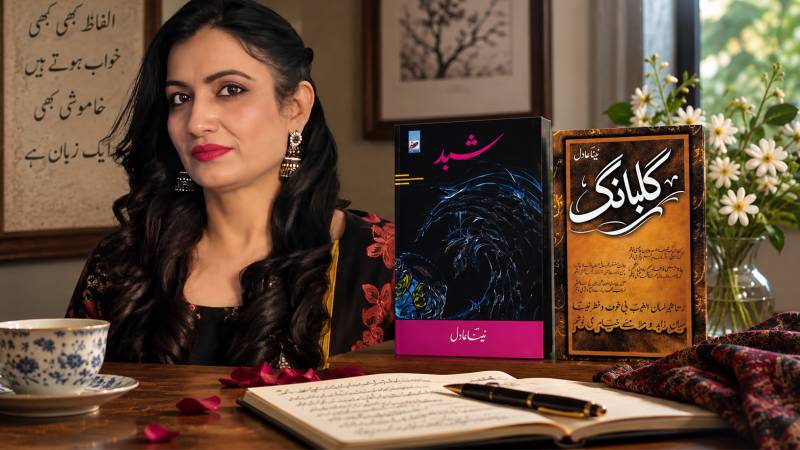
Naina Adil’s poetic identity can best be understood through her two major poetry collections, Shabd and Gul Baang. Published several years apart, the two books belong to the same broad imaginative universe and reveal the persistence of certain fundamental characteristics in her poetry: an intense consciousness of language, sensuous imagery, feminine self-awareness, melancholy, psychological depth, philosophical questioning, musicality, social concern and a continuing fascination with the relationship between expression and silence. Shabd, published in 2018, established Naina Adil as a poet with a distinctive relationship to language and inner experience. Gul Baang, published in 2026, is a considerably substantial collection. It confirms the breadth of her continuing poetic engagement and provides a larger space in which many of the concerns associated with her poetry can be encountered.
The importance of these two books should not, however, be approached merely through comparison. Shabd and Gul Baang are better regarded as two substantial manifestations of the same poetic sensibility. Together they make it possible to identify the general characteristics of Naina Adil’s poetry and to understand the imaginative territory in which she repeatedly works. The title Shabd itself immediately directs attention toward the centrality of the word. The term suggests not only language but the act through which experience acquires expression. Critical discussion of Shabd, particularly by Nasir Abbas Nayyar, has emphasised that Naina Adil does not appear to regard words merely as linguistic instruments. Words in her poetry acquire a kind of independent existence. They carry sensation, memory, associations and emotional possibilities.
This understanding of language remains valuable when approaching Gul Baang. The later title invokes voice, call, resonance and song. Yet it would be too restrictive to treat the titles simply as two stages in a linear progression. More significantly, both names reveal how deeply Naina Adil is concerned with expression itself. Shabd places emphasis upon the word; Gul Baang places emphasis upon its resonance. In both cases poetry is understood as more than description: it becomes a means of discovering and articulating experience. Thus, throughout her poetic work, language itself often becomes part of the subject. The poet is interested not only in what can be said but also in what remains difficult to say. Words may provide liberation, but they may also reveal the inadequacy of language before intense emotional experience. This tension between articulation and silence gives much of her poetry its psychological and philosophical force.
One of the most recognisable characteristics of both Shabd and Gul Baang is the sensuous quality of Naina Adil’s imagination. Her poetry repeatedly draws upon colour, fragrance, rain, water, flowers, wind, darkness, light, roads, walls, dreams and the human body. Such images are rarely decorative accessories. They become vehicles through which inner experience is made perceptible. This tendency was already strongly visible in Shabd. Critical responses to the collection have noted her ability to move naturally between abstract feeling and sensory experience. Emotions are rarely allowed to remain abstract propositions; they become connected with temperature, weather, movement, space, colour and physical sensation.
The larger canvas of Gul Baang permits the same sensuous imagination to operate across a broader range of poetic situations. Its scale with more than a hundred individual pieces suggests that the reader encounters not a single thematic argument but a poetic personality responding to numerous emotional and intellectual occasions. What remains important in both books is the poet’s ability to convert internal experience into external atmosphere. Instead of merely naming sadness, anxiety, love, desire or loneliness, she frequently creates environments in which such feelings appear to inhabit the surrounding world. Nature therefore becomes psychological rather than merely scenic.
Another defining characteristic of Naina Adil’s poetry, visible throughout the critical reception of Shabd and equally relevant to Gul Baang, is the coexistence of beauty and disturbance. Her poetry often employs conventionally beautiful images associated with flowers, fragrance, rain, music and natural surroundings. Yet this beauty rarely exists in complete innocence. Behind tenderness there may be anxiety; behind intimacy, vulnerability; behind fragrance, disappearance; behind memory, loss. For this reason Naina Adil cannot satisfactorily be described simply as a romantic poet. Her lyricism frequently carries an element of unease. The attractive image becomes more powerful because something threatens it. Beauty appears temporary, fragile or endangered.
The earlier critical discussion of Shabd recognised precisely this combination. Her language was described as soft, musical and fragrant, yet the same poetic world contained wounds, psychological disturbance, anger and social consciousness. Gul Baang can also be situated within this characteristic imaginative territory. Its title itself possesses lyrical associations, yet the collection should not be understood as a book of uncomplicated song or beauty. The resonant quality suggested by Gul Baang allows tenderness, confession, invocation, protest and emotional intensity to coexist within the same poetic field.
The feminine voice constitutes one of the most important dimensions of Naina Adil’s poetry. Shabd attracted substantial critical attention precisely because of its engagement with women’s freedom, domestic and social confinement, repression, violation, emotional autonomy and the need for self-expression. Yet the feminine consciousness in Shabd should not be reduced to straightforward ideological poetry. Naina Adil’s woman is not simply a literary symbol of oppression. She thinks, desires, remembers, loves, suffers, questions and resists. Womanhood becomes a mode of experiencing the world rather than merely a subject to be discussed.
Across these books, Naina Adil emerges as a poet of inward experience who remains alert to the world outside the self; a poet of femininity whose concerns extend toward universal human vulnerability; a poet attracted to beauty but equally conscious of its fragility; and a poet whose accessible language often conceals complex psychological and philosophical depths.
The same perspective remains useful in approaching Gul Baang. A mature feminine voice need not continually announce its legitimacy. It can simply speak from within its own experience. For that reason, femininity in Naina Adil’s poetry often appears most effectively when it emerges naturally from emotional, psychological or social situations rather than from explicit declaration. This also explains the range of critical interpretations surrounding Shabd. Some critics have foregrounded its feminist dimensions, while Khalid Javed has cautioned against reducing Naina Adil’s poetry to programmatic feminism, arguing that her poetic experience eventually reaches the broader level of human existence. The same balance is important for Gul Baang. Gender remains significant, but it does not exhaust the poetry. The female self can become the point from which larger questions of dignity, freedom, loneliness, memory, power and mortality are explored.
Melancholy is another major characteristic connecting the poetic worlds of Shabd and Gul Baang. Naina Adil’s poetry frequently inhabits emotional territories associated with absence, separation, disappointment, anxiety, unfulfilled longing and memory. In discussions of Shabd, sadness has been described not as ornamental sorrow but as an organising emotional element. It enters the atmosphere of the poems and shapes their perception of relationships, objects and surroundings. This melancholy is significant because it rarely remains simple lamentation. It often becomes a form of heightened perception. The wounded consciousness notices more, remembers more and questions more. Sadness therefore contributes directly to the reflective and philosophical character of the poetry.
Within Gul Baang, this inwardness belongs to a larger poetic canvas. The number and variety of compositions allow a range of moods, but the contemplative and psychologically sensitive voice associated with Naina Adil remains central to understanding the collection. Both Shabd and Gul Baang reveal a poet strongly attracted to the hidden movements of consciousness. The external event matters, but its psychological aftermath often matters more. For Naina Adil, physical realities can quickly acquire psychological significance. Enclosure can become emotional imprisonment; distance can signify estrangement; silence can represent either suppression or withdrawal; memory can simultaneously preserve and disturb. This quality gives her poetry an inward, reflective character. Her speakers frequently seem to exist between the visible and invisible worlds: outwardly located within ordinary social reality while inwardly experiencing memory, fear, longing or conflict. This psychological dimension is particularly important because Naina Adil’s literary career has not been confined to poetry. Between Shabd and Gul Baang, she also developed substantially as a fiction writer, producing Muqaddas Gunah and Kokh. Her fiction engages with psychology, memory, trauma, family and social expectations.
Although both Shabd and Gul Baang are strongly inward in orientation, Naina Adil’s poetry is not detached from social reality. Shabd already demonstrated concern with freedom, repression, social violence, gender relations and the anxieties of urban existence. Critical discussion of the collection has particularly noted her ability to make the city and social environment part of the emotional consciousness of the poem. The importance of this element is that social commentary does not necessarily appear as direct political declaration. Public realities often enter poetry through their effects upon the private self. Social fear becomes personal anxiety; political boundaries acquire psychological meanings; gendered restrictions become questions of dignity and freedom. This interaction between the individual and society remains central to understanding the broader poetic sensibility represented by Gul Baang as well. A voice does not exist in isolation; it implies an audience, a surrounding world and the possibility of being heard or ignored. In this sense the title Gul Baang carries social as well as lyrical possibilities.
Throughout Naina Adil’s poetry there is a recurring tension between enclosure and freedom. This is particularly noticeable in critical readings of Shabd, where physical, domestic and geographical boundaries often acquire symbolic meaning. Such boundaries may be social, emotional, political or psychological. Against them stands the desire to speak, move, imagine and retain individual identity. This tension also gives Gul Baang particular significance within her poetic oeuvre. The notion of voice itself carries the possibility of overcoming silence. Yet resistance in Naina Adil’s poetry should not be understood only in overtly political terms. Remembering can be resistance. Preserving individuality can be resistance. Naming an experience that society prefers to leave unspoken can be resistance.
Poetry thus becomes a domain in which the private self can reclaim authority over its own experience. Perhaps the most inclusive description of Naina Adil’s poetic personality, taking both Shabd and Gul Baang into account, is that she is a poet of thresholds. Her poetry repeatedly occupies the uncertain spaces between word and silence, beauty and pain, freedom and confinement, memory and forgetting, woman and society, private consciousness and public reality, desire and absence, dream and awakening. The critical reception of Shabd already identified many of these characteristics: Nasir Abbas Nayyar emphasised the independent imaginative life of the word; Khalid Javed stressed mystery, silence and existential experience; other critics foregrounded femininity, sensuous imagery, freedom and social awareness.
Gul Baang should be located within this broader poetic identity. Its importance lies not simply in being a later collection but in enlarging the available body of poetry through which Naina Adil’s characteristic concerns can be observed. Its 115 pieces provide a substantial field for the continued exploration of language, emotion, gender, psychological experience, society and the complex relationship between beauty and suffering. Taken together, Shabd and Gul Baang establish Naina Adil as a poet whose work is characterised by sensuous imagery, psychological inwardness, feminine consciousness, melancholy, philosophical questioning, social awareness and a persistent fascination with language itself.
Shabd remains particularly important because it established the central place of the word within her poetic imagination. It revealed a poet intensely conscious of language, silence, emotional vulnerability and the possibilities of expression. Gul Baang, in turn, significantly enlarges her poetic corpus. Its scale and range allow the reader to encounter the same broad poetic temperament across a more extensive field of experience. The title itself draws attention to resonance, voice and the audible presence of poetic expression, but the collection remains rooted in the larger imaginative concerns that define Naina Adil as a poet. Neither collection should therefore be reduced to a single label. Shabd is not merely a collection about language, just as Gul Baang is not merely a collection about voice. Both participate in a larger poetic inquiry into what happens when human experience seeks expression.
Across these books, Naina Adil emerges as a poet of inward experience who remains alert to the world outside the self; a poet of femininity whose concerns extend toward universal human vulnerability; a poet attracted to beauty but equally conscious of its fragility; and a poet whose accessible language often conceals complex psychological and philosophical depths. The essential character of her poetry lies precisely in these intersections. Shabd and Gul Baang together reveal a poetic imagination in which word, voice, silence, memory, femininity, beauty, suffering and freedom continually encounter one another. That sustained interaction, rather than any isolated theme, forms the distinctive character of Naina Adil’s poetry.