

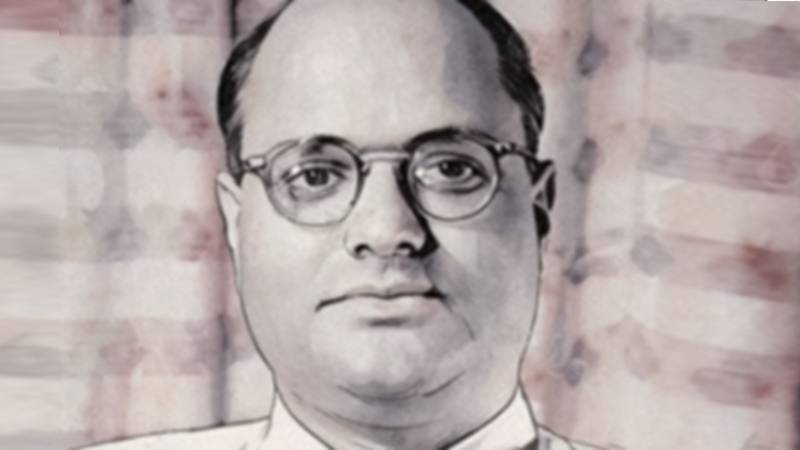
Before him, Urdu poetry was dominated by traditional ghazals. It was beautiful, but it was also strictly bound by rigid rules of meter and rhyme, often trapped within a familiar set of metaphors. Nazar Muhammad Rashid, famously Noon Meem, abandoned them entirely.
As the pioneering father of modernism in Urdu literature, he adopted the Azad Nazm (free verse), pulling the language out of courts and thrusting it into the 20th century.
Making a Modernist
Rashid was born on the 1st of August 1910, in the small village of Kot Bhaaga in Alipur Chatha, Punjab. He didn't come from a family of radical bohemians. His father, Fazal Ilahi Chishti, was an education inspector and a scholar with a deep love for classical Urdu and Persian poetry, especially the works of Ghalib. Growing up, Rashid was steeped in this classical tradition.
A bright student, he eventually enrolled at Government College in Lahore, where he pursued a Master's degree in Economics while immersing himself in English literature, history, and Persian. He was reading John Keats, Robert Browning, and Matthew Arnold, but he was thinking and writing in Urdu.
At that time, the Progressive Writers' Movement was gaining massive traction across the subcontinent. Writers were actively using literature as a tool for social change, rallying against British imperialism and class inequality. While Rashid shared many of their anti-imperialist views, he remained an outsider.
The Progressives often viewed literature through a Marxist lens. For Rashid, the human experience was too complicated and too deeply psychological to be reduced entirely to economic struggles. He was as fascinated by the individual's inner neuroses as he was by the outer political world.
In 1940, Rashid published his first collection of poetry, Mavra (Beyond). The book came to be considered scandalous.
While a few poets had experimented with free verse before, Rashid committed to it fully. He proved that Urdu poetry didn't need a strict, repeating rhyme scheme to retain musicality. Instead, he relied on the internal rhythm of words, stretching and contracting his lines to match the emotional breath of the poem.
Mavra explored themes that were considered highly taboo for the era. Rashid wrote about physical desires, psychological repression, and the frustrations of the modern man. He wasn't writing about abstract, idealized romance. His topics were flesh, blood, and the anxiety of intimacy.
Traditional critics dismissed the book, claiming it lacked the discipline of "real" poetry. But the younger generation, already feeling suffocated by colonial rule and rigid societal norms, saw it as representing them. Rashid had given them a new vocabulary!
A Stranger in the World
After working for All India Radio and serving briefly in the Royal Indian Army during World War II, Rashid built a career as a diplomat and public relations officer, eventually joining the United Nations. His work took him to New York, Jakarta, Ceylon (Sri Lanka), and Tehran.
This global exposure profoundly influenced his second collection, Iran Mein Ajnabi (A Stranger in Iran), published in 1955. Here, the lens pulls back. The poetry becomes less about individual angst and more about the collective despair of the Third World. He writes about the illusion of post-colonial freedom, warning that departing European empires were simply being replaced by new, invisible structures of control and neo-imperialism.
Rashid treated Urdu as an acoustic instrument - his lines cascade and build up like a symphony
His later collections, La=Insan (Nothingness = Man) published in 1969, and the posthumously published Guman Ka Mumkin (The Possible of Speculation) in 1976, dive straight into existentialism. In these works, Rashid grapples with the silence of the universe, the concept of nothingness, and the heavy burden of human consciousness. He keeps on asking what it means to be human in a world devoid of inherent meaning.
One of his most complex works from this mature period is the long poem Hasan Kuzagar (Hasan the Potter). It is delivered as a dramatic monologue, and tells the story of a Baghdad potter who falls madly in love with a woman named Jahanzad. It is a remarkable exploration of the tension between the creative process, obsessive love, and the relentless passage of time. Through Hasan, Rashid explores how passion can simultaneously fuel and destroy art.
“Tu chahay to main phir palat jaun un apne mahjoor kuzon ki janib, Gul-o-la ke sukhe tagharon ki janib,
Ma'eeshat ke, izhaar-e-fan ke saharon ki janib; Keh main is gul-o-la se, is rang-o-roghan...
...se phir woh sharare nikalun keh jin se, Dilon ke kharabe hon roshan!”
(If you wish, I will turn back again toward my forsaken clay pots,
Toward those dried-up troughs of mud and clay,
Toward the pillars of my livelihood and the expression of my art;
So that from this mud and clay, from these colors and glazes,
I may once again extract those sparks,
That will illuminate the ruins of hearts!)
NM Rashid is using the potter's wheel as a metaphor for the artist's burden. The poem suggests that while romantic love is overpowering, the highest calling of an artist is to use their craft to heal, inspire, and illuminate humanity. The clay is ordinary, but the artist's touch turns it into light.
Architect of Sound
For all his modernism, Noon Meem Rashid is not an easy poet to read. He never pandered to the masses. Over the decades, his vocabulary became heavily Persianized, his metaphors dense, and his allusions complex. He treated Urdu as an acoustic instrument, employing a unique, catalectic form of classical meters (such as the hazaj meter) to create a hypnotic, undulating rhythm.
Reading Rashid aloud is an entirely different experience from reading him quietly on the page. His lines cascade and build up like a symphony, full of majestic, rolling syllables, and then suddenly drop into sharp, stark truths.
This complexity is perhaps why he didn't achieve the same street-level fame as his contemporary, Faiz Ahmed Faiz.
Faiz used traditional forms and familiar romantic metaphors to sing about revolution, making his work deeply accessible and universally beloved. Rashid, on the other hand, demanded that his readers climb up to his level. He required patience, a dictionary, and a willingness to confront uncomfortable ideas.
Mainstream Resurgence
Despite his reputation for difficulty, Rashid's core messages are deeply humane and universal. In 2010, the indie Bollywood film Peepli Live unexpectedly introduced Rashid to an entirely new, younger generation. The film's soundtrack featured a raw, rock-infused rendition of his poem "Zindagi Se Darte Ho" (Are You Afraid of Life?), brilliantly performed by the band Indian Ocean.
The poem is a perfect encapsulation of his philosophy. It is a direct address to those paralyzed by the fear of the unknown, the fear of speaking out, and the fear of living fully:
“Zindagi se darte ho? / Zindagi to tum bhi ho, zindagi to hum bhi hain.
Aadmi se darte ho? / Aadmi to tum bhi ho, aadmi to hum bhi hain.”
(Are you afraid of life? You are life too, and so are we.
Are you afraid of man? You are a man too, and so are we.)
The poem reminds us that the forces we fear are made of the exact same fabric as we are. It is a cry against self-censorship and existential cowardice.
Final Rebellion
Rashid was a man who lived strictly on his own terms, and he made sure he died on them, too. After retiring, he settled in England. On the 9th of October 1975, he passed away in a London hospital at the age of 65. But even in death, he managed to shock the conservative society he had left behind.
In his will, Rashid had explicitly requested to be cremated rather than buried. This was a direct contradiction of traditional Islamic burial rites. His family honored his wishes, and his body was cremated. When the news reached Pakistan and the broader Urdu literary world, it caused an absolute uproar. Clerics condemned him, of course, but even some of his liberal peers were taken aback. For a time, there was an effort by conservative critics and segments of the literary establishment to sideline his legacy.
The cremation controversy, in a way, was his final, silent poem. It was a refusal to be bound by the rituals, dogmas, and expectations of a society that he had spent his entire life questioning.
Today, he is no longer seen simply as a provocateur, but as a visionary who saw the limitations of Urdu poetry and expanded them by force. It may be said that he gave the language the elasticity that it needed to survive the modern era.