

Travel is easy to undertake, convenient to describe, difficult to write, and harder still to write well about. Anyone can recount a journey. Few can turn a journey into literature that changes the way we see the world.
Today, faster transport shortens distances. Digital communication keeps travellers connected across countries and cultures. Longer life expectancy gives people more time to explore. More journeys now find their way into print. Yet greater mobility has not produced better travel writing. Much contemporary travel writing follows the itinerary: where the writer went, what they saw, where they stayed, and what they ate. In the rush, streets become routes, villages become destinations, buildings become attractions, and people become background figures. Their memories, routines, struggles, and ties to place disappear from view. The writer records the landscape but misses the society within it.
Seasoned travel writers observe before they explain and listen before they judge. They notice gestures, silences, routines, conversations, and small acts. These details show how people live. A road can carry a childhood memory. A market can preserve an old relationship. A ruined building can open a forgotten chapter of history. A landscape can hold traces of migration, labour, loss, and belonging. There is a long tradition of fine travel writers whose work offers much to aspiring anthropologists. In this essay, I focus on three: Paul Theroux, Amitav Ghosh, and William Dalrymple. Their work shows how travel writing can move beyond describing places to deepen our understanding of people and society. Theroux sharpens the art of observation. Ghosh brings people and their lives into focus. Dalrymple uncovers the social history held in places.
Paul Theroux and the Art of Observation
Let me begin with gratitude. I owe my first encounter with Paul Theroux to Abdul Qadir Junejo, the celebrated Sindhi fiction writer and dramatist who became widely known in the 1980s for his Urdu television dramas, Deewarein and Karwan.
I still remember Junejo sitting at Aga Rafique’s official residence in the Sindh University Employees Residential Colony. He held a cigarette between his fingers and spoke in his distinctive, unhurried style. At the time, Aga Rafique taught in the Department of Mass Communication at the University of Sindh and lived on campus. During one of those conversations, Junejo spoke at length about Paul Theroux, his novels, and his travel writing. It was the first time I heard the name.
In the rush of contemporary travel writing, streets become mere routes and villages become destinations – the writer records the landscape but entirely misses the society within it
I listened carefully. Something in Junejo’s conversation stayed with me. His storytelling had its own rhythm. He did not simply discuss books; he connected what he read with travel, people, places, and everyday experience. As he moved from one subject to another, his own experiences entered the conversation. That evening, I became curious about Theroux.
Now, while writing this piece, I ask myself why that conversation affected me so deeply. I cannot give a definite answer. Perhaps it was Junejo’s way of speaking. Perhaps it was the way he connected literature with ordinary life. Or he made Theroux sound like a writer worth following, not sure.
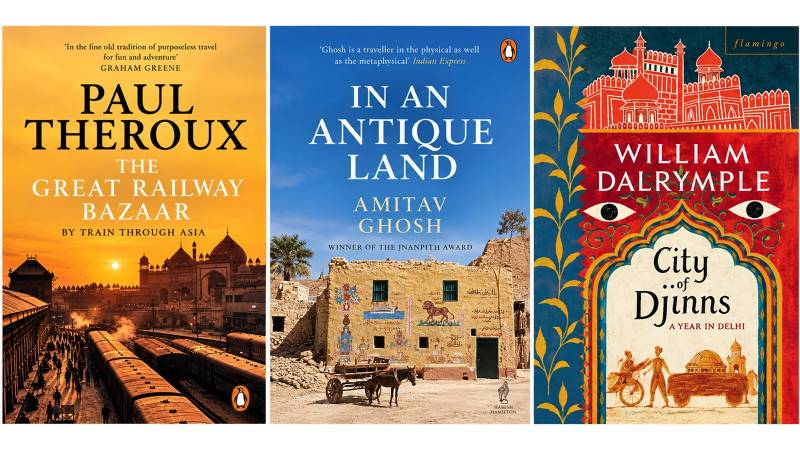
Whatever the reason, I began reading Theroux. Over time, I read several of his books. Among them, The Great Railway Bazaar: By Train Through Asia left the strongest impression on me. Before turning to the book, however, it is useful to introduce its author.
Paul Theroux is an American novelist and travel writer known for his sharp observations of people and places. He lived and worked in several countries, including Malawi, Uganda, Singapore, and England. Those experiences broadened his understanding of different societies and deepened his interest in travel. Trains, in particular, became central to his imagination.
In 1973, Theroux set out from London’s Victoria Station on a long journey across Europe and Asia. He travelled east by train through Europe, the Middle East, the Indian subcontinent, and Southeast Asia before reaching Tokyo. He then returned through the Soviet Union on the Trans-Siberian Railway. The journey lasted about four months. He planned much of it with railway timetables and maps.
The railway already held a powerful place in the history of travel. The original Orient Express began service in 1883 and connected Western Europe with Constantinople, now Istanbul. It offered more than transportation. It linked distant regions and cultures and became a symbol of long-distance travel between Europe and Asia. By the time Theroux began his journey, however, the original service had changed, and the name Orient Express referred to different routes and services.
His journey became the basis of The Great Railway Bazaar. The book’s importance lies not simply in the distance Theroux covered, but in how he turned a journey into close observation.
He watched stations, streets, landscapes, trains, food, conversations, gestures, and faces. He noticed how passengers sat, ate, slept, talked, waited, argued, and shared space. He caught details that another traveller might have missed. A railway carriage became a small social world. A station became a meeting point for strangers. Food suggested habits. Conversations exposed attitudes. Landscapes hinted at history, migration, economic change, and social life.
Theroux did not wait for dramatic events. He found material in ordinary moments. He watched people move through their daily routines and paid attention to their habits, reactions, and relationships. His observations turned passing encounters into scenes with social meaning.
The train became his moving field site. He observed people at close quarters, entered conversations, and followed relationships as they developed during the journey. The railway was not merely the route he travelled. It became the setting in which different lives unfolded before him.

I remember reading Salman Rashid’s 2016 article, “The Line They Forgot,” in which he described how The Great Railway Bazaar inspired him to undertake his own “Little Railway Bazaar.” The connection stayed with me. One travel book had prompted another journey and another piece of writing.
The Great Railway Bazaar was first published in 1975 by Houghton Mifflin in the United States, with the British edition appearing the same year through Hamish Hamilton. More than fifty years later, the book still matters because it shows how a traveller can turn a journey into meaningful writing.
An anthropologist can draw a clear lesson from Theroux’s method. Observation begins with attention. Notice what people do, how they move, what they eat, where they gather, what they discuss, and how they relate to one another. Then ask what these details reveal about the social world around them.
Amitav Ghosh and the Portrayal of People
I have followed Bengal studies since my university days. Its cultural consciousness, attachment to the mother tongue, and strong academic tradition in the subcontinent have long attracted me.
I first came across Amitav Ghosh’s name in 2013, while reading Jhumpa Lahiri’s The Lowland. I finished the novel but soon moved on. Three years later, Ghosh’s novel, The Hungry Tide, accompanied me to Zero Point in Badin, Kharochhan, and Shah Bandar, the coastal towns of Sindh. Set in the Sundarbans, a vast mangrove delta shaped by rivers, tides, and forests, the novel follows people whose lives are closely tied to the changing ecology of the Bengal Delta. I still remember reading the book in the cool, salt-laden breeze of the Indus Delta, where the Indus River meets the sea through tidal creeks, muddy banks, and scattered villages.
Ghosh is an Indian novelist whose work crosses literature, history, anthropology, and travel. His training in social anthropology at the University of Delhi and his doctoral work at Oxford further shaped his attention to people, places, memory, and history.
The idea for In an Antique Land grew out of Ghosh’s anthropological fieldwork in Egypt in the early 1980s. He lived in villages, learned Arabic, listened to conversations, observed daily routines, and entered the homes and social worlds of ordinary people. During this work, he encountered documents from the Cairo Geniza that referred to Abraham Ben Yiju, a Jewish merchant who travelled from Tunisia to India in the eleventh century and lived for years in Mangalore. The discovery opened a new path. Ghosh began tracing Ben Yiju through documents, places, and memories, linking the merchant’s story to the wider history of the Indian Ocean.
Years later, Ghosh returned to Egypt and met people he had known during his fieldwork. Their lives and villages had changed, as had the political world around them. He brought these changes into conversation with the older history preserved in the Geniza. In an Antique Land grew from this encounter between fieldwork and archival discovery, between the lives of ordinary people and the movements of a much older world.
The result was In an Antique Land, published in 1992 by Ravi Dayal Publisher in India and later by Granta Books in the United Kingdom. The book moves between the eleventh and twentieth centuries, India and Egypt, archival documents and village life. Through the story of Abraham Ben Yiju, Ghosh connects a forgotten Indian Ocean history with the lives and experiences of the people he encountered in Egypt.
His method offers anthropologists a clear lesson: treat everyday life as evidence and follow its connections to the wider history of people and places.
William Dalrymple and Social History
I remember that I began writing for The Friday Times in Lahore in 2019. I wanted to develop a style that felt distinctly my own. To find that voice, I read widely across various fiction and non-fiction genres.
One day, during a long-distance call from Malaysia to Karachi, I spoke with my friend Irfan Ahmed Khan. Among our circle of friends, he is perhaps the most widely read and thoughtful. He argues carefully and rarely offers an opinion without considering it closely. During that conversation, he introduced me to William Dalrymple. The first Dalrymple book I read was City of Djinns: A Year in Delhi.
William Dalrymple is a Scottish historian, writer, and broadcaster whose work brings history to life through people, places, buildings, and personal stories. His fascination with Delhi began when he first visited India in 1984, at the age of eighteen. The city immediately struck him as a place where different periods of history existed side by side.
Dalrymple returned to Delhi a few years later, after completing his studies at Cambridge. At twenty-two, he decided to stay and explore the city more closely. He rented a house, walked through its neighbourhoods, visited monuments and ruins, met residents, listened to their stories, and followed traces of the past. He also turned to historical records and archival sources. These encounters eventually formed the basis of City of Djinns: A Year in Delhi.
Dalrymple did not approach Delhi as a conventional historian. He entered its history through the people who inhabited it. He met priests, caretakers, artists, historians, shopkeepers, officials, and ordinary residents. Their memories led him beyond monuments and into the social life of the city. Streets, mosques, temples, tombs, gardens, markets, and old houses became evidence of a changing Delhi.
The title invokes the djinns of Delhi’s popular beliefs and legends, but it also captures the city’s many historical layers. Ruins and memories surrounded its inhabitants. The past had not vanished. It continued to shape everyday life.
Dalrymple shows how a ruined tomb can reveal an earlier world. An old house can open a family history. A conversation can reveal social change. A local legend can preserve a forgotten memory. A street can show how a city grew.
In 1993, HarperCollins in the United Kingdom first published City of Djinns: A Year in Delhi. More than three decades after its publication, it remains valuable for the way it brings people, place, and history together.
Dalrymple’s method offers anthropologists a simple lesson: read a place through its people and traces. Walk its streets. Listen to its people. Observe its buildings. Follow local stories. Search the archives. Such details can reveal histories missing from official records.
What Masters’ Books Offer
Paul Theroux, in The Great Railway Bazaar: By Train Through Asia, teaches the value of close observation. He notices the small details of travel, such as stations, trains, food, gestures, and conversations, and turns fleeting encounters into revealing scenes of social life.
Amitav Ghosh, in In an Antique Land, moves from encounters with people to the worlds they carry with them. Memories, relationships, customs, and histories connect the lives he encounters to the wider movements of the Indian Ocean world.
William Dalrymple, in City of Djinns: A Year in Delhi, reads a city through its layers of history. Buildings, archives, family stories, local legends, and streets become clues to a past that still shapes the present.
Together, these three writers offer anthropologists three ways of approaching a place: observe its details, understand its people, and uncover its history. Their lesson is simple: look beyond what is immediately visible and follow the clues that lead to the larger world.