

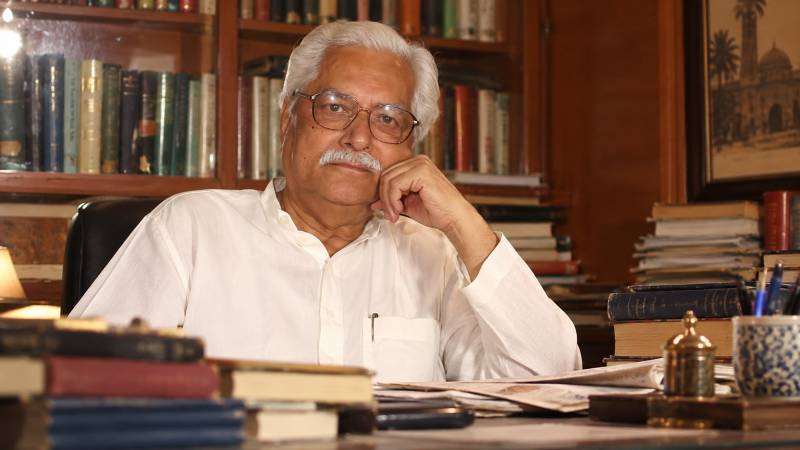
Siraj ul Haq Memon, popularly known as Siraj, was a writer, journalist, linguist, lawyer and intellectual whose work helped expand the possibilities of Sindhi as a language of literature, scholarship and public debate. His contributions spanned fiction, translation, journalism and linguistics, reflecting a sustained engagement with Sindh’s cultural identity and intellectual history.
Born on 24 October 1933 in Tando Jam, near Hyderabad, Siraj was influenced by his father, Muhammad Yaqub “Niaz” Memon, a primary schoolteacher with a deep interest in literature. His father’s translation of Diwan-e-Hafiz held an important place in Sindhi literature and helped nurture Siraj’s early interest in reading and writing. After completing his primary education in his hometown, Siraj attended Noor Muhammad High School, where he secured third position in the university matriculation examination. He subsequently earned a BA (Honours), an MA in Economics and an LLB.
According to Shaikh Aziz, Siraj moved to Karachi in 1950 after matriculation. While studying at DJ National College, he worked part-time as a sub-editor at the weekly Sindh Observer to support his education and boarding expenses. He later returned to Hyderabad and worked at the printing press of Mohammad Usman Deplai, initially proofreading manuscripts before being entrusted with translations. Among these were Cheen Mein Hariyan Khe Zamin Keean Milee (How Did the Farmers in China Get Land?) and Dakhhan Maan Tho Sij Ubhray (The Sun Rises from the South). At Deplai’s initiative, he also translated Insan aen Insaniat jee Tareekh (The History of Humanity).
The printing press brought Siraj into contact with prominent Sindhi writers. In 1953, intellectual Muhammad Ibrahim Joyo facilitated his employment at the Sindhi Adabi Board, where he became assistant secretary in 1955. Two years later, Siraj passed the competitive examination for the Central Superior Services and joined the Income Tax Department. His civil service career ended abruptly in 1969, when General Yahya Khan retired him along with 303 other senior officers. Recalling the circumstances, Siraj wrote that propaganda against him had prompted investigations by the Criminal Investigation Department and the Bureau of Intelligence, whose reports ultimately cost him his job. He subsequently established a legal practice specialising in taxation. According to his younger sister, scholar Dr Fahmida Hussain, he became known as an “Encyclopedia of Income Tax Law”.
Siraj’s return to journalism brought him into the political and cultural ferment of the era. Zulfikar Ali Bhutto, who knew him personally, invited him to become chief editor of Hilal-e-Pakistan after the newspaper’s publication moved from Hyderabad to Karachi. Siraj described the demands of the job in characteristically direct terms: “I was Chief Editor, the Chief Reporter, the Chief Publisher and even the chief Paster to make up a page ready for printing.” He wrote editorials, humorous columns, reports on the lives of Sindhi people and accounts of his travels abroad with Bhutto, often working more than eighteen hours a day.
According to Shaikh Aziz, Siraj introduced greater emphasis on objective reporting and constructive criticism, while also modernising the gossip column. His editorial work helped establish new standards in Sindhi journalism, bringing literary sensibility to the coverage of public affairs. His literary career was equally expansive. His first short-story collection, Aey Dard Hali Aao (Come, O Pain), appeared in 1961, followed by Uthoon Manhoon (The Eighth Person) in 1985. His fiction explored human experience and the social realities of Sindh. He also wrote the historical novel Paarado Soee Sad (The Echo Is Call), published in 1979, which depicts the oppressive period of Arghun and Tarkhan rule, and Marann Moon San Aa (Rendezvous with Death), published in 1988. Siraj’s three-novel series, collectively titled Piyasi Dharti Ramandaa Baadal (Parched Earth and Wandering Clouds), comprised Munhinji Dunya Mirg Trishna (My World: A Mirage), Munhinji Dunya Haikyal Viyaakal (My World: Lonely and Restless) and Tuhinji Dunya Sab Rang Sanwal (Your World Is Full of Colours, Sanwal). His son, Dr Amjad Siraj, translated his novels into English, making them accessible to a wider readership.
Writing under the pen name “Bismil” early in his career, Siraj also produced poetry and plays. His free-verse poem Karachi holds historical significance for its engagement with the city’s separation from Sindh and placement under federal administration in the early 1950s. His poetry and plays were collected in Tunhji Tand Tanwar, published in 2015. His essays, reviews, literary profiles and travelogues were subsequently collected in volumes including Daahip an Daat jee Laat, Moon ja Sirji Sit, Dosti jo Safar and Shah Latif ji Aafaaqiat.
Translation was another important dimension of his work. He collaborated with Ghulam Rabbani on Choond Amerikee Mukhhtasir Afsanna (Selected American Short Stories), translated Charles and Mary Lamb’s Tales from Shakespeare, and rendered Dr S. P. Chhablani’s Economic Conditions in Sindh, 1595–1843 into Sindhi as Sindh Ji Iqtisadi Tareekh. He also translated Oliver Goldsmith’s She Stoops to Conquer and Richard Brinsley Sheridan’s The School for Scandal for the Sindhi Adabi Board.
Perhaps his most significant contribution to linguistic scholarship was Sindhi Boli (The Sindhi Language), published in 1964 and recognised by the Pakistan Writers Guild. The work challenged established assumptions about Sindhi and contributed to wider debates about the language’s origins and development. Siraj received several honours, including the Sitara-i-Imtiaz in 2011. He died of a heart attack at Karachi’s National Medical Centre on 2 February 2013 and was buried at Gizri Cemetery two days later.
Siraj’s legacy lies not simply in the number of books he wrote or translated, but in his effort to establish Sindhi as a medium for modern intellectual inquiry. Through fiction, journalism and linguistic scholarship, he connected questions of language and cultural identity with history, politics and public life. His career demonstrated that a regional language could serve not only as a repository of cultural memory but also as a vehicle for intellectual experimentation and debate. That enduring contribution secures his place in the cultural and intellectual history of Sindh. His career also reflected the tensions between language, cultural identity and political authority in Pakistan. For Siraj, Sindhi was not merely a means of preserving inherited traditions; it was a language capable of engaging with modern scholarship, political thought and social change. At a time when debates over provincial autonomy and cultural recognition remained central to Sindh’s political life, his insistence on the intellectual possibilities of the language carried significance beyond literature. His legacy, therefore, lies as much in expanding the scope of what Sindhi could express as in the body of work he left behind.