

Several tombs erected during the Kalhora period (1700–1783) and Talpur period (1783–1843) depict folk tales of Sasui and Punhun, Suhni and Mehar, Leela and Chanesar, Laila and Majnun, Moomal and Rano, Umar and Marvi, Nuri and Jam Tamachi, Safal Muluk wa Badhi al-Jamal, and Sorath-Rai Dyach and Bijal. These folk tales appear in the Jamali and Chandia tombs in Kamber-Shahdadkot district; the Talpur, Kalhora, Muridani Jamali, Qalandarani Laghari, Rodnani, and Shahani tombs in Dadu district; the Abra tombs in Nawabshah; and the Marri tombs in Sanghar district.
The earliest representations of folk romances appear in the tombs of Mian Nasir Muhammad Kalhoro and Mir Allahyar Khan Talpur in Dadu district.
The Lost Jamali Tombs
Paintings depicting the folktale of Sorath, Rai Dyach, and Bijal appear in many tombs dating to the Kalhora period (1700–1783). Notable examples include the Jamali tombs, where the walls were richly painted with scenes from folk romances, battles, and everyday social life in eighteenth-century Sindh. The tombs were believed to have been built during the Kalhora period (1700–1783), and some of the dignitaries buried there are said to have served the Kalhora rulers.
Folk legends, the main source of entertainment for the rural population, survived on the walls of Kalhora, Talpur, and even colonial-era funerary monuments as wall paintings
I first visited the Jamali tombs in 2002 with the late Comrade Wali Muhammad Manghanhar, journalist and historian from Shahdadkot. I returned to the site in 2004, 2005, 2006, 2007, and 2009 to study and document the paintings. Unfortunately, these historic tombs collapsed during the devastating floods of 2010. The photographs and field notes recorded during these earlier visits therefore preserve valuable evidence of a painted funerary tradition that has since been lost.
Art, Society and Folklore in Rural Sindh
In recent years, funerary monuments in rural Sindh have attracted more attention from interested segments of society. The distinctive feature of these structures was mural paintings that represented the social history of eighteenth- and nineteenth-century Sindh. Folk legends, the main source of entertainment for the rural population, survived on the walls of Kalhora, Talpur, and even colonial-era funerary monuments as wall paintings. These figural tomb paintings reflected liberal, secular rulers who allowed this art to flourish.
Alongside the better-known urban centres, several rural centres of folk painting flourished in Sindh during the eighteenth century. Artists working in these settings drew much of their imagery from the world around them, painting folk romances, battles, ceremonies, and scenes of rural life on the walls of tombs. The Garhi Centre in Dadu was particularly notable in this regard. Its painters portrayed episodes connected with the socio-political history of the Kalhoras, while also offering glimpses into the period's cultural life. Musical instruments, dance performances, folk legends, rituals, and customs appear alongside battle scenes and depictions of everyday rural life.
These murals provide a visual record of how artists observed and represented the society in which they lived. Sindh has a rich tradition of folklore, including myths, legends, ballads, folk tales, riddles, and proverbs. But folk tales dominate people's social life and remain a principal form of entertainment and education for a large proportion of Sindh's inhabitants.
Folk tales also influenced poets, folk storytellers, and painters alike, who expressed their feelings through poetry and paintings. One such legend that inspired folk painters was the story of Sorath, Rai Dyach, and Bijal.
The Legend of Generosity and Sacrifice
According to legend, Rai Dyach was the generous ruler of Jhunagarh, celebrated for never turning away anyone who sought his favour. His fate became entwined with that of Bijal, his sister’s son, who had been abandoned as an infant after a sage foretold that he would one day cause Rai Dyach’s death. Raised by a minstrel and his wife, Bijal grew into an extraordinary musician. His music was said to be so powerful that people and animals alike were drawn to its sound.
The story also centres on Sorath, a beautiful young woman raised by Ratna Kumbhar, a potter in Rai Dyach’s kingdom. When King Ani Rai sought to marry her, Rai Dyach intervened and took Sorath as his own wife. Humiliated, Ani Rai vowed revenge and offered a fortune to anyone who could bring him Rai Dyach’s head.
Bijal travelled to Jhunagarh and captivated Rai Dyach with his music. Moved by his performance, the king promised him any reward. Bijal asked for his head. True to his reputation for generosity, Rai Dyach sacrificed his life and granted the bard’s extraordinary request. Overcome by what followed, Sorath entered Rai Dyach’s funeral pyre, and Bijal, stricken with remorse, followed her into the flames.
Whether the story is rooted in historical events or belongs entirely to the world of legend matters less than the influence it has had on Sindh's artistic and literary imagination. At the heart of the tale is Rai Dyach's extraordinary generosity: his willingness to give away even his own life rather than break a promise. This ideal of generosity appears to have particularly appealed to poets and painters. Poets celebrated Rai Dyach in verse, while folk painters translated the story into visual form on tomb walls. Different moments from the tale—Bijal playing his instrument before Rai Dyach, the king listening to his music, and other episodes involving Sorath and Bijal—were arranged in painted panels. In this way, the legend moved beyond oral narration and poetry to become part of Sindh's visual tradition, allowing painters to retell a familiar story through images.
Visual Retellings in the Jamali Tombs
The Jamali tombs depicted the story of Sorath, Rai Dyach, and Bijal. Five tombs of the Jamali tribe were located in Shahdadkot taluka of Kamber-Shahdadkot district. Of these, three tombs were adorned with figural representations. One of the tombs, which belongs to Mir Sobdar Jamali, was located 12 km south of Shahdadkot. He was believed to have served the Kalhoras. The necropolis of Mir Sobdar contained two tombs: Bhai Khan Jamali and Mir Sobdar Jamali, which collapsed in the floods of 2010.
In addition to the tomb of Mir Sobdar Jamali, another tomb of a dignitary of the Jamali tribe belonged to Shakal Khan Jamali. This tomb lay 8 km west of Shahdadkot on the same road leading to the necropolis of Mir Sobdar Jamali. This tomb was also decorated with paintings of folk romances. The third tomb, belonging to Rehan Khan Jamali, was located 12 km northwest of Shahdadkot in the village of the same name.
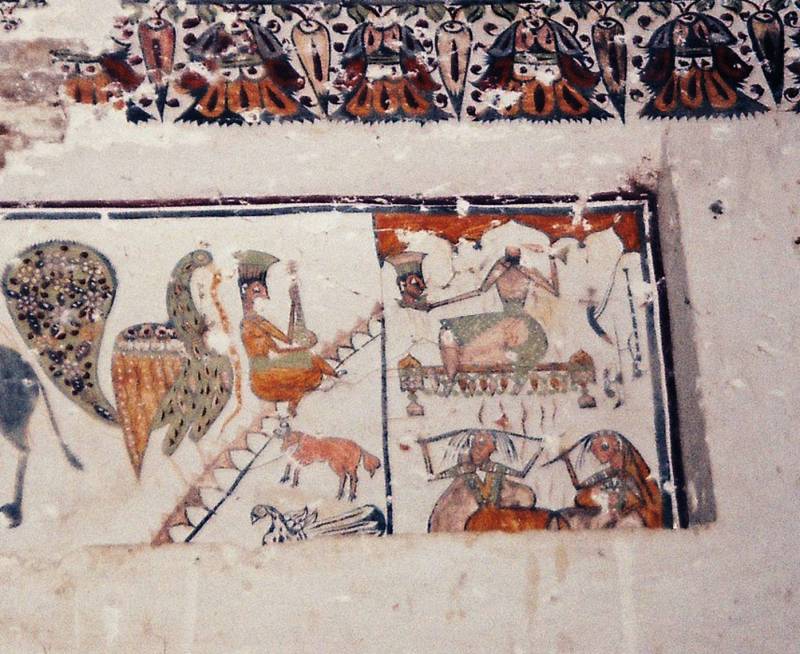
All three tombs depicted the tragic folk tale of Sorath-Rai Dyach and Bijal. The tomb of Mir Sobdar Jamali depicted the story of Sorath-Rai Dyach and Bijal in more detail. The tomb's southern wall depicted the story of Rai Dyach. The painting showed Bijal sitting outside the palace. He was playing the surando (fiddle), and inside the palace were three figures: Rai Dyach, his wife Sorath, and a maid. Legend has it that, on hearing Bijal's melodious tune, Rai Dyach asked him to request whatever he wished or demanded. Bijal asked for the head he needed, as described above. Rai Dyach took out his sword and, in one blow, severed his head as Bijal demanded. The painting showed Rai Dyach presenting his severed head to Bijal. Rai Dyach is shown sitting on the cot, given a local touch by the painters.
Beside the cot were figures of Sorath and her maid, both shown wailing and pulling their hair, a gesture associated with mourning in Sindhi society. Sorath, whose marriage had become a point of contention between King Ani Rai and Rai Dyach, was depicted pulling her hair with both hands in extreme sorrow, expressing her grief over the death of her husband. The figures were not finely executed; the painter seemed more concerned with telling the story and bringing its principal characters—Rai Dyach, Sorath, and Bijal—into the painted scene.
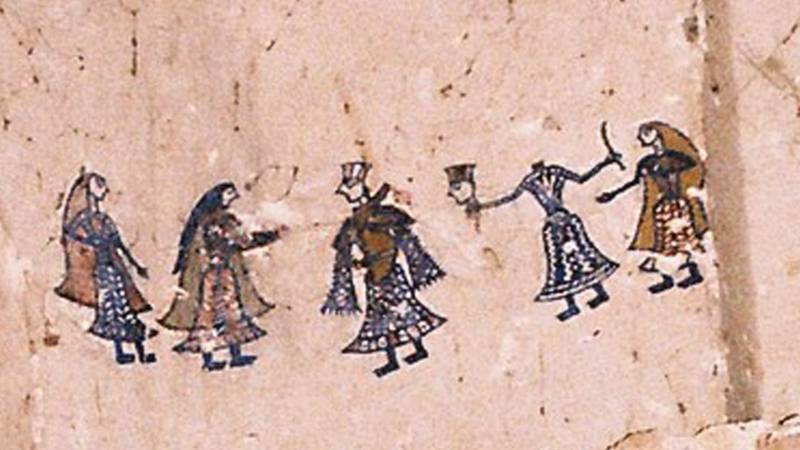
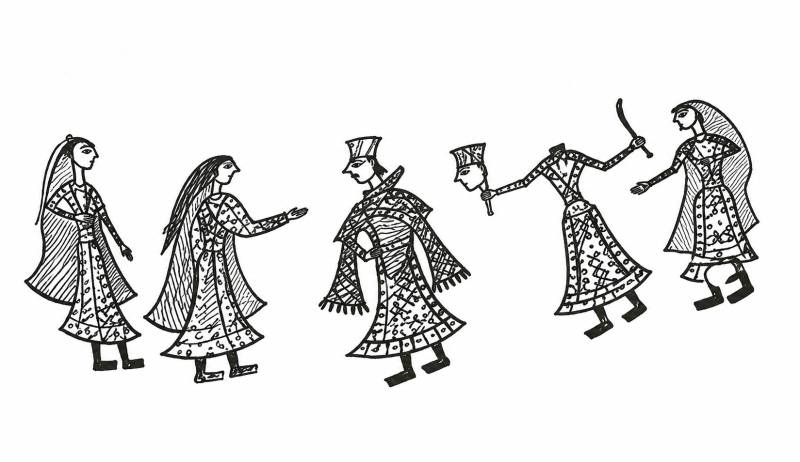
The story appeared somewhat differently in the tomb of Rehan Khan Jamali. Here, all the characters were shown outside the palace, and the composition contained five figures. Rai Dyach was depicted presenting his severed head to Bijal while holding a dagger in his other hand. This differed from the painting in the tomb of Sobdar Jamali, where Rai Dyach was shown cutting off his head with a sword. Sorath stood behind Rai Dyach, while Bijal, rather than facing the king, appeared to be talking with two women, possibly Sorath's maids. The scene suggests the women were trying to persuade Bijal to accept something other than Rai Dyach's head. One of them held a platter containing what appeared to be money, perhaps offered as an alternative reward. Bijal, however, appears unmoved by their appeal. The painter thus captured one of the central themes of the legend: Rai Dyach’s renowned generosity and his willingness to honour his promise even at the cost of his own life.
While Bijal talked with the maids, Rai Dyach cut off his head and presented it to him.
There was also a similar depiction in the tomb of Shakal Khan Jamali, which showed Rai Dyach with the severed head. It was also an imitation of the one painted in the tomb of Mir Sobdar Jamali. The painting represented four characters: Rai Dyach sitting on the cot and presenting his severed head to Bijal. Bijal was depicted playing surando and sitting at the entrance to the palace. Inside the palace, Rai Dyach, his wife Sorath, and the maid mourned Rai Dyach's death. However, it appeared to be a poor representation, indicating how the art of wall paintings lost its patrons.
Painting flourished in Sindh during the Samma period and reached its height under the Kalhoras, continuing into the Talpur period. Sindhi artists drew upon the folk romances and folk legends popular in eighteenth-century Sindh and transformed them into painted narratives on tomb walls. What made the Jamali tombs particularly distinctive was their depiction of the legend of Rai Dyach and Bijal, a subject that, to my knowledge, no other painted tomb in Sindh represented. The painter appeared to have been more concerned with telling the story than with refining the human figures. Rai Dyach, Sorath, Bijal, and the other characters were rendered rather simply, but the principal episodes of the legend were clearly conveyed. The paintings thus emphasised narrative and action, allowing the story to unfold visually across the tomb walls.