

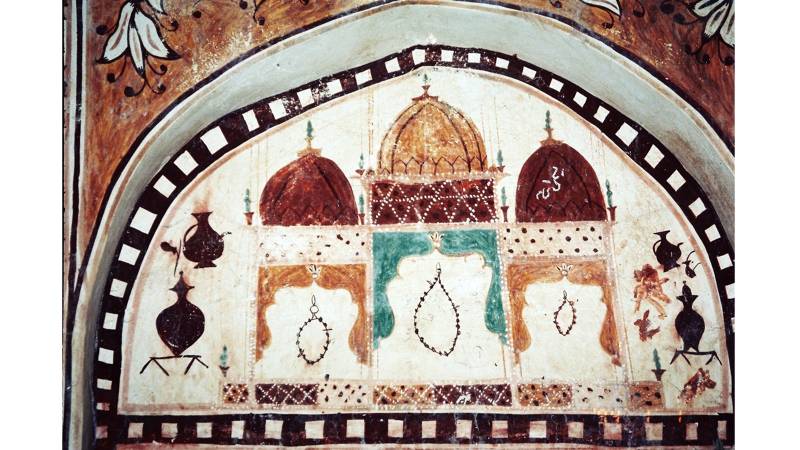
The mihrab, an arched niche in the qibla wall of a mosque that indicates the direction of prayer, also became an important feature of Sindhi tombs, particularly those of kings, princes, and nobles. In some tombs of local elites, Sindhi artisans further marked the direction of the qibla by depicting a mosque on the western wall. These painted mosque representations on the western wall are a distinctive feature of Sindhi funerary mural painting.
Many tombs across the districts of Dadu, Kamber-Shahdadkot, Larkana, and Sanghar feature mosque depictions on their western walls.
The Tombs of Dadu District
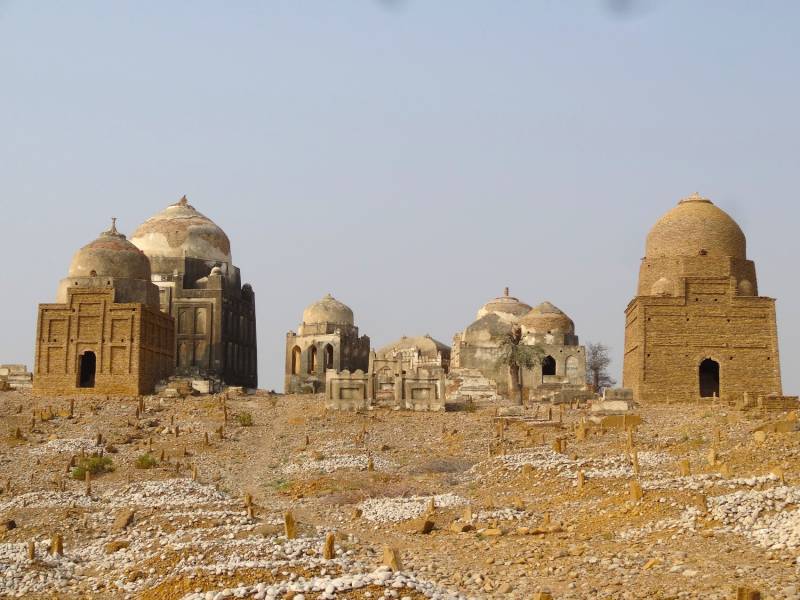
Five tombs in the Shahan Faqir Rodnani necropolis near Thull village in Dadu district are decorated with mosque paintings. One tomb's mihrab depicts a mosque. The three arched entrances depict a man carrying an object in the central arch, reciting the Holy Quran, and a pair of water jars in the right entrance. The hemispherical domes spanning the two aisles and the nave are also striking. From these paintings, one can reconstruct the mosque architecture of the Kalhora (1700–1783), Talpur (1783–1843), and colonial era (1843–1947). The same graveyard also depicts a mosque in the Sangu Faqir's canopy. This is a simple illustration of a mosque, without any devout person or object.
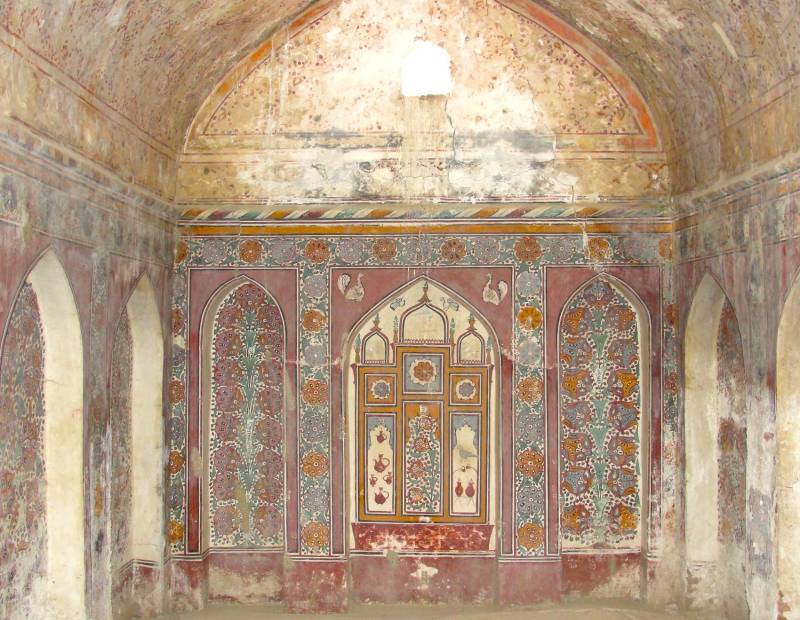
Some particularly refined mosque representations appear in the necropolis of Mir Allahyar Khan Talpur near Drigh Bala in Dadu district. The necropolis contains three tombs with mosque paintings. In a tomb west of Mir Allahyar Khan Talpur's tomb, a three-domed mosque is painted on the western wall. Within the mosque are several objects associated with prayer and everyday religious practice, including rosaries, water jugs, jars, and a Quran stand. Above the mosque is a separate panel depicting fruits arranged on a stand.
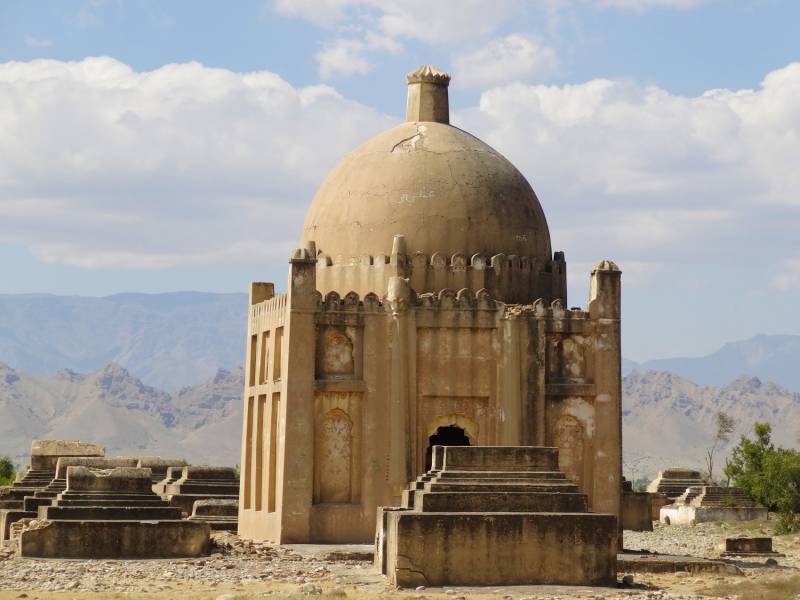
Such compositions are not confined to this necropolis. In several tombs, paintings of fruits and vegetables appear above or alongside representations of mosques. One of the finest examples appears in a Shahani tomb near Baleel Shah, where a three-domed mosque is depicted alongside a pair of rosaries. The same tomb also contains paintings of various fruits, vegetables, and fish. Fruits and vegetables arranged on stands form a recurring theme in the painted tombs of Dadu and Kamber-Shahdadkot districts. In some examples, a pair of birds is also shown above the domes of the painted mosque. These motifs often appear alongside mosque paintings, linking religious imagery with familiar objects from everyday life.
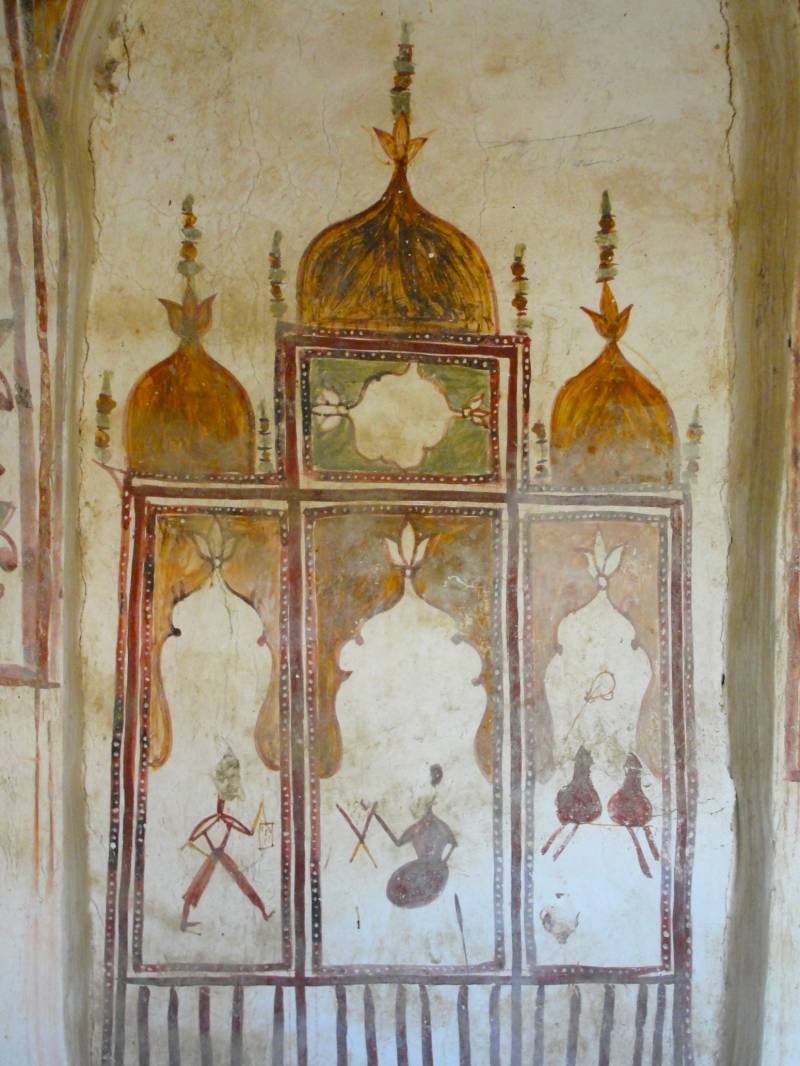
South of the tomb of Mir Manik Khan Talpur, in the necropolis of Mir Allahyar Khan Talpur, is a tomb that depicts a mosque with similar objects. The third tomb in the necropolis of Mir Allahyar Khan Talpur depicts a mosque with three domes and projecting corner kiosks. A tomb at the necropolis of Rawat Faqir near Drigh Bala also depicts a mosque. This tomb depicts a three-domed mosque with three arched entrances. Each entrance shows a rosary. Water jugs and jars flank the mosque on the right and left.
Johi Taluka and Tor Village
Two tombs in the Qalandarani Laghari necropolis in Johi taluka show mosques on the western walls. Both are three-domed structures. The first depiction of a mosque shows a man on the left walking towards it, apparently to offer prayers, while another figure prays beneath the central arch. Water jars and jugs also appear in the scene. In the second depiction, a man stands beneath the mosque's central arch holding a large rosary. Quran stands, water jars, and jugs are among the objects that frequently appear in these paintings, reflecting familiar aspects of religious life associated with mosques and prayer.
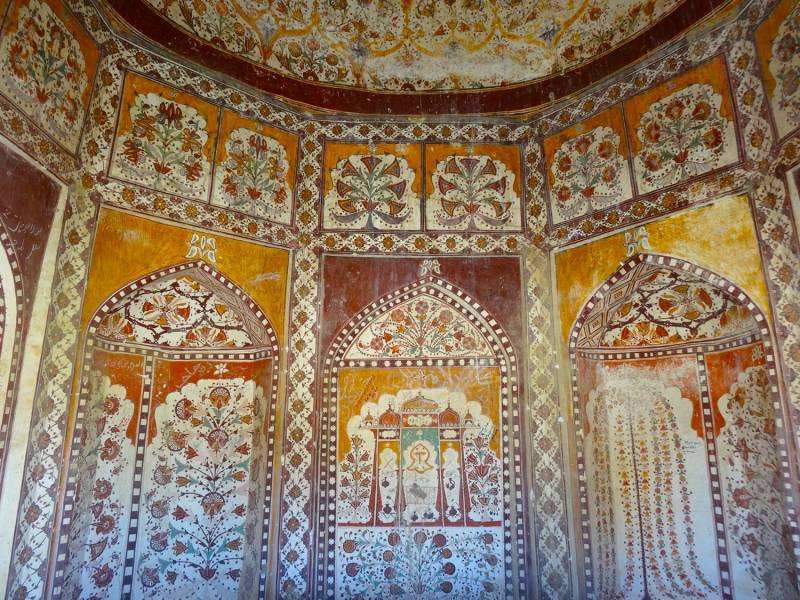
Another mosque representation appears in a funerary canopy at Tor village. The mosque has three domes and a single arched entrance, where a man holding a large rosary is depicted. Two tombs belonging to the Laghari tribe at Tor contain figural paintings. Such representations are interesting not only for their depiction of mosque architecture but also for the details of everyday religious practice they preserve. Figures at prayer, rosaries, Quran stands, and water vessels together offer glimpses of the religious life and visual traditions of the community that produced these paintings.
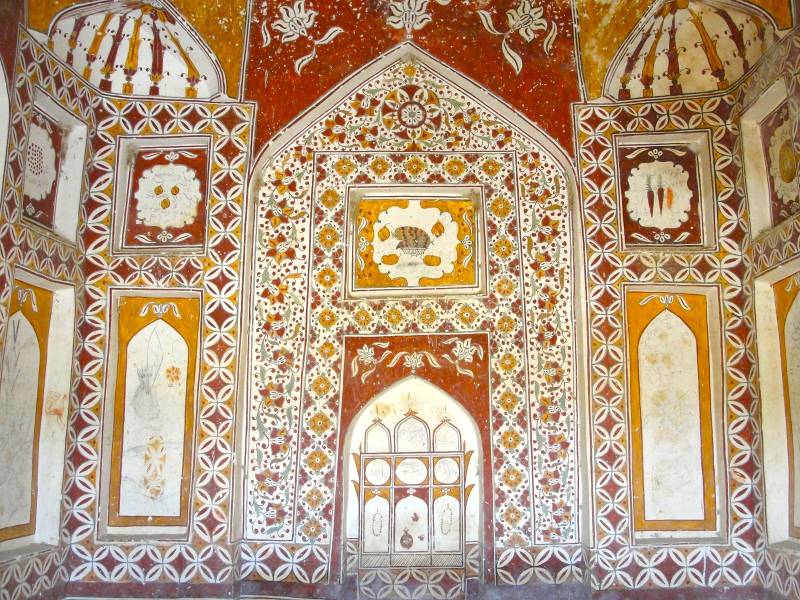
A tomb at the Muridani Jamali cemetery in Johi taluka depicts a mosque. It is a three-domed structure with onion-shaped domes. The frequently depicted objects are missing from this depiction. A beautiful depiction of the mosque is found in the tomb of Bakhar Jamali in Johi taluka. It depicts a three-domed mosque with three arched entrances. Each entrance depicts a devout person. The tomb of Bakhar Jamali is noted for paintings of Sasui and Punhun, Suhni and Mehar, horse riders, birds, and fruits.
The most refined mosque painting can be seen in the tomb of Jangu Jamali. This mosque is a two-storey structure that shows the Holy Quran stand, water jars, and jugs on both storeys.
Khanpur and Kamber-Shahdadkot
In the mosque depictions in the tombs at Khanpur town, arched entrances are decorated with flowers, which are missing in other mosque representations in Johi taluka. The tombs in Khanpur town, Dadu district, contain three mosque representations.
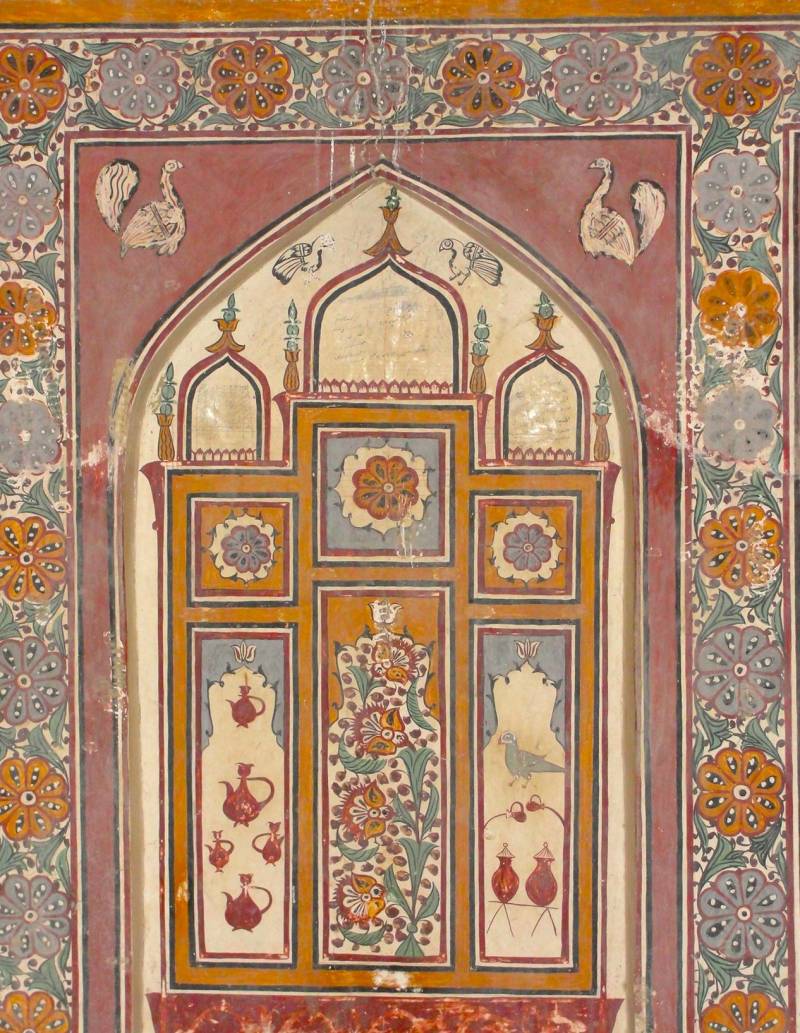
Fruits and vegetables arranged on stands form a recurring theme in the painted tombs – linking religious imagery with familiar objects from everyday life
In Kamber-Shahdadkot district, tombs of the Chandia tribe depict some refined mosque paintings. The Dau-Ja-Quba near Gebi Dero features beautiful mosque depictions.
Architectural Details and Inscriptions
In this article, I discuss a selection of mosque depictions found in wall paintings across different districts of Sindh. Besides their artistic value, these paintings preserve interesting details of mosque architecture. Most mosques are depicted as three-domed structures with three arched entrances. The artists also carefully distinguished the internal arrangement, showing a central nave flanked by two aisles.
The depicted mosques are often characterised by cusped arches and sometimes include inscriptions in Persian and Khudabadi scripts. Persian couplets also appear near some of the mosque representations. Of particular interest are the names of artists, occasionally inscribed within the painted mosques, while the names of masons and painters also appear in Sindhi and Persian inscriptions. Visitors likewise left commemorative inscriptions in and around these mosque depictions, recording their presence in Sindhi, Persian, and, in some cases, Khudabadi script. These inscriptions add another layer to the painted surfaces, preserving the names and traces of the artisans and visitors associated with the tombs.