

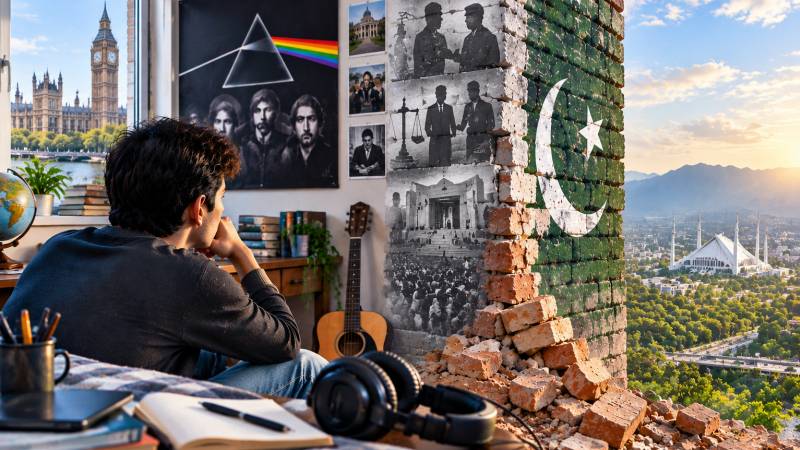
Growing up in Pakistan in the 1980s, there were certain songs that seemed almost compulsory listening among English speaking high school students of our generation. Pink Floyd was part of that soundtrack. We listened to the music long before many of us properly understood what Roger Waters and David Gilmour were saying. Another Brick In The Wall had rebellion in it, which was enough for teenagers. Comfortably Numb sounded hauntingly beautiful without requiring us to understand why.
My younger brother Athar loved these songs. Few years later, when he was studying at the London School of Economics, he had a Pink Floyd poster hanging in his dorm room. He passed away in 2020, still only in his early fifties. Recently, listening again to these two songs brought him suddenly and painfully back to me. The boy I grew up with, the young man in that LSE room with Pink Floyd’s poster in the background, and memories of a Pakistan that I left almost three decades ago. But this time I heard something else in the music as well. I heard my country.
Pink Floyd’s The Wall is ultimately about what happens when disappointment, trauma, humiliation and alienation accumulate until a person begins building barriers between himself and the world. The wall is not constructed at once. Every painful experience becomes another brick. Eventually, the wall that was supposed to protect its builder becomes his prison. Read politically rather than personally, it is difficult not to see something of Pakistan’s story in it.
Pakistan has been building its own wall for decades. Every military intervention was a brick. Every manipulated political process was another. Every civilian politician who sought establishment patronage against an opponent added one more. Every judge who bent when the law required standing firm, every bureaucrat who discovered that obedience was safer than professionalism. Every businessman who learnt that access mattered more than competition, every journalist who learnt that certain truths carried unacceptable costs and every government that preferred patronage to institution building contributed something to the structure.
The tragedy, therefore, is more complicated than blaming one institution alone. Pakistan’s military establishment may today occupy the commanding heights of the political system, but the wall was built over decades with assistance, acquiescence and sometimes enthusiasm from large parts of the civilian elite as well. Politicians have repeatedly invited intervention when it suited them, only to denounce it when it was turned against them. Courts have alternately legitimised exceptional arrangements and challenged them. Bureaucracies have adapted to whoever held power. Business elites have frequently learnt to prosper regardless of who governed. Brick by brick, exception became precedent and precedent became habit. That is Another Brick In The Wall. But perhaps the more unsettling song for Pakistan today is Comfortably Numb.
In Pink Floyd’s story, numbness is a form of protection. Feeling has become painful, so not feeling becomes easier. The phrase itself captures the contradiction perfectly. There is comfort in numbness because numbness shields us from disappointment. But it does so by cutting us off from everything else as well. Something similar may have happened to Pakistan. Pakistanis are not apathetic people. Quite the opposite. Politics is argued passionately in homes, workplaces, cafes, television studios and social media feeds. Elections produce enormous emotional investment. Political leaders inspire fierce loyalty and fierce hostility. Protest remains deeply embedded in the country’s political culture.
Do not keep adding bricks to a wall simply because the wall has always been there. And never become so comfortably numb that you stop noticing you are living behind one.
Yet beneath all that noise lies something quieter and perhaps more dangerous, resignation. People know how the system works. They know that written constitutional arrangements and actual distributions of power are not always the same thing. They know that governments can change while deeper structures remain remarkably durable. They have watched political leaders rise with powerful support and later fall out with the same centres of power. They have seen institutions celebrated as independent one year and condemned as compromised the next. The remarkable thing is not that Pakistanis fail to understand their political system. It may be that they understand it too well. And having understood it, many have learnt to live around it.
The shopkeeper and farmer concentrate on surviving another difficult year. The professional concentrates on his career. The businessman learns whom he must know. The bureaucrat learns where the invisible boundaries lie. Families who can afford private schools stop expecting the public education system to function. Those who can afford private healthcare stop expecting public hospitals to work. Those who distrust the police search for influence. Those who distrust the courts look for connections before they look for justice. And some of the country’s brightest young people increasingly stop asking how they can improve Pakistan and begin asking how quickly they can leave it. This is not indifference. It is numbness born from repetition and disappointment.
A society can absorb disappointment only so many times before lowered expectations become a survival mechanism. If institutions repeatedly fail to deliver justice, people eventually stop expecting justice from institutions. If governments repeatedly fail to deliver prosperity, citizens stop believing that politics will change their material circumstances. If constitutional rules are repeatedly bent, people gradually stop being surprised when they are bent again. What once produced outrage begins to produce a shrug. That shrug may be Pakistan’s version of Comfortably Numb.
The military establishment itself should reflect deeply on the metaphor of the wall. Pakistan unquestionably needs a strong, professional and respected military. The country faces real security challenges. But when any institution extends itself too deeply into political management, economic decision making, administration and areas that properly belong to civilian institutions, it risks weakening precisely the institutions whose weakness is then cited as justification for continued involvement.
A wall built for protection can become a prison. That is the central tragedy of Pink Floyd’s story, and perhaps it is also Pakistan’s. But the songs also contain the beginning of an answer. If Another Brick In The Wall tells us how the prison was constructed and Comfortably Numb tells us what it feels like to live inside it, then escaping requires reversing both processes.
Pakistan must first begin removing the bricks. That means restoring constitutional boundaries until they cease to be theoretical. It means allowing elected governments to govern and then holding them accountable for whether they succeed or fail. It means a judiciary capable of applying the same law to the weak and the powerful. It means a bureaucracy rewarded for competence rather than obedience. It means political parties that stop seeking unelected assistance against their rivals. It means a military strong enough to defend the state without needing to manage it. And it means citizens refusing to accept that the abnormal is simply Pakistan’s normal. But dismantling the wall is not enough. Pakistan must also stop being comfortably numb. The real antidote to numbness is not rage. Pakistan has had plenty of rage. Nor is it another political saviour promising to fix everything. The country has had enough saviours too. The antidote is consciousness.
To feel again means refusing to become accustomed to injustice merely because it is familiar. It means continuing to be disturbed when constitutional lines are crossed. It means caring about the rights of political opponents as much as those of political allies. It means refusing to celebrate institutional overreach simply because it temporarily benefits one’s own side. It means remembering that rule of law matters most precisely when the law protects someone we dislike. In that sense, these two songs offer an unexpected prescription for Pakistan. Question the wall. Identify every brick. Understand why it was placed there. Then begin removing them. And above all, refuse the seduction of numbness. My brother Athar would probably smile at the seriousness with which I now interpret music we once simply loved. Perhaps songs work that way. They wait for us. We hear them at sixteen and hear rebellion. We hear them decades later and discover grief, memory and meanings we were too young to understand or recognize.
Today Comfortably Numb takes me back to Athar and that Pink Floyd poster in his room at LSE. It takes me back to our childhood and the Pakistan of the 1980s. And it takes me back to the country I left almost thirty years ago but have never really left emotionally. Pakistan has changed enormously since then, yet its deepest political argument remains strangely the same. Who ultimately governs the country, under what rules, and who is accountable when those rules are broken? Perhaps that is the wall we have never dismantled. And perhaps Pink Floyd, unintentionally and from thousands of miles away, offered Pakistan a simple but profound warning decades ago. Do not keep adding bricks to a wall simply because the wall has always been there. And never become so comfortably numb that you stop noticing you are living behind one. Pakistan’s way out begins when it starts to feel again.