

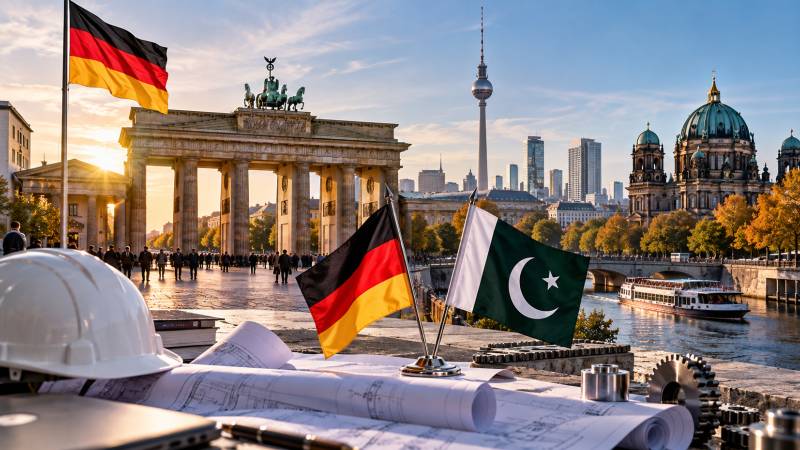
Every year on 3 October, Germany celebrates the Day of German Unity, marking the formal reunification of East and West Germany in 1990. The occasion commemorates much more than the disappearance of a political boundary. It recalls the end of more than four decades of division, the collapse of the Berlin Wall, democratic change in East Germany, a complex diplomatic settlement and the enormous economic and institutional task of transforming two very different systems into one state. The Unification Treaty entered into force on 3 October 1990, extending the constitutional order of the Federal Republic to the eastern Länder and making the date Germany’s national holiday. In 2026, the official celebrations are being held in Bremen from 2 to 4 October, with discussions extending well beyond memory and ceremony to Germany’s future, including security, investment, digitalization, climate policy and social cohesion.
For Pakistan, German Unity Day deserves attention not merely as an anniversary belonging to another country. Pakistan and Germany are very different in history, geography and political evolution, and simplistic comparisons would be misleading. Yet Germany’s experience raises questions that are directly relevant to Pakistan: how states maintain cohesion, how industrial capacity is built, how education connects with production, how technological capability becomes strategic power, how disparities between regions are reduced and how institutions convert national ambition into measurable development. Germany’s reunification also demonstrates that bringing territory under one constitutional framework is only the beginning. Economic integration, social confidence, infrastructure, administrative capacity and equality of opportunity require decades of work. Pakistan’s own history, particularly the separation of East Pakistan in 1971, makes the distinction between territorial integrity and genuine national integration especially important. Germany’s experience therefore offers material for reflection, not a template for imitation.
The industrial dimension is perhaps the most striking. Modern Germany built much of its economic strength around manufacturing, engineering, chemicals, automobiles, electrical equipment, precision machinery and a dense network of specialised medium-sized firms. Industrial power is not produced simply by erecting factories. It rests on a chain connecting technical schools, universities, research laboratories, suppliers, skilled workers, finance, regulation and export markets. Germany continues to invest heavily in this knowledge base: expenditure on research and development reached €137.1 billion in 2024, equivalent to 3.17 per cent of GDP, the highest share in the German statistical series dating from 1995. Of that expenditure, the business sector accounted for more than €92 billion. The figure is significant for Pakistan because it illustrates a principle often missed in developing economies: industry becomes competitive when research is embedded inside the productive system rather than confined to academic publications.
Pakistan possesses substantial industrial capabilities of its own, particularly in textiles, garments, leather goods, surgical instruments, sporting goods, food processing, pharmaceuticals and parts of engineering. But its export structure remains comparatively concentrated in lower- and middle-value segments. German-Pakistani commerce reveals both the strength and the limitation of this relationship. Germany is Pakistan’s most important bilateral trading partner within the European Union; bilateral trade amounted to about €3.3 billion in 2024. Pakistan’s principal exports to Germany are textiles and leather products, while Pakistan imports machinery, chemical and electrical goods, vehicles and iron products from Germany. That composition tells an economic story. Pakistan sells large quantities of labour-intensive products while purchasing a considerable share of the capital goods and advanced industrial inputs on which productivity depends. The next stage of the relationship should therefore be less about increasing trade volumes alone and more about changing the technological content of trade.
German firms and institutions could become more important partners in upgrading Pakistani manufacturing. Textile cooperation, for example, need not end with garments. It can include automated production, technical textiles, recycling technologies, water-efficient dyeing, industrial energy management and compliance with increasingly demanding European environmental standards. Pakistan’s surgical-instrument clusters could move further into precision manufacturing and biomedical technologies. Its automotive supply chain could benefit from collaboration in components, testing and electrification. Pharmaceuticals could move from conventional formulations towards advanced manufacturing, analytical technologies and stronger regulatory systems. Such development would require Pakistan to improve reliability in energy supply, logistics, contract enforcement, skills and regulatory predictability. Industrialization is ultimately an ecosystem, not a collection of incentive packages.
National strength in the twenty-first century extends beyond conventional defence to energy security, technological capability, industrial depth, cyber resilience, food systems and strategic supply chains.
Climate cooperation is already an important pillar of German engagement with Pakistan. German development cooperation with Pakistan began in 1961, and Berlin says that it has pledged about €3.8 billion in project support since then. Current priorities include climate and energy, sustainable economic development, vocational training and employment, health and social protection. German development programmes have also supported renewable energy, climate resilience, vocational education and private-sector development in Pakistan. This matters because Pakistan faces a development paradox: it contributes comparatively little to historical global emissions yet remains highly exposed to floods, heat, water stress, glacial change and agricultural disruption. Climate cooperation therefore has to move beyond conferences and declarations towards adaptation technologies, resilient infrastructure, water management, disaster forecasting, energy efficiency and locally relevant research.
The educational dimension may be even more consequential than trade. Germany’s economic model depends heavily on the link between learning and work. Its dual vocational system brings together employers, vocational schools, government institutions and social partners, combining practical workplace training with formal instruction. German vocational training regulations themselves are developed through cooperation among the federal government, the Länder and social partners. Pakistan has repeatedly attempted technical and vocational reforms, but the persistent difficulty is matching training with actual industrial demand. Too many qualifications remain disconnected from the machines, software, quality systems and production processes employers use. Germany’s experience suggests that industry should not merely receive graduates; it must participate in defining what graduates learn.
Pakistan also has a growing academic connection with Germany. DAAD reported that 9,873 Pakistani students were enrolled at German universities in 2024, and the German higher-education database recorded 51 institutional partnerships between German and Pakistani universities in 2025. Germany itself remains one of the world’s major destinations for international students, with around 420,000 international students and doctoral candidates estimated in the winter semester 2025–26. For Pakistan, this creates an opportunity extending beyond individual scholarships. Joint degrees, co-supervised PhDs, laboratory partnerships, faculty exchanges and industrial research programmes could be concentrated in areas where Pakistan has urgent needs: renewable energy, water, materials science, biotechnology, pharmaceuticals, artificial intelligence, agricultural technologies, climate modelling and advanced manufacturing.
Germany’s research system also offers another important lesson: universities are only one component of innovation. Industrial laboratories, applied-research organisations and companies account for much of the country’s R&D spending. German businesses alone accounted for roughly two-thirds of total R&D expenditure in 2024. Pakistan’s universities, by contrast, are frequently expected to carry a disproportionate share of national research while industry often remains a modest participant. That separation has consequences. Universities produce theses that industries never use, while industries import technologies that local researchers could potentially adapt. A more mature innovation system would force these two worlds into the same room.
German Unity Day also carries a strategic dimension. The reunification of Germany was not simply an internal constitutional act. It required diplomacy involving the United States, Soviet Union, Britain and France through the Two Plus Four process, which addressed sovereignty, borders and security arrangements. The broader lesson is that national strength is inseparable from the international environment. Germany subsequently anchored itself deeply in European institutions and the transatlantic security order while building economic relationships across the world. Its present security debate has become more urgent because of the changing European strategic environment; notably, Germany’s 2026 Unity Day programme itself includes a public discussion on “Germany’s security in uncertain times.”
Pakistan’s strategic environment is entirely different. It sits at the junction of South Asia, Central Asia, China, the Arabian Sea and the wider Middle East. Its security discourse has traditionally focused heavily on conventional defence, India, Afghanistan and nuclear deterrence. Those remain important dimensions of statecraft, but twenty-first-century strategic power is broader. Energy security, semiconductor access, cyber resilience, telecommunications, food systems, water, supply chains, artificial intelligence, biotechnology and industrial depth are now components of national security. Germany’s experience is relevant here because it demonstrates the strategic value of possessing a sophisticated productive base. A country that manufactures advanced machinery, chemicals, vehicles, sensors and industrial systems enjoys forms of influence that cannot be generated by diplomacy alone.
There is also an important lesson in federalism. Reunified Germany did not erase regional identity. Its federal system gives substantial political and administrative authority to its Länder. The eastern regions continued to have distinct economic and demographic experiences even after political reunification. Germany invested heavily in infrastructure and reconstruction in the east, yet disparities did not disappear overnight. Even decades later, German discussions about unity continue to address economic differences, representation and social perceptions between east and west. The 2026 national celebrations include discussions specifically concerning eastern Germany, demonstrating that integration is treated as a continuing process rather than a task completed in 1990.
Pakistan should recognize the importance of this distinction. Diversity is not necessarily a threat to unity. Provinces can possess their own languages, histories, economic structures and cultural identities while remaining part of a shared constitutional system. The greater danger arises when citizens believe that resources, political influence or opportunities are distributed unfairly. Infrastructure, universities, hospitals, water, employment and representation therefore have political consequences far beyond their administrative categories. National cohesion requires citizens in Karachi, Quetta, Lahore, Peshawar, Gilgit, Hyderabad and smaller towns to believe that participation in the federation carries tangible value.
The relationship should also move towards the digital economy. Artificial intelligence, automation, industrial software, cybersecurity and advanced data systems are reshaping manufacturing everywhere. Pakistan has a large young population and a growing software sector; Germany has sophisticated industrial companies seeking digital talent and technological solutions. There is scope for collaboration between Pakistani software capabilities and German manufacturing expertise, especially in Industry 4.0, industrial automation, supply-chain management, embedded systems and cybersecurity. Such cooperation would require stronger intellectual-property frameworks, data governance and specialized technical education in Pakistan.
Agriculture is another overlooked field. Pakistan’s food security is threatened by water scarcity, climate volatility, soil degradation and inefficient irrigation. Germany’s strength in agricultural machinery, sensors, environmental engineering and applied science could support Pakistani research and commercial partnerships in precision agriculture, water efficiency, cold chains and food processing. Moving agricultural produce into processed exports would also reduce Pakistan’s dependence on a narrow range of manufactured exports.
Health and pharmaceuticals deserve similar attention. Germany possesses one of the world’s significant pharmaceutical, medical-device and chemical sectors, while Pakistan has a large domestic pharmaceutical market and growing manufacturing capacity. Partnerships could focus on quality systems, analytical science, biosimilars, medical devices, clinical research infrastructure and regulatory capability. The objective should not simply be importing German equipment, but progressively acquiring the knowledge required to maintain, adapt and eventually manufacture sophisticated technologies locally.
German Unity Day also reminds us that institutions matter more than slogans. The political unification of Germany was accompanied by detailed legal and administrative integration. The Unification Treaty ran to hundreds of pages and addressed constitutional, financial, administrative, social, cultural and institutional questions. National development similarly depends on painstaking institutional work. Pakistan often announces policies with ambitious titles, yet implementation is weakened by discontinuity, overlapping jurisdictions and frequent policy reversals. Germany is hardly free of bureaucracy or policy disputes, but the broader principle remains valuable: states become effective when rules outlast individuals.
The fundamental question therefore is what Pakistan should see when it looks towards Germany on 3 October. It should not see an idealized country without problems. Germany itself confronts demographic pressures, industrial competition, energy costs, political polarization, technological challenges and unresolved regional differences. The more useful observation is that Germany has repeatedly treated economic productivity, technical competence, research capacity and institutional organization as matters of national importance. Its Unity Day in 2026 is itself being used to debate future security, investment, climate policy, digitalization and social cohesion rather than simply celebrating the past.
The most enduring lesson of German reunification may ultimately be that national unity cannot be separated from national capability. A flag can symbolize unity, a constitution can define it and a border can contain it, but citizens experience unity through jobs, institutions, infrastructure, justice and opportunity. Germany spent decades rebuilding and integrating its eastern regions after the political act of reunification. Pakistan, with its own deep regional, economic and educational disparities, has reason to reflect on the same relationship between cohesion and development.
On 3 October, Germans remember the day when a wall ceased to divide their country. For Pakistan, perhaps the more pertinent question is about the walls that remain invisible: the walls between university and industry, between skilled labour and formal education, between research and production, between provinces and opportunity, between policy and implementation, and between the country’s scientific potential and its economic reality. Those are the walls Pakistan still has to bring down!