

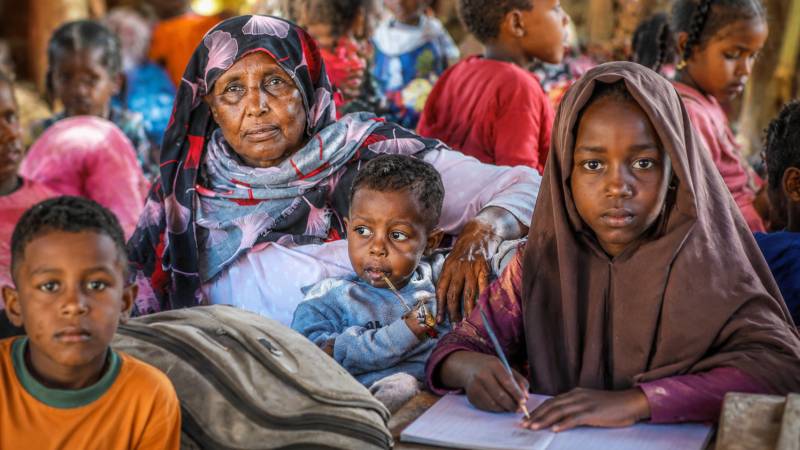
When a crisis strikes, the humanitarian instinct is rightly to save lives. Food, water, shelter, and healthcare become immediate priorities. Yet in today’s world of prolonged and overlapping crises—what many now describe as a poly crisis; one essential service continues to be treated as optional: education. This is a dangerous mistake. Exclusion of education as a lifesaving priority is a failure not only of education policy but of the overall humanitarian strategy.
Across Yemen, Afghanistan, Sudan, and Mali, millions of children are growing up amid conflict, displacement, economic collapse, and climate shocks. For adolescent girls especially, the loss of education is not simply a disruption to learning. It is a loss of dignity, protection, social connection, and most of all hope. In environments where institutions are collapsing and communities are fragmenting, education is one of the few systems that can help people survive the present while preparing for the future. Education must be recognised as a life-sustaining humanitarian intervention; equal in importance to food, shelter, water, sanitation, and health.
The humanitarian system has historically viewed education as an investment for the future—something to restore after the immediate emergency has passed. That logic may have been understandable in shorter, more predictable crises. It is however, no longer appropriate in a world where emergencies last years, sometimes decades, and where children can spend their entire childhoods displaced!
A child who loses access to education for even a couple of years does not simply lose academic progress. They lose protection from: exploitation, early marriage, child labour, recruitment by armed groups, and other forms of abuse. They lose opportunities to develop: skills, confidence, and freedom. They lose their connection to a future beyond survival!
This impact is particularly severe for adolescent girls. In Afghanistan, restrictions on girls’ education have demonstrated that denying learning opportunities is not only an education issue—it is a fundamental assault on their dignity and participation in society. Girls excluded from classrooms lose: access to knowledge, friendships, mentors, and the possibility of economic independence. Their exclusion also weakens communities by removing the contributions of half the population.
In Yemen, years of conflict, poverty, and displacement have pushed many families into impossible choices. Choices that no parent should ever have to make! When resources become scarce, girls are often the first to leave school. The consequences are profound: increased risks of early marriage, reduced decision-making power, and fewer opportunities to shape their own futures.
In Sudan, where a devastating conflict has displaced millions and destroyed essential services, education systems are collapsing at precisely the moment when children need stability most. For displaced girls, schools and learning spaces can provide safety, psychosocial support, and a protective environment amid violence and uncertainty.
In Mali, where conflict, insecurity, and climate pressures have displaced communities and closed schools, the absence of education has broader implications. Schools are not only places of learning; they are spaces where social relationships are built, differences are negotiated, and communities maintain cohesion. When education disappears, social fragmentation deepens.
This connection between education and social cohesion is increasingly important during poly-crises. Conflict does not only destroy infrastructure; it damages trust between people and institutions. Education creates opportunities for young people from different backgrounds to develop shared values, learn peaceful ways to resolve conflict, and participate constructively in society. Yet despite its importance, education remains chronically underfunded in humanitarian appeals for decades. It is often among the first sectors cut when resources decline, and it is frequently separated from the broader survival response. This approach must change!
First, humanitarian actors and donors must formally recognise education as a life-saving intervention. Education should be integrated into emergency planning from the earliest stages of a crisis, not introduced months or years later. Humanitarian needs assessments should measure the loss of education as seriously as they measure hunger, displacement, or disease.
Second, funding mechanisms must change. Education in emergencies requires predictable, multi-year financing because crises are increasingly prolonged. Short funding cycles are incompatible with the reality faced by children living through conflict and displacement. Donors should recognize education as a core component of humanitarian response and provide sustained financial support. Donors should commit to education as part of core humanitarian financing rather than treating it as a secondary development investment.
Third, humanitarian responses must prioritise adolescent girls. This means creating safe learning environments, supporting female teachers, providing protection services, addressing barriers such as transportation and school-related costs, and engaging communities to challenge harmful gender norms. Keeping girls in school is one of the strongest investments societies can make in resilience and recovery.
Fourth, education must be better integrated with other humanitarian sectors. Schools and learning spaces can serve as platforms for health information, nutrition support, psychosocial care, child protection, and community engagement. The separation between “education” and “survival” sectors is increasingly artificial. In reality, education strengthens survival across multiple dimensions.
Finally, the international community must recognise that protecting education is also protecting peace. Societies emerging from conflict require educated, skilled, and connected citizens. Destroying educational opportunities today creates deeper instability tomorrow.
The question facing the humanitarian community is not whether we can afford to include education in emergency responses. The question is whether we can afford not to? A generation of children is growing up amid the world’s most complex crises; their survival cannot be measured only by whether they receive food, water, and shelter. Survival also means preserving dignity, freedom, relationships, and hope. In a poly-crisis world, education is not what comes after survival. Education is what makes survival meaningful and what makes recovery possible.