

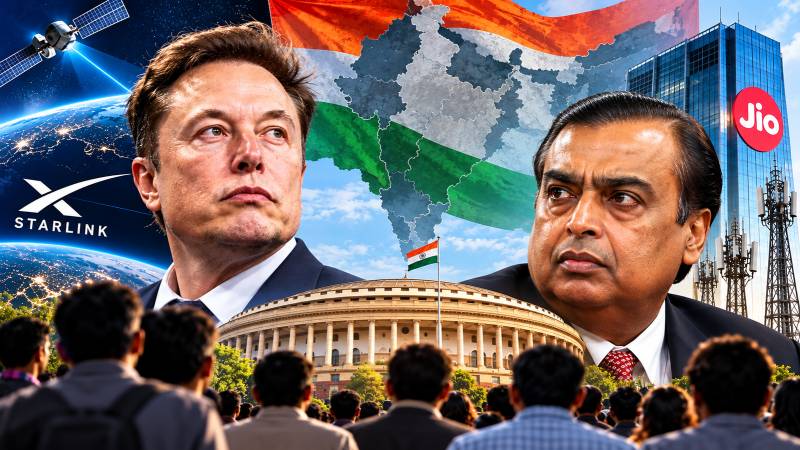
Recently, the richest man in the world posted a question that few heads of government would put in public. Elon Musk wrote that Starlink is licensed in over 165 countries and has spent five years complying with Indian requirements, then asked whether Ambani is "the real boss of India." A day earlier he had accused unnamed oligarchs of protecting a monopoly. Rahul Gandhi replied by welcoming Musk to India and teasing that he should wait until he discovers "the other guy."
Whether Musk is right about Starlink remains to be settled, and the Indian government describes the delay as a security clearance matter. The shape of the argument carries the larger meaning. Two men whose fortunes exceed the budgets of many states are publicly disputing who sits closer to power, and the audience finds the question entirely natural. That reaction reveals something liberal democracy usually prefers to leave unsaid.
Marx and Engels wrote in 1848 that the executive of the modern state is a committee for managing the common affairs of the bourgeoisie. It was a polemic, and political scientists spent the next century refining it. Ralph Miliband, in The State in Capitalist Society, argued that business elites shape the state through personal ties, funding and a shared class background. Nicos Poulantzas answered that the mechanism is structural: even a state run by honest officials must protect profitability, because its revenues, jobs and stability depend on it. Charles Lindblom made the same point in Politics and Markets when he described the privileged position of business. A government can lose an election, and it can never afford a strike of capital.
The Musk and Ambani episode displays both mechanisms together. The instrumental one appears in the access, the lobbying and the question of whose calls get returned. The structural one appears in the fact that a regulator deciding who may sell internet from orbit is adjudicating between two corporate empires, and the citizen sits outside the case. Modern research supports the old suspicion. In 2014, Martin Gilens and Benjamin Page analysed nearly two thousand American policy questions and found that economic elites and business groups had substantial independent influence on outcomes, while average citizens had little or none. Jeffrey Winters, in Oligarchy, argued that the wealthy rule indirectly. They employ lawyers, lobbyists and lenders to defend their wealth, and the state becomes the arena where that defence takes place. Colin Crouch called the result post-democracy: elections continue to be held while the substance of decision-making migrates to boardrooms.
Two men whose fortunes exceed the budgets of many states are publicly disputing who sits closer to power, and the audience finds the question entirely natural. That reaction reveals something liberal democracy usually prefers to leave unsaid.
Musk himself illustrates the pattern. According to campaign finance reporting, he spent more than a quarter of a billion dollars to help elect Donald Trump in 2024, and he then led the Department of Government Efficiency, an office with reach into federal agencies, some of which regulated his own companies. A private citizen bought access and then took a seat inside the machinery. Citizens United, the 2010 Supreme Court ruling that opened the door to unlimited independent political spending, made the purchase lawful, and an open market in influence made any conspiracy unnecessary.
India supplies the second example. In 2024 its Supreme Court struck down the electoral bonds scheme, which allowed anonymous corporate donations to political parties, and ruled it unconstitutional. A court had to intervene before the public could see how deep the arrangement ran. Reliance Jio entered the market with free data and went on to become India's largest operator by subscribers, a single group with the weight of a public utility. When Rahul Gandhi hints that Musk has yet to meet the other tycoon, he voices a view Indian opposition leaders have held for years: the state sits very close to a handful of conglomerates.
Musk is the world's richest person, and his complaint concerns his own exclusion. He accepts a political system in which capital decides who may operate, and he protests the moment he finds himself on the losing side. Had Starlink received its licence on schedule, the sentence "Is Ambani the real boss of India?" would never have appeared on his feed. The quarrel pits two beneficiaries of the same arrangement against each other, and their rivalry has made that arrangement visible.
Here lies the lesson for liberal democracy. We are taught that markets and states occupy separate spheres, with the state as a neutral referee. A dispute like this one shows the referee being lobbied by both teams while the fans, who are citizens and consumers, watch from the stands. The remedy begins with treating concentrated wealth as a constitutional question as well as an economic one. That means real limits and full disclosure on campaign finance, independent regulators with security of tenure who publish their reasons, competition authorities with the power to break up dominant firms, and a firm rule that officeholders step aside from decisions touching their private interests. Elections will keep their meaning once these safeguards exist. Musk's question deserves a straight answer, and citizens deserve the power to give it: to know who the real boss is, and to vote that person out.