

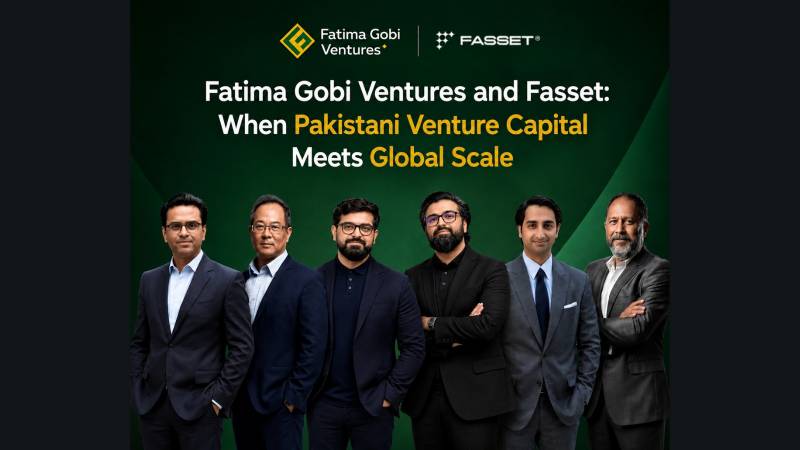
Fasset has reached unicorn status after raising US$68M in Series C funding at a US$1B valuation, in a round led by SBI Group, one of Japan's major financial institutions. The round follows a US$51M Series B1 earlier this year.
Four years ago, the company raised a US$22M Series A co-led by Liberty City Ventures and Fatima Gobi Ventures (FGV).
Within that global funding announcement sits a significant first for Pakistan. That makes FGV the first Pakistan-based venture capital fund to count a unicorn among its portfolio companies, an important milestone for an industry still relatively young by global standards, and a tangible example of Pakistani venture capital participating in a company's journey from early-stage potential to billion-dollar scale.
From early capital to global scale
Fasset today looks very different from the business its Series A investors first backed.
Founded in 2019 by Mohammad Raafi Hossain and Daniel Ahmed, the company grew out of a problem its founders had seen up close: access to financial opportunity still depends heavily on where a person is born, not on the merit of the opportunity itself. Solving that meant building access to financial infrastructure for markets the traditional system had underserved, and doing it with the conviction that a solution built for emerging markets could eventually work everywhere.
The company today spans 125 countries and more than three million user wallets, works with over 1,000 enterprise clients, and moves upwards of US$40B in transaction volume a year, a business that has grown its revenue roughly sixfold year-on-year and turned profitable along the way.
OWN Network, the regulated infrastructure Fasset has built to link banks, telecom operators, payment providers and liquidity partners across borders, carries much of that volume. Part of the new funding will go toward extending that network further, alongside deeper investment in agentic AI systems for cross-border banking, stablecoin settlement and tokenised assets.
Backing the company early
Early-stage venture capital is fundamentally about conviction in founders, and about supporting them long before that conviction is proven right. The founders worth betting on early are usually the ones solving a problem they understand intimately, and Pakistan has no shortage of such talent. The test, over time, is whether early belief in a team translates into the traction, scale and access to capital needed to build something lasting.
Fasset's trajectory provides a particularly clear example. In early 2022, regulated digital asset infrastructure for emerging markets was still an unproven category, and the regulatory frameworks across most of the company's target markets were only beginning to take shape. Two investors co-led that round on the view that the durable opportunity lay in the financial rails underneath the asset class: Liberty City Ventures, a New York firm with a track record in digital asset infrastructure, and FGV, investing from Pakistan with a mandate for founders building well beyond their home markets.
From that US$22M Series A, the company has progressed to a billion-dollar valuation and a Series C led by one of Japan's largest financial groups.
“Financial infrastructure across emerging markets is fundamentally fragmented, solving that problem has required us to go deeper than simply building another financial product. FGV backed our thesis early because they operate in such markets themselves.
Four years later, that thesis has become the foundation of Own Network. We’re grateful to have had FGV as a partner from the beginning. That conviction is becoming increasingly important as we bring together banks, payment providers, telcos and liquidity partners across markets to enable global money movement and financial services for all.”
— Daniel Ahmed, Co-founder, Fasset
"We've always believed the talent to build this kind of company exists in Pakistan; the job is to find the founders carrying that vision, believe in it early, and stay close enough to help them get there. Fasset is one example of what that can produce. The bigger opportunity is making sure more founders with that kind of ambition get found early, and that outcomes like this become far more common over time ."
— Naiel Ikram, Partner, Fatima Gobi Ventures
A tangible outcome for Pakistan
For Pakistan, Fasset's milestone matters because it provides something the country's venture ecosystem increasingly needs: tangible outcomes.
The earlier chapters of Pakistan's technology story were mostly about groundwork: digitisation, a growing entrepreneurial culture, new startups and the arrival of local venture capital. What comes next is less about inputs and more about results. Do early bets turn into companies of real scale? Do they go on to raise from serious international investors? Can they build a customer base across borders and create lasting value?
Fasset provides one of the clearest proof points yet, arriving alongside broader progress across the wider digital and investment ecosystem. Years of investment in technology, entrepreneurship and digitisation are increasingly becoming visible through businesses reaching greater scale and attracting global capital.
Looking beyond the domestic market
Fasset also demonstrates why the ambition of Pakistan's venture ecosystem isn't limited by the size of Pakistan's domestic market.
Many of the challenges technology companies in emerging economies are trying to solve — financial access, inefficient payments, fragmented infrastructure, the difficult cross-border movement of value — are shared across markets. That creates an opportunity to identify problems through an emerging-market lens while building solutions that can travel globally.
Fasset is a clear illustration. The company is built for the corridors and constraints that emerging markets know well, holds regulatory approvals across multiple jurisdictions and now operates in 125 countries, with its latest capital coming from a major Japanese financial group. Fasset's trajectory is really a reflection of its founders' own ambition: the willingness to build for a problem far bigger than any one country, and the conviction to keep going before that ambition had been proven out. What early investors can do is recognise that ambition before it's obvious, and help connect it to the capital, networks and support needed to scale
From potential to proof
No single unicorn defines an entire technology ecosystem, and billion-dollar valuations shouldn't become the only measure of its success. But firsts matter. This milestone serves as inspiration for ambitious founders in Pakistan today, who can now point to Fasset’s achievement and see building a billion-dollar enterprise as achievable.
Pakistan's venture ecosystem is developing, and Fasset's journey from an early-stage investment to a US$1B company is proof of what the country's talent can produce when it's matched with early belief and the right support. The work ahead is to make that pairing more common: more founders backed at the point where their vision is still unproven, given the room and support to pursue ambition that extends well beyond Pakistan, so that more of the value created along the way flows back to the entrepreneurs, investors and wider economy that helped build it.