

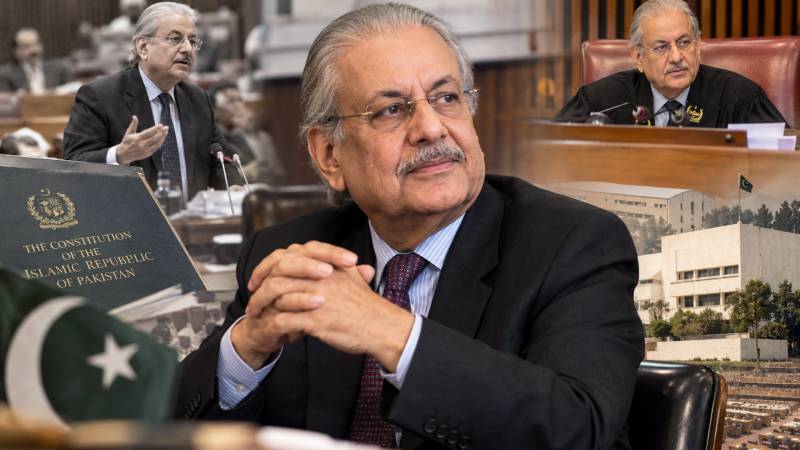
Some leaders make history through power; others shape it through principle. Their influence is measured not by the offices they hold or the governments they lead, but by the institutions they defend, the traditions they preserve, and the standard they set for those who follow.
In Pakistan, where democracy has repeatedly faced periods of retreat, national memory must honor those who did more than merely participate in politics. They defended democratic principles, upheld constitutionalism, and helped preserve democratic traditions for generations to come. Mian Raza Rabbani is one such leader whose contributions deserve to be remembered, recognized, and honored.
He has been my favorite politician since my student days. Perhaps there was something inevitable about it. He was a leader of the Pakistan Peoples Party (PPP), while I was a young activist in its student wing, the Peoples Students Federation (PSF). But my admiration was never merely a matter of party affiliation. Over time, it deepened into a firm conviction that individuals like Raza Rabbani provide democracy with a moral compass and an intellectual foundation that institutions alone cannot supply.
Rabbani belongs to a generation that experienced dictatorship not as a historical footnote, but as a lived reality. Joining the PPP in 1968, he spent over two and a half years in prison at different times between 1977 and 2001 for advocating democracy, human rights, and the rule of law. In April 1998, he was subjected to police brutality outside Parliament House. These experiences illuminate something fundamental: for Raza Rabbani, democracy is not merely a mechanism for forming governments, but a conviction forged through personal sacrifice.
After more than three decades of parliamentary service in the Senate, spanning from 1993 to 2024, including roles as Leader of the House and Leader of the Opposition, his career reached a historic milestone during the 2009–2010 constitutional reform process. He was unanimously elected chairman of the multiparty Parliamentary Committee on Constitutional Reforms, which produced the draft that became the 18th Constitutional Amendment.
The 18th Amendment was far more than a routine revision. It reversed major constitutional changes introduced under military rule, restored the parliamentary character of the 1973 Constitution, strengthened provincial autonomy, and transferred important powers back toward Parliament and the elected executive. The committee brought together political adversaries who ultimately forged consensus on historically contentious issues. Rabbani’s ability to guide this process demonstrated the parliamentary temperament required to build consensus across deep political differences.
For Raza Rabbani, democracy is not merely a mechanism for forming governments, but a conviction forged through personal sacrifice.
His contributions extend to other defining political moments, notably as a member of the small cross-party team that worked on the drafting of the Charter of Democracy. Signed in 2006 by Shaheed Mohtarma Benazir Bhutto and Nawaz Sharif, the Charter represented a historic attempt by the country’s two major political parties to establish democratic norms, strengthen civilian institutions, and prevent a return to military rule.
For me, Raza Rabbani has always represented the voice of public conscience. He has been described as “Mr. Clean,” the “Man of Law,” and “the most honest politician ever.” While no single label can fully capture the man, they reflect the public trust and reputation for integrity he has built through decades of public life. What stands out is his personal integrity, his unwavering commitment to the Constitution, and his independence of judgment, even when that meant disagreeing with his own party. Federalism sits at the core of his political philosophy. To him, provincial autonomy is not a political concession, but a constitutional imperative and a central condition for a durable federation.
Equally admirable is his willingness to take a stand within his own party. In May 2011, he resigned as federal minister for interprovincial coordination to protest compromises over the implementation of the 18th Amendment, including the PPP leadership’s decision to bring the PML-Q into the ruling coalition. Later, in 2015, when Parliament considered the 21st Amendment to establish military courts, Rabbani voted for the measure on his party’s direction while publicly stating that he was voting against his conscience. His emotional address on the Senate floor remains one of the most poignant moments in modern parliamentary history. While politics frequently rewards those who suppress doubt for expediency, Rabbani’s career reflects the difficult tension between party discipline and personal conviction, and his willingness to make that tension public.
His tenure as Chairman of the Senate from 2015 to 2018 marked another crucial period. Elected unopposed, he introduced reforms to strengthen legislative oversight, governmental accountability, and public access. Under his leadership, the Senate established mechanisms for citizens to submit petitions directly to the House.
As Chairman, he sought to strengthen the Senate's institutional authority and connect it with the public. He enhanced transparency with a comprehensive interactive website, commemorated democratic struggles with a monument inside Parliament, and used the parliamentary space to preserve and display elements of constitutional history and democratic memory. Alongside modernizing the Senate Library into a more comprehensive digital and print research facility, he translated parliamentary supremacy into practice, most notably in December 2017, when the Chief of Army Staff briefed the Senate’s Committee of the Whole, marking an important moment of institutional dialogue between Parliament and the military leadership.
As my understanding of Pakistan’s political history matured, my admiration for Raza Rabbani evolved into a deeper appreciation of his role as one of the country’s constitutional custodians. Through military rule, constitutional crises, and constant friction between elected and unelected centers of power, his insistence on the supremacy of the Constitution has remained steadfast. In a political culture driven by shifting alliances and changing political loyalties, such consistency is rare. Raza Rabbani has demonstrated that party loyalty and democratic integrity need not be mutually exclusive.
Pakistan's democracy owes him a debt that cannot be measured by titles or awards. Although his final Senate term ended in March 2024, he remains a visible voice in public discourse, particularly on federalism, provincial autonomy, constitutionalism, and the institutional balance of the state. May he live long, and may his voice continue to contribute to the country’s democratic and constitutional discourse for many years to come.