

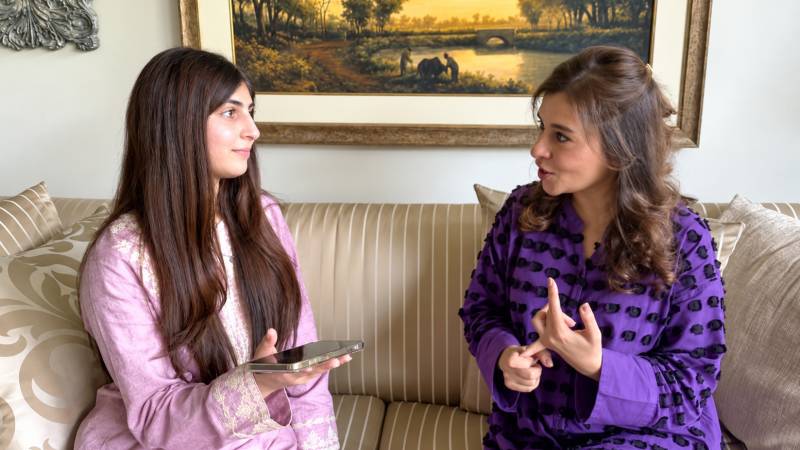
I had the opportunity to meet Ayesha Raza Farooq, Chairperson of the National Commission on the Rights of Child (NCRC), who kindly agreed to answer a few questions on the spot. What follows is an unplanned but illuminating conversation that offers a rare direct look into the state of child protection in Pakistan today.
Q: What in your opinion is the biggest child-rights issue?
A: There are so many interconnected issues facing children that it's hard to choose just one. Most critical are lack of education and healthcare. Pakistan has one of the highest out-of-school numbers in the world, approximately 26.8 million. Even those in school aren't learning much, it's "learning poverty." We also have one of the highest stunting rates in the country. On the child-protection side: abuse, child marriage and child labour are also very serious. But if we can fix the education problem, I think a lot of the protection issues which make children more vulnerable to abuse would be resolved to a large extent.
Q: Pakistan has several laws designed to protect children. Is the bigger problem the weak laws or poor implementation?
A: The weakest link is enforcement and implementation, we need to improve implementation of the laws we have and strengthen the ones that are toothless. However, in order to ensure protection to our children, we have to work on a third and most important dimension of the problem, that is behaviour change in the communities at the very grassroots level and that starts with awareness. For example, the Anti-Rape (Investigation and Trial) Act 2021 created special courts, investigation units and anti-rape crisis cells at the police level but very few women and girls use them. Community change means getting people to report and "community" includes the entire criminal justice system: police, prosecution and judiciary where there's still a lot of pushback and survivor-blaming. Right now reporting is low, evidence is weak because witnesses don't come forward and families often withdraw cases so investigations stay weak and trust in the system stays low. Everyone in influential roles: police, politicians, bureaucrats, religious scholars and teachers need a child-sensitive and gender-centric lens.
Q: What are NCRC's biggest obstacles?
A: NCRC's mandate is that of an oversight body not an executive authority like police or judiciary. Our mandate is to check government, advise on policy and legislative reform, raise awareness, sponsor research and inquire into violations of child rights which we then refer to the appropriate authority including police, Federal Investigation Agency (FIA) & National Cyber Crime Investigation Agency (NCCIA). For us, the obstacles are: lack of coordination between institutions, not enough efficient complaint-redressal mechanisms and not enough rehabilitation centres for child survivors. We need law enforcement agencies, child protection, social welfare, provincial and federal governments to work together to prevent violations and ensure swift redressal. Survivors also need psycho-social support which is lacking, we need more psychologists and therapists to help rehabilitate and reintegrate children, including orphans and street children.
Q: Do you think one of the major obstacles would also just be fear in the survivors due to the reactions of their families and all the criticism they might receive if they do end up reporting the issue?
A: That's a problem on the reporting side, especially among children we're seeing it globally with tech-facilitated child sexual exploitation and abuse. If a child has shared an image with a friend or partner or is being blackmailed in a conservative patriarchal society, girls often don't tell their parents because of the shame involved and there have been honour killings and suicides linked to this. So yes, that's also a huge challenge for the Commission.
Q: How has social media and increased internet access changed the risks children face in Pakistan?
A: We're working on a national action plan for government on how it should be checked, but we don't support blanket bans, it's like saying "there are road accidents, so keep cars off the road." Our solution lies in more platform responsibility, age-appropriate content, parental guidance and digital literacy.
Q: Why does child labour particularly domestic child labour remain a serious problem in Pakistan to this day?
A: One problem is that domestic child labour is normalized by people justify it by saying "we're feeding them better, dressing them better." I think that's completely indefensible, we shouldn't normalize child labour. These families should be supported with school enrolment, scholarships and stipends instead. On the legal side, these children are invisible while the provinces' new child labour surveys only count the formal sector, not domestic settings. Domestic child workers are the most vulnerable because they're invisible: no proper breaks or fixed hours, sometimes locked up when employers go on holiday and some fall into modern-day slavery, where families collect a year's advance salary and never check on them again. The known “Rizwana case” is an example, she was sent from Sargodha to work in a sitting civil judge's house in Islamabad and it only came to light that she'd been beaten to death when her body was returned to her parents. That's when the Commission drafted a bill to ban children in domestic labour because they're invisible, vulnerable and uncounted. The bill hasn't been passed yet; we want child domestic labour to be a non-bailable, non-compoundable offence, so powerful families can't settle out of court and go scot-free which is exactly the pressure building in Rizwana's own case, two years on. These cases need to move quickly, while parents' resolve is still strong, before it erodes toward settlement.
Q: Why do child marriage and forced marriage continue despite legal protections?
A: Khyber Pakhtunkhwa is the only province still lagging on this law. These new laws also added stricter punishments for anyone complicit in solemnizing an underage marriage, for example the registrars, Nikah khawans or families and made the National Identity Card number mandatory, because we have one of the lowest birth registration rates in the world. Without a registered birth certificate, there's no way to verify a child's age and age-determination tests carry roughly a two-year margin of error, which is exactly how the defence in Rizwana's case argued that she was older than she was. That's why we keep saying: please register your child's birth.
Q: What is the NCRC doing in provinces like that to help implement the law?
A: Our role isn't implementation, that's the job of the institutions like courts and police. Our role is advocacy: pushing the relevant government to act. We work with Chief Ministers, NGOs, civil society and assembly members. In Balochistan, for example, the Chief Minister, Sarfraz Bugti Sahib, committed to passing this as the first law after taking office.
Q: How does the NCRC make sure that children themselves have a voice?
A: Child participation is central to the UNCRC, which Pakistan has ratified. Children's voices should be in the room when decisions about them are made. The NCRC is the only commission in the SAARC region with two sitting child members, plus a voluntary Child Advisory Panel of about 60 children aged 15 to 17, representing both genders and transgender children, selected for one-year terms. For every major piece of work, a policy on drug abuse or on tech-facilitated child sexual exploitation, we talk to these children first. They guide our work, help run events like International Children's Day and Child Labour Day and just helped us translate the UN's Concluding Observations on Pakistan into a child-friendly, pictorial format.
Q: One last question, if you could change one thing about the way Pakistan protects its children tomorrow, what would it be and why?
A: Almost 50% of Pakistan's population is under 18, we're an extremely young nation and if we don't invest in our children today, we're looking at a very bleak future. That responsibility isn't just the government's, it's parents, caregivers and teachers too. First: let's plan our families, so we can raise, educate and clothe them better. Second: let's get every child into school, that alone would take care of a lot of the issues raised here, whether it's child labour or child marriage. Parents have told us that safe secondary schools for girls would stop early marriage and that children in school rather than on the street wouldn't be exposed to rape, abuse and exploitation. Government alone can't do this, the private sector needs to help too, improving non-formal education, updating curricula and adding skills-based learning, so children have somewhere to go after matriculation. I know this is not one, but this is the bear minimum that is required as a starting point.