

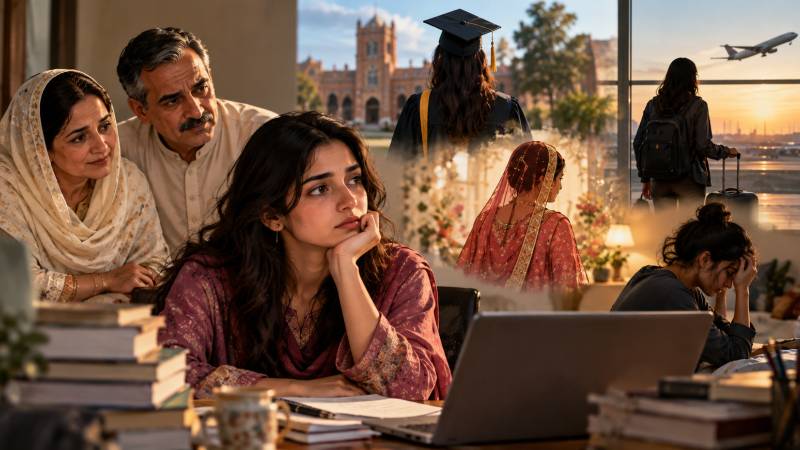
Growing up in many Pakistani homes is rarely seamless; it comes with an unspoken contract: studying hard, opting for and securing a reputable job, making your parents proud, supporting the family, pleasing relatives, and tying the knot at the right age. To help realise a worthwhile life for their children, parents sacrifice all that they have. Given the sacrifices parents make for their children, their efforts and expectations of them are not inherently bad; they are, nevertheless, often influenced by social trends that, when overwhelming, can take a toll on children's potential and on the lives they could otherwise have lived. Consequently, caught between fulfilling family responsibilities and building an individual life, many young Pakistanis face a challenging question: how much of your own life can you put off to become the child everyone expects you to be?
Choosing a degree is often where this burden begins. A student interested in the social sciences may be guided towards medicine or engineering. For a first-generation university student, the pressure can be considerably higher. When a family has spent years of savings on a child's education, failure can feel less like an individual setback and more like letting down everyone who contributed to the journey. The severity of this pressure is illustrated by recent events. In January 2026, a 21-year-old D-Pharmacy student, Fatima, at a private university in Lahore reportedly attempted suicide after, according to police, experiencing pressure from her family to continue studying a subject she found challenging. She had reportedly performed well academically, with 94 per cent attendance and strong mid-term scores.
The incident should not be reduced to a simple story about “strict parents”. Academic pressure, personal circumstances and mental health can intersect in complex ways. But it raises an uncomfortable question: when does guidance become pressure, and when does parental concern leave too little room for a young person to make decisions about their own future? The pressure does not necessarily go away after graduation. According to the Pakistan Bureau of Statistics’ Labour Force Survey 2024–25, Pakistan’s unemployment rate increased from 6.3 per cent in 2020–21 to 6.9 per cent in 2024–25. The rate was considerably higher among young women than young men.
Being the responsible child should not require being silent; young people should be able to acknowledge the sacrifices their families have made while still communicating their ambitions, struggles and vision for their own lives.
In such circumstances, a son may feel he must start earning quickly because his parents are growing old. A daughter may have a degree but feel compelled to prioritise marriage over employment. The choice is rarely between selfishness and responsibility. It is often between different forms of responsibility. Similarly, someone may want to leave Pakistan because of limited opportunities, while their parents worry about being left behind. Migration can become an extension of this pressure. Data from the Bureau of Emigration and Overseas Employment showed increases in brain drain of 178 per cent in 2022 and 76 per cent in 2023. At the same time, the Higher Education Commission estimates that more than 400,000 undergraduates, postgraduates and PhD graduates enter the labour market each year. For some families, migration is therefore not simply an individual career decision. It becomes a family strategy.
For women, the equation can be even more problematic. A daughter may be encouraged to obtain a university degree but later encounter limitations around mobility, employment, job choices and marriage. The expectation may not be “do not study”; it may instead be “study, but eventually prioritise family”. That contradiction matters. Marriage adds another layer. For many women especially, reaching a certain age can trigger a shift in family conversations from “What do you want to study?” to “When are you getting married?” The result can be a generation that becomes exceptionally good at appearing fine.
For instance, a young person may not tell their parents that they are struggling to find work. They may avoid discussing financial difficulties because they do not want to become a problem for the family. They may simply say, “I’m fine,” but being the responsible child should not require being silent. Admittedly, parents cannot solve Pakistan’s unemployment problem; young people cannot simply be told to follow their dreams without considering economic realities. Universities cannot guarantee jobs, and families cannot carry financial obligations indefinitely.
What can change is the conversation. Parents can ask not only what job will give their children security, but also what kind of life they want. Young people can communicate their ambitions while acknowledging the sacrifices their families have made. Universities can provide stronger career counselling. And society can stop treating every unfamiliar career choice as evidence of failure. Ultimately, the definition of a good child may need to evolve. A good child should not be the one who fulfils every expectation without question. It should be someone who grows into a self-sufficient, responsible adult — someone who can support their family without completely abandoning their own aspirations. Perhaps the real measure of a successful family is not how perfectly its children follow a predetermined path, but whether they are given enough trust and space to build a meaningful life of their own.