

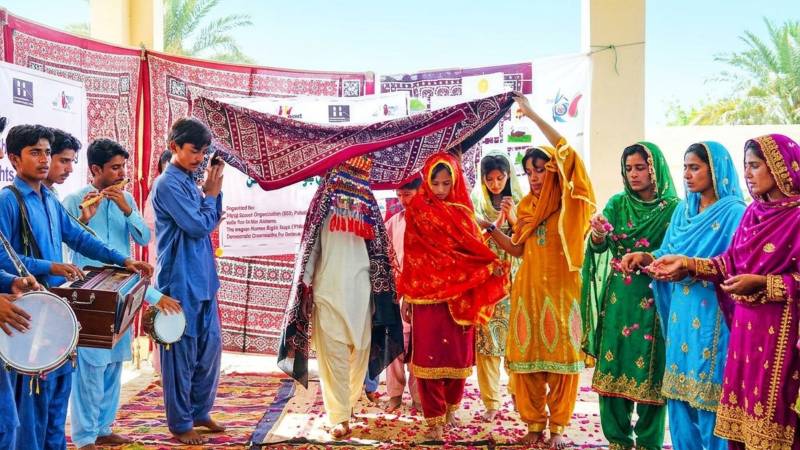
For Bakhtawar (pseudonym), a 12-year-old girl from Balochistan's Green Belt (Nasirabad Division), childhood was never a luxury of envisioning a future for herself. Her life days revolve around doing embroidery, stitching clothes and carrying out household chores. These domestic skills are taught to girls from an early age. Marriage was not a matter of personal agency. In her belt, decisions about marriage are usually taken by older family members, while a girl's consent was rarely taken into consideration. “Girls are rarely consulted regarding their marriage decisions,” Bakhtawar says.
She was only 12 when she was married, shortly after experiencing her first period. She was still a child who was learning how to navigate childhood when she was expected to assume the role of a wife and homemaker. There had been no plans for her education and career. Her future was influenced by what she had witnessed around her: marriage, shifting into her husband's home and taking responsibility for domestic duties. “After marriage, I would become a housewife and look after the household,” she recalls. The change was not simply from one household to another. It was a sad shift from childhood dreams into household responsibilities.
When she had her first child, she had little idea how to cradle the newborn baby properly. She had to rely on mother-in-law. Her husband, a drug-addicted wage labourer couldn't provide adequate financial support for the household. Bakhtawar had to count on embroidery and sewing to earn money. But those earnings were not always under her control. “When my husband needed money, he would take the earnings while, refusal could lead to physical violence,” she said.
The mistreatment also included constant belittling, taunting and scolding at home. She continued carrying out domestic chores despite enduring all forms of violence and the dearth of financial support from her husband. As the mistreatment escalated, her brother eventually took her back to her family's home. According to her brother, Bakhtawar returned home carrying all anger, anguish and resentment after going through all traumatic experiences in her marital home. “She shouldn't have to live with violence, mistreatment, and exploitation, work all day for them without recognition, and then put up with their insults and taunts as well,” her brother Zulfiqar asserted.
Bakhtawar's experience mirrors a broader challenge being faced by girls in Balochistan, where child marriage is linked with gender disparity, educational constraints and restricted personal agency. According to the National Commission on the Rights of Child’s 2024 report, State of Children in Pakistan, data from 2019-20 reveals that 21.9 per cent of women aged 20-24 in Balochistan were married before reaching 18, and 7.2 per cent were married before reaching 15. The flagship report titled “Drivers of Child Marriage in Pakistan” compiled by the United Nations Children's Fund's (UNICEF) further classifies poverty, traditional power hierarchy and societal pressure regarding puberty as the collective factors prolonging this practice. From a legal perspective, the case raises serious concerns under Balochistan’s child protection and child marriage laws.
Balochistan High Court (HC) Advocate Abdul Hayee who is working on child rights, said the Balochistan Child Marriages Restraint Act 2025 designates 18 years as the minimum legal age for marriage for both males and females. “Any marriage below the prescribed age is deemed unlawful,” he said, and also pointed out that the law imposes penalties for those who conduct and facilitate child marriages. He emphasized that a 12-year old can not be considered as mature enough to make informed consent regarding marriage. Parental agreement does not override the statutory prohibition. The advocate stated that the Balochistan Child Protection Act 2016 provides a legal framework for safeguarding children who are vulnerable to violence, disregard and exploitation.
Balochistan-based Gender Based Violence (GBV) Specialist Imrana Imdad said child marriage is a serious infringement of girls’ rights, particularly when it takes place without their free consent. A 12-year-old girl is too young to comprehend the long-term implications of marriage, she said, further observed that it robs girls of their childhood and its emancipation while risking their dignity, safety, well-being and personal agency. Girls who are married at a young age are more vulnerable to gender-based violence because they have no clue how to navigate the responsibilities and expectations of married life. “These girls are forced to carry out household chores for their husbands and in-laws while being denied financial independence despite earning their own money” she uttered. The specialist further stated that innumerable girls endure sufferings in silence because they fear social stigma, family pressure and possible accusations for inviting shame and dishonour upon their families. In rural belt, such as in Nasirabad division, low literacy ratio, deep-seated traditional norms and limited access to institutional support can make it herculean for girls to seek assistance. “Leaving an abusive marriage is akin to sacrificing family support, financial security and social acceptance,” she said, elaborating that economic reliance on men further constraints women’s choices especially when one is a mother. Child marriage, too, interrupts girls’ education and narrows their avenues for economic independence. Given the role of legal framework, she stressed that legislation is insufficient to eradicate these customs and traditions. “Laws alone cannot eliminate a practice that is deeply embedded in social structure,” Imrana clarified.
Parents, tribal leaders, religious scholars, educational institutions and relevant authorities must also play their respective roles in confronting these deep-rooted practices and ensuring that girls reporting abuse are protected rather than silenced. She emphasized that tackling poverty, ensuring greater access to education and enhancing girls’ livelihood opportunities are equally crucial as financial strain often prompts some parents to treat early marriage as a solution to ease the burden of household responsibilities.
A child protection officer working in the Social Welfare Department, Government of Balochistan, agrees to spoke on the basis of anonymity, said child marriage remained a widespread concern in Nasirabad division, while cases in other parts of the province mostly go undocumented. In some communities, he said, this practice is still regarded as an accepted traditional norm. “The real problem does not lie in the absence of laws, but the lack of institutional framework to implement them,” he said, adding that girls subjected to domestic violence mostly face barriers from seeking institutional protection.
He said Balochistan's child protection services lack unsatisfactory infrastructure while government-operated centres are struggling to provide adequate space, capacity and facilities. Dar-ul-Aman, which provides accommodation to women in distress, has a limited capacity of 50 residents, which is considered insufficient to address the shelter needs of entire Balochistan. He added that shortage of shelter facilities and the absence of sustainable arrangements could put the lives of the vulnerable girls at risk.
Poverty, geographical isolation and a lack of trust in law enforcement further prevent children and their families from seeking help, he said. Families in remote areas often cannot afford to travel to major cities to access protection services, while decisions made within patriarchal social structures may favour men. “Poverty is not the sole factor. Gender disparity, economic vulnerability, local traditions and patriarchal structures collectively contribute to girl's vulnerability to child marriage and domestic violence,” he stated. In certain cases, he added, girls are viewed as commodities from whom families anticipate financial reward rather than treating them as individuals with rights.
The officer also underpinned the significance for effective coordination among government departments overseeing child protection, women's development and law enforcement. He further said that protection centres require sufficient accommodation, educational facilities and alternative care arrangements to ensure a secure environment for children whose return to their families is not a safe option. “Every district should have a fully resourced child protection centre,” he said, emphasizing that legislation must be backed by effective enforcement, functional institutions and transparent accountability. He said that safeguarding girls required more than legislative measures or policy declarations. “Good governance, capable institutions, sense of responsibility and merit-based systems are indispensable to protect girls rights and well-being.”