

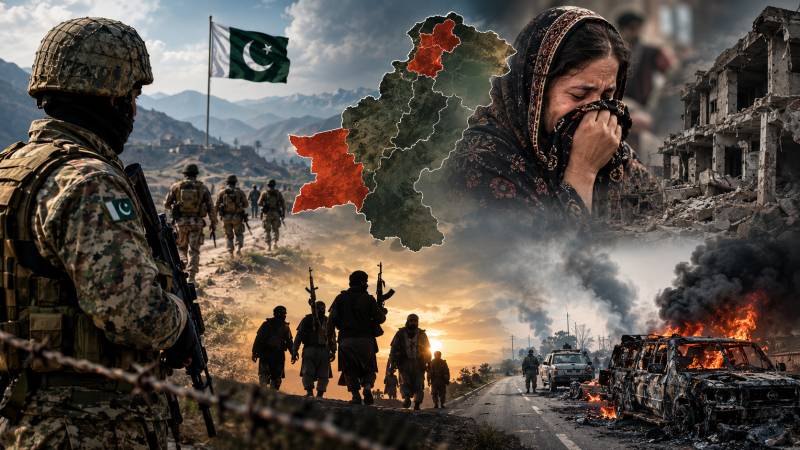
Pakistan recorded an alarming 83 percent increase in violence-related fatalities during the third quarter of 2026, reversing the declining trend witnessed during the first and second quarters of the year. There was also a significant rise in deaths resulting from terrorism and counter-terrorism operations across the country.
According to a report by the Centre for Research and Security Studies (CRSS), the period from July to September 2026 witnessed a substantial increase in terrorism, counter-terrorism operations and other violent incidents. Balochistan emerged as the worst-affected province, with the number of fatalities increasing more than threefold compared with the second quarter. Nearly 88 percent of the national increase in violence-related fatalities was attributed to Balochistan.
Khyber Pakhtunkhwa (KP) remained the second most affected province after Balochistan. Both provinces once again remained the main centers of terrorism and counter-terrorism operations in the country. According to the report, Balochistan and KP together accounted for approximately 98 percent of all violence-related fatalities recorded in Pakistan during the third quarter.
The CRSS report states that at least 1,415 violence-related fatalities were recorded across the country during the three-month period. These included civilians, security personnel and other individuals. A total of 585 violent incidents were reported, including terrorist attacks and counter-terrorism operations.
Balochistan recorded 829 fatalities, accounting for approximately 59 percent of the national total. Khyber Pakhtunkhwa recorded 556 fatalities, representing more than 39 percent of the total. Together, the two provinces accounted for 1,385 deaths, or approximately 98 percent of all violence-related fatalities in the country.
Balochistan also recorded the highest number of violent incidents, with 186 incidents, representing more than 48 percent of the national total. KP followed with 173 incidents, accounting for approximately 45 percent of all reported incidents.
The number of people injured also reflects the severity of the situation. In Khyber Pakhtunkhwa, 376 people were injured, while 163 people were injured in Balochistan. Thus, the two provinces experienced not only the highest number of fatalities but also a significant proportion of injuries resulting from violence.
According to the CRSS, the increase in violence between the second and third quarters was the most significant quarter-on-quarter rise recorded since 2021.
An important feature of Pakistan's current security situation is that violence is not evenly distributed geographically. Balochistan and Khyber Pakhtunkhwa continue to bear the greatest burden of the country's security crisis. The available figures clearly indicate that the overwhelming majority of violence-related fatalities and incidents remain concentrated in these two provinces.
The situation requires not only an examination of military and security operations but also a deeper understanding of the factors that contribute to continuing instability. Border conditions, activities of armed groups, local conflicts, weak governance, underdevelopment, limited employment opportunities and problems of trust between state institutions and local communities in certain areas also require serious attention.
At the same time, the interaction of these factors can vary from one area and incident to another. Therefore, policy responses need to take local circumstances into account rather than relying solely on a uniform national approach.
The 83 percent increase in fatalities is not merely a statistical development. Behind these numbers are human lives lost, families devastated and economic activities disrupted. Every figure represents an individual tragedy as well as a wider social and economic cost.
The CRSS report also indicates that a significant number of militants were killed during the third quarter. However, the continued loss of civilian and security personnel lives demonstrates that the law-and-order and security challenges remain serious.
The report also examines attacks claimed by militant organizations. According to the CRSS, the Tehreek-e-Taliban Pakistan (TTP) claimed responsibility for 13 attacks during the third quarter, in which 117 people were killed. The Balochistan Liberation Army (BLA) claimed responsibility for five attacks, resulting in 34 deaths and 42 injuries.
The report also points to changes in the methods used in violent attacks. Vehicle-borne suicide attacks caused a combined 81 deaths and 204 injuries. Armed attacks resulted in 147 deaths and 116 injuries, while 58 incidents of firing caused 72 deaths and 18 injuries. Meanwhile, 16 drone attacks resulted in 13 deaths and 48 injuries.
These figures demonstrate that violence in Pakistan is taking multiple forms and involves a range of weapons and attack strategies. The changing nature of attacks presents an additional challenge for security agencies and policymakers.
The third-quarter figures once again raise an important question: if the decline observed during the first two quarters could not be sustained, what additional measures are required to establish lasting peace and security in the country?
The human cost recorded during these three months—1,415 fatalities and 558 injuries—demands that Pakistan's security situation be treated not merely as a matter of quarterly statistics but as a long-term national challenge.
There is a need to integrate security policies with political, administrative and economic measures at both the federal and provincial levels. In sensitive provinces such as Balochistan and Khyber Pakhtunkhwa, effective security measures must be accompanied by greater attention to the concerns of local communities, basic public services, education, employment, development and the effective rule of law.
A sustainable response to violence requires more than a short-term security approach. It requires continued efforts to strengthen institutions, improve governance, address local grievances and expand economic and social opportunities. The latest figures underline the urgency of such a comprehensive approach if Pakistan is to reverse the renewed rise in violence and move towards lasting peace and stability.