

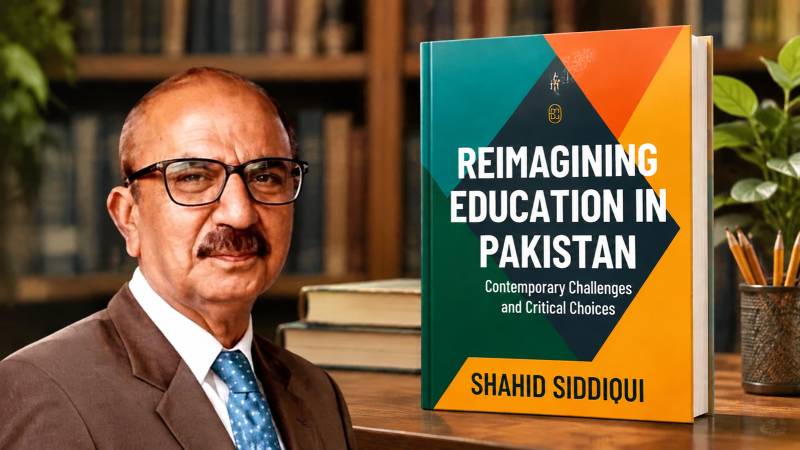
Book: Reimagining Education in Pakistan: Contemporary Challenges and Critical Choices
Author: Shahid Siddiqui
Publisher: Book Corner, Jhelum
What should education do for a society that is changing faster than its education system can respond? This question sits quietly beneath much of Dr Shahid Siddiqui’s Reimagining Education in Pakistan: Contemporary Challenges and Critical Choices. The book does not approach Pakistan’s education system as merely a collection of failures to be corrected. Instead, it invites readers to examine the structures that have shaped education—its policies, planning, language, institutions, universities, teachers and prevailing ideas and to ask whether these structures are still adequate for the demands of the present.
This question is particularly relevant today. Education is being reshaped by technological advancement, artificial intelligence and changing forms of knowledge, as well as increasingly complex social realities. In such a context, reform cannot simply mean adding another policy, changing a curriculum or introducing new technology into classrooms. It requires us to reconsider what education is meant to achieve in the first place.
Dr Siddiqui’s book brings together nine broad areas of discussion: contemporary educational discourse; educational challenges in Pakistan; education and the twenty-first century; education and teaching; the state, education and planning; language and education; the role of education and universities; teachers and teaching; and education and change. The breadth of these themes is one of the book’s strengths. Rather than isolating individual problems, Siddiqui places them within the larger educational structure and connects them to wider questions about society and national development.
The book is also notable for its accessible and contextually relevant language. The discussion is research-driven but remains accessible to readers outside academia. International comparisons are used to place Pakistan’s educational challenges within a wider context and, importantly, to suggest that the difficulties facing the country are neither permanent nor unavoidable. Dr Siddiqui highlights possible approaches and solutions, lending the book a constructive and optimistic tone. He does not leave readers with a diagnosis alone; he also asks what might be done differently.
One of the ideas that stayed with me while reading the book was the need to look beyond individual problems and examine the structures within which education operates. Policies, planning, language, institutional governance and university autonomy are not separate concerns. They shape one another and, together, determine what becomes possible within an education system. The discussion of universities, for instance, raises important questions about institutional autonomy and the role universities can play when their ability to make independent academic and institutional decisions is constrained. Similarly, the discussion of language moves beyond its role as a medium of instruction and considers its relationship with identity, opportunity and social division.
The discussion of teachers is particularly important when considering the implementation of reform. Educational policies may be designed at the level of governments and institutions, but they must ultimately reach the classroom. Teachers and school administrators working at the grassroots level are the people who translate educational intentions into everyday practice. In this sense, they are frontline actors in educational reform, often described as street-level bureaucrats.
This raises a question I found particularly important: how much trust and autonomy do we give to the people expected to implement change? Teachers cannot be treated simply as recipients of policies developed elsewhere. They work with students who have different needs, in different contexts and under different institutional conditions. If reform is to become meaningful rather than remain another policy document, teachers need professional trust, appropriate autonomy and meaningful opportunities to participate in the reform process.
Dr Siddiqui’s discussion of teacher training adds another important dimension to this question. His concern about the declining quality of teacher training over the decades points to a contradiction within educational reform. We continue to expect teachers to respond to increasingly complex demands, yet the professional preparation and support available to them do not always keep pace with those demands. Reform, therefore, cannot be separated from investment in the people expected to carry it forward.
Educational reform cannot be achieved through new policies and technologies alone; it requires institutional autonomy, professional trust in teachers, and a willingness to question the assumptions on which the system itself is built.
This brings us to one of the larger challenges facing education in Pakistan: the gap between planning and implementation. According to the book, the country has witnessed ambitious educational plans and reform agendas, often emerging in response to changing national and international debates. Yet the existence of a reform plan does not necessarily translate into reform in practice. The deeper challenge may lie in how stakeholders understand, participate in and sustain change. If reform is to result in meaningful improvements, it requires contextualisation rather than the wholesale adoption of international agendas and funding priorities. Furthermore, reforms require a proper implementation framework, with clearly defined phases. For instance, we cannot overhaul the entire system at once, as governments sometimes attempt to do during the census phase of an international survey.
Another part of the book that I found particularly thought-provoking is Dr Siddiqui’s discussion of education and change, especially his emphasis on the role of writing and ideology. Writing may appear secondary when compared with policy, funding or institutional reform, but it can perform a different and equally important function: it can create a vision. Writing tells stories, articulates ideas and gives people a language through which to develop a vision for education. Such writing is not only for policymakers or academics. It can shape how teachers think about their profession, how parents understand the purpose of schooling and how students imagine their own possibilities. It can contribute to the formation of an individual's self-concept, as well as a broader vision of the kind of society education should help create. Dr Siddiqui’s observation that there is a need for more educational literature and creative work is therefore significant. Educational change requires not only new policies but also new ways of imagining education.
This idea becomes even more relevant in the age of artificial intelligence. Dr Siddiqui argues for an education system that moves beyond conformity towards critical discourse, viewing education as a tool for change, both in the life of the individual and in the wider social fabric. AI makes this question even more urgent. Students who know how to use AI effectively may increasingly have an educational advantage over those who do not. But this creates a paradox. If education responds to AI mainly by teaching students how to use AI tools more efficiently, we may end up confusing technological skills with education itself. A student may become highly skilled at generating an answer without necessarily developing the knowledge, judgement or intellectual capacity required to evaluate it.
Perhaps, then, the challenge for education in the AI era is not simply to teach students how to use AI, but to ensure that they have sufficient knowledge and critical agency to use it meaningfully. When information can be generated in seconds, students need to know how to question it, evaluate it, connect it with existing knowledge and decide what it means. They need to understand not only how to obtain an answer, but also how to ask a worthwhile question in the first place.
This brings the discussion back to one of the book’s most important concerns: the purpose of education. If education is organised primarily around conformity, its function may be to reproduce existing knowledge, expectations and structures. But if education is understood as a form of critical discourse, it can become a space where individuals learn to question, interpret, create and participate in change. In this sense, Reimagining Education in Pakistan is not simply about improving an existing system. It asks us to rethink what we expect the system to produce.
The book’s greatest strength is perhaps its refusal to treat educational problems as isolated technical issues. Its discussions of policy, language, universities, teachers, planning and change point towards a larger question: what kind of individuals and what kind of society should education help us create? Its constructive tone is important here. Siddiqui identifies serious structural challenges, but he also leaves room for possibility through international learning, institutional reform, better teacher preparation and a renewed educational imagination.
For teachers, policymakers, researchers, university educators, parents and others concerned with the future of education in Pakistan, the book offers much to consider. More importantly, it invites a shift in how we think about reform. Educational change cannot be achieved simply by producing new plans, introducing new technologies or asking teachers to implement new directives. It requires vision, trust, professional agency and a willingness to question the assumptions on which the system itself has been built. Ultimately, to reimagine education may mean more than deciding what students should learn. It may require us to ask what kind of people we want them to become and what kind of society we want their education to make possible. In an age in which machines can increasingly produce answers, perhaps the enduring task of education is to help human beings learn how to ask better questions.