

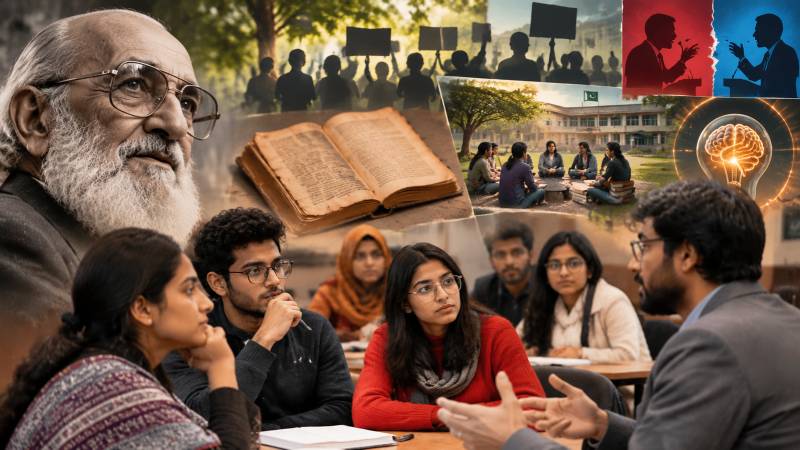
In an age of algorithmic echo chambers, partisan slogans, and rigid syllabi, it is worth asking whether our classrooms are teaching young people how to think or simply what to repeat. Whenever educators critique rote memorization and passive instruction, one name inevitably comes to mind: the Brazilian philosopher Paulo Freire and his landmark work, Pedagogy of the Oppressed. Yet Freire’s relevance today extends far beyond classroom mechanics. His vision of education as the "practice of freedom" offers an urgent framework for navigating social upheaval, polarization, and institutional reform.
At the heart of Freire’s philosophy is a simple but radical distinction: human beings are meant to be Subjects who interpret their reality and shape history, rather than passive objects acted upon by decisions made elsewhere. Education, in this view, is never neutral. It either trains learners to adapt quietly to inherited arrangements or equips them to examine the conditions of their lives and contribute meaningfully to changing them.
Freire describes historical eras as defined by central themes—a society’s shared hopes, problems, values, and unfinished tasks. When societies undergo rapid cultural or technological "tidal waves," the meanings attached to work, authority, belonging, and progress become fiercely contested. In such moments, education must help learners navigate the tension between tradition and emerging possibilities without falling into two familiar traps: assuming that everything inherited is obsolete, or assuming that every new trend represents genuine progress.
When critical engagement is missing during periods of transition, societies become vulnerable to what Freire called myth-making and massification. Myth-making relies on simplified narratives circulated through media, advertising, and political rhetoric to obscure complex realities and make manipulation easier. Massification occurs when citizens are drawn into modern social life without gaining any real voice in the decisions that govern them. As Freire warned in Education for Critical Consciousness, a massified society is one in which people are "manipulated by the elite into an unthinking, manageable agglomeration."
Where massification prevails, leaders often reach for imported, one-size-fits-all policies without understanding local realities. Meanwhile, public discourse slides into naive transitivity—a state marked by broad generalizations, weak arguments, resistance to evidence, and a preference for noisy polemics over genuine dialogue.
Critical consciousness demands a far more disciplined relationship with reality. It requires learners to look for root causes rather than scapegoats, test claims against evidence, distinguish between an assertion and an explanation, and remain willing to revise their conclusions when confronted with new facts.
Critical consciousness—what Freire termed conscientização demands a far more disciplined relationship with reality. It requires learners to look for root causes rather than scapegoats, test claims against evidence, distinguish between an assertion and an explanation, and remain willing to revise their conclusions when confronted with new facts. Crucially, critical inquiry also requires the humility to question our own assumptions. An educator’s role is not to hand down a fixed sequence of approved opinions, but to cultivate this habit of reflective questioning as a lifelong practice.
Without that habit, social anxiety can easily curdle into fanaticized consciousness—an emotional reaction detached from careful examination of reality. When slogans replace inquiry and imposed certainties silence doubt, even heightened public awareness can be captured by demagoguery, leaving citizens passive, fearful of freedom, and susceptible to manipulation.
This is not an argument for stripping emotion from education. Hope, moral concern, courage, and commitment are essential to meaningful action. The danger arises when emotional intensity becomes a substitute for evidence, reasoned judgment, and respect for human dignity. Critical education helps learners anchor their deepest commitments in informed understanding rather than blind reactivity.
To illustrate this balance, Freire drew a sharp line between radicalization and sectarianism. In everyday speech, "radical" is often used as a synonym for extremist or coercive. Freire meant the exact opposite. To be radical, in his view, is to hold a deep, courageous commitment to justice while remaining humble, communicative, and respectful of another person’s freedom to choose. The radical invites dialogue and refuses to accept systems that dehumanize people, yet never seeks to impose their will by force.
Sectarianism, by contrast, is arrogant, emotional, and anti-dialogical. Whether it emerges from the political right or the political left, the sectarian treats relative judgments as absolute truths, refuses to listen, and tries to impose a single orthodoxy on everyone else. In a fractured society, the antidote to sectarianism is not apathy—it is dialogical education.
As Freire famously wrote, "Education is an act of love, and thus an act of courage. It cannot fear the analysis of reality or, under pain of revealing itself as a farce, avoid creative discussion." An education grounded in love recognizes every learner as a person whose lived experience and voice matter. Courage is required because honest inquiry inevitably exposes contradictions not only in society’s established arrangements, but in our own institutional practices. Building a horizontal relationship of inquiry does not diminish a teacher’s responsibility for expertise, preparation, and guidance; rather, it demands that authority be exercised without humiliation or silencing.
Freire gave practical form to this ideal through "culture circles," where literacy was paired with open discussion of everyday realities. Learning to read the word became inseparable from learning to read the world. For our own schools and universities, Freire’s ideas offer a pressing set of questions rather than a ready-made blueprint to import. Can students openly examine problems affecting their communities without fear of ridicule? Are they taught to weigh competing explanations, evaluate evidence, and propose constructive action? A classroom discussion on unequal educational opportunity, for instance, should not prescribe a partisan conclusion; it should train students to investigate disparate circumstances, verify facts, and recognize shared civic responsibilities.
Sustaining such learning, however, cannot rest on individual teachers alone. If classrooms are to become spaces of genuine inquiry rather than compliance, educational institutions themselves must change. Empowering learners to think critically requires leadership that values dialogue over control, supports teachers as reflective practitioners, and aligns institutional vision with the courage to ask difficult questions. Only then can education fulfill its promise—not as an instrument of conformity, but as the practice of freedom.