

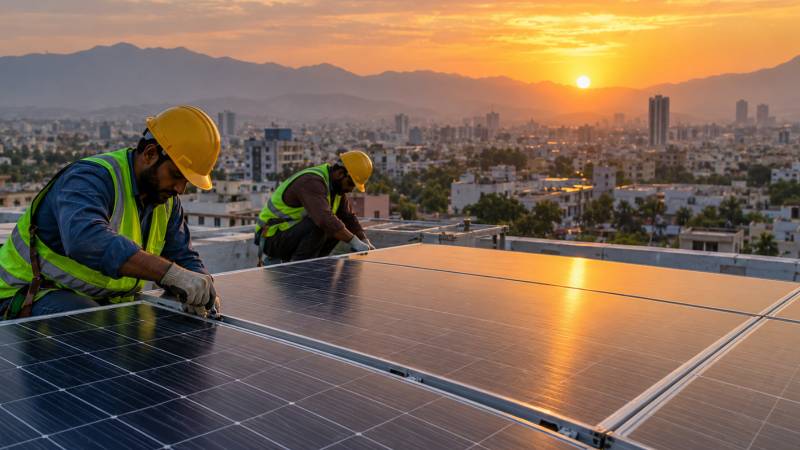
Every prodigious policy level twitched with surprise, and Pakistan's surprise came in shipping containers. They arrived at Chinese ports, bursting with glass and aluminium, then were trucked and stacked on the roofs of houses, farms, and factory sheds. In 2022, Pakistan imported around 3.5 gigawatts (GW) of solar panels, and by 2024, that figure had increased fivefold. A businessman turns off the diesel generator in his shop on a Lahore Street and welcomes the silence. In Pakistan, millions are doing the same, signifying solar energy as a substitute for the national grid. This uprising was not marked by any minister cutting ribbons. Ordinary families scrutinised their electricity bills. From FY2021 to FY2025, electricity prices increased by almost 140%, the rupee depreciated by around 75%, and imported solar panel prices dropped by around 60%. As of 2025, solar energy has become a significant component of Pakistan’s energy mix, accounting for approximately 25% of electricity generation. It is no longer a pilot initiative but an established part of the country’s energy transition. This is a people-led revolution.
Nonetheless, the global energy sector is also moving in the same direction. In 2026, total global energy investments are predicted to rise to $3.4 trillion, with $2.2 trillion directed toward clean energy and $1.2 trillion to fossil fuels. Surprisingly, the question remains whether Pakistan should embrace this transition and, if so, how it should manage it effectively. The solution is built on four pillars (4Es): Energy, Economy, Environment, and Equity. Pakistan’s estimated 38 GW of distributed solar capacity, combined with approximately 41 GW of officially recorded installed power generation capacity, brings the country’s estimated total installed capacity to around 79 GW. In FY2025, these structures generated about 51 TWh of power, representing 46% of grid electricity sales, and grid demand grew by only 1.7%. The solar transformation initiative in Pakistan will save an estimated $100–120 billion in fuel import costs over time. The country imported solar panels worth approximately $7.4 billion between FY 2017 and FY2025. The solar shift reduced fossil fuel imports by 40% between 2022 and 2024. Furthermore, the solar transformation has saved around $12 billion on LNG imports between 2021 and early 2026. The shift will reduce the burden on Pakistan’s import bill, conserve foreign exchange, and strengthen the country’s long-term energy security.
The environmental benefits are equally significant. In 2025, Pakistan's electricity generation originated from around 50% low-carbon sources, while the global average was 43%. Pakistan's per-capita power-sector emissions are only about 1/10th of the global average. Clean energy is not merely an environmental accountability; it is also a matter of national security. Although Pakistan contributes approximately 1% of global greenhouse gas emissions, it remains highly vulnerable to climate-related disasters, including heatwaves and devastating floods.
Pakistan’s estimated 38 GW of distributed solar capacity, combined with approximately 41 GW of officially recorded installed power generation capacity, brings the country’s estimated total installed capacity to around 79 GW.
Equity is another important consideration, as the available data highlight significant disparities in the distribution of solar energy’s costs and benefits. During FY2024, Rs 1.9 trillion was extended for power plants to generate electricity. This massive influx of fixed payments pushed electricity costs up by as much as 46%. In February 2026, the power sector's circular debt was Rs 1.8 trillion. Fixed costs account for around a Rs 19-20 per unit increase in electricity bills for grid-connected consumers. Meanwhile, electricity consumption from the national grid has dropped by 11% in three years as more patrons who can afford to buy solar panels opt to generate their own electricity.
As more consumers shift to solar energy, fewer households may rely on grid electricity. Consequently, fixed grid costs may be spread across a smaller customer base, increasing the financial burden on households that cannot afford to install solar systems. However, an energy transition that excludes low-income households can hardly be considered successful. Moreover, restricting rooftop solar adoption may accelerate consumers’ shift away from the national grid. However, this approach is not viable. Pakistan’s primary challenge is managing capacity payments rather than expanding generation capacity, as the country already has underutilized power plants. Pakistan lacks institutions that can turn its potential into influence — good rules, good professionals, open data and trusted partnerships. Hence, we propose a Four-E Solar Compact based on institutional capacity and soft power.
The government should reduce dependence on imported fossil fuels and switch power plants to solar and wind energy for electricity generation. Economic sustainability is a big challenge for the incumbent government. The government should renegotiate capacity-payment agreements with independent power producers to reduce the unnecessary financial burdens on consumers. To do this, it should encourage local manufacturers of solar panels, batteries, and other equipment. Environmental protection is yet another key challenge for the incumbent government. Solar and wind energy can reduce reliance on fossil fuels and other suitable low-carbon energy sources. Equity and inclusion are key measures for low-income households, small farmers, and small businesses. For this, the government should develop subsidies or grants for low-income families to help cover the initial costs of installing solar plants. Developing a skilled workforce is also needed; the government should promote vocational training and university partnerships to strengthen the energy sector.