

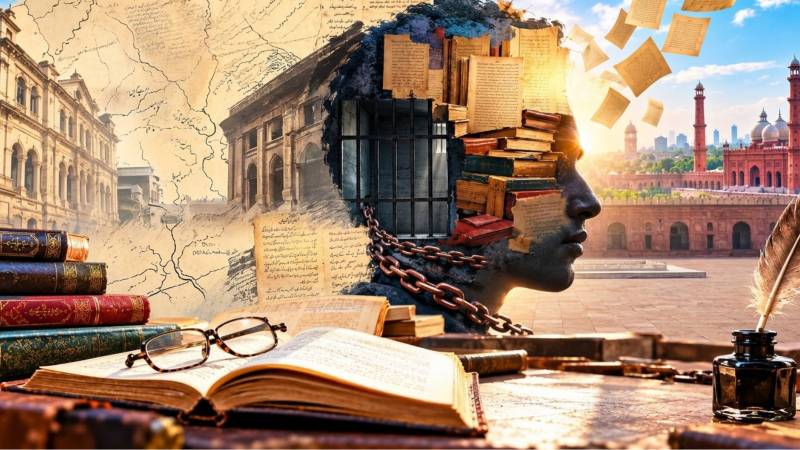
During my school years in Lahore, I read Urdu literature voraciously, until English gradually took over in the later years of my schooling. Reading opened doors beyond the classroom to lives and possibilities larger than my own. Yet a question began troubling me later, after I had started my career. Why had writers such as Faiz Ahmed Faiz and Habib Jalib not occupied a more substantial place in our formal education? Why had we not been encouraged to engage deeply with the Pakistan they questioned, mourned and imagined?
The colonization of consciousness means shaping how people think and judge until the powerful’s worldview feels like their own common sense. Anthropologists Jean and John Comaroff developed the concept in their work on colonial South Africa. Its deeper danger is internalized control when people begin to censor themselves before authority needs to intervene. My recollection concerns my own education, not every Urdu syllabus in the schools. Our formative reading helps define what we consider reasonable, patriotic and possible. Power can influence which histories deserve remembrance, whose suffering merits sympathy and which questions invite suspicion. Education can cultivate judgment or organize our loyalties before we can examine them.
Ngũgĩ wa Thiong’o explored language, culture and domination in Decolonizing the Mind. Pakistan’s experience extends that argument. Independence ended British sovereignty, but inherited habits of governing survived. The privileged official, the suspect dissenter and the public presumed incapable of confronting uncomfortable truths. The colonial administrator departed but the conviction that society required supervision proved harder to dislodge. The contradiction appeared early. Jinnah’s address of August 11, 1947, envisaged citizenship unconfined by religious identity. Yet the new state struggled to accommodate other forms of diversity. His insistence in Dhaka in 1948 that Urdu would be Pakistan’s state language collided with the linguistic identity of its Bengali majority. The killing of language protesters in 1952 exposed the danger of confusing national unity with cultural uniformity. A language could become an instrument of exclusion even while being presented as a bond.
The narrowing of political imagination also began before the first martial law. In the Rawalpindi conspiracy case of 1951, Faiz and the progressive writer Sajjad Zaheer were arrested alongside military officers over an alleged plot to overthrow Liaquat Ali Khan’s government. The accusations went beyond forbidden verse. But an enduring question remains. Could the state investigate alleged criminal conduct without casting a wider shadow over leftist thought, intellectual association and dissent? Faiz’s importance exceeds his imprisonment. In Subh-e-Azadi, he confronted the distance between independence’s promise and its wounded arrival. His poetry allowed love of country to coexist with disappointment in its condition. His patriotism asks us to judge a country by its promises, rather than judge loyalty by a willingness to overlook its failures.
Under Ayub Khan, the takeover of Progressive Papers Limited in 1959 brought influential newspapers, including the Pakistan Times and Imroze, under state control. Habib Jalib’s Dastoor, written against the 1962 constitution, challenged the presentation of concentrated power as public consent. Jalib asked who actually possessed authority and whose interests the constitution served. His directness made political exclusion intelligible beyond the drawing room. Cinema carried this contest over consciousness into the public imagination. Riaz Shahid’s Zarqa (1969), centred on Palestinian resistance, brought Habib Jalib’s protest into popular film through its lyrics. His Yeh Aman (1971), originally titled Aman, addressed the struggle in Kashmir but underwent heavy censorship before release. Even a film about a cause Pakistan officially championed could have its vision curtailed. Sympathy for the oppressed did not necessarily include freedom for the artist interpreting their struggle.
The most enduring chains are those woven into the mind, until a society mistakes its captivity for culture, its conformity for virtue, and its silence for peace.
Shahid’s films belong beside the poems because both invited audiences to judge power through the experience of those subjected to it. Their politics remain open to criticism, but their survival matters. A society loses when cinema carrying difficult ideas to mass audiences becomes a footnote, and the censor’s version becomes the only one later generations can see. Ahmad Faraz belongs in this company. The poet celebrated for romantic longing also wrote against repression and lived in exile during Zia-ul-Haq’s rule. In 2006, he returned the Hilal-e-Imtiaz awarded to him two years earlier, protesting the Musharraf government. His example unsettles the convenient separation between the poet of love and the citizen of conscience. Sensitivity to personal humiliation can also sharpen recognition of public injustice.
Women writers exposed another frontier of control. Fahmida Riaz and Kishwar Naheed challenged the authority to prescribe women’s bodies, speech and place in society. Riaz faced sedition charges under Zia and went into exile in India. Their writing showed that domination operates inside households and conventions as well as governments. A society cannot claim intellectual freedom while treating half its population’s independence as a threat to its moral survival. Manto complicates this history further. He cannot comfortably be recruited into any obedient ideological procession as he quarrelled with progressive orthodoxies too. His obscenity prosecutions, before and after Partition, reveal the persistence of colonial legal restraints under new national ownership. His Partition stories confronted cruelty without distributing innocence according to communal identity. They required readers to look where respectable narratives preferred not to look. That discomfort had moral value.
These writers belong together without being identical. Jalib’s public defiance, Faraz’s lyricism, Faiz’s revolutionary humanism, feminist resistance and Manto’s unsettling independence offered different ways of refusing an authorized reality. Their disagreements matter. Replacing one orthodoxy with another would betray their work. Pakistan’s most devastating failure to accommodate political difference came in 1971. The Awami League’s electoral mandate was not translated into national power. Military repression, atrocities, civil war and war with India culminated in the country’s dismemberment. No single explanation captures that catastrophe. But years of presenting Bengali grievances through the language of suspicion helped diminish the possibility of understanding them. A population becomes easier to coerce once its demands have been made difficult to hear.
The long secrecy surrounding the Hamoodur Rahman Commission’s findings compounded the failure. Material emerged publicly in 2000, decades after the events it investigated. Enforced ignorance obstructs understanding of catastrophe. Orwell’s Nineteen Eighty Four offers a warning about power’s relationship with memory, although Pakistan has never been its completely sealed world. Here, competing memories survived in homes, literature, journalism and testimony, repeatedly challenging the official account. Under Zia, censorship and coercion reinforced a prescribed moral and political order. In 1978, journalists were sentenced to flogging for their resistance to press restrictions. The intimidation extended beyond those sentenced. Editors, teachers, artists and students could calculate the possible consequences of crossing uncertain boundaries. Control becomes economical when a few visible punishments teach many others to remain silent.
Curricula can sustain the same habits more quietly. The Sustainable Development Policy Institute’s The Subtle Subversion, initially released in draft in 2003, documented historical distortions, prejudice and inadequate encouragement of critical inquiry in the materials it examined. Without diminishing courageous teachers, the findings expose a basic problem. Children taught to reproduce approved conclusions may struggle to recognize the difference between evidence and authority. Responsibility does not belong to one institution or regime alone. Civilian governments, political parties, religious gatekeepers, media proprietors and influential families have also demanded obedience. Distortion does not always require conspiracy. Careers, patronage, fear and sincere conviction can produce conformity without a central command. Today, partisan digital communities reproduce their own versions of this discipline, rewarding loyalty and punishing unwelcome facts.
I fear our distance from the imaginative inheritance that might help us resist such confinement. We can celebrate culture ceremonially while becoming strangers to what its works ask of us. These traditions remain alive. The concern is whether admiration includes reading, understanding and argument. A familiar name or a beautiful melody is only the beginning of engaging with a demanding work. Dastan-e-Amir Hamza and Alif Laila, or The Thousand and One Nights, open vast worlds of adventure, invention and competing possibilities. They offer more than nostalgia, an inheritance of wonder, narrative complexity and invention. In Alif Laila, Shahrazad tells stories to postpone a murderous king’s violence and ultimately preserve lives. Imagination keeps a space open where arbitrary power would close it.
Ferdowsi’s Shahnameh offers a different education. In the tragedy of Rustam and Sohrab, the great warrior fatally wounds his own son before recognizing him. Heroic strength cannot undo the catastrophe of recognition arriving too late. Read alongside our history of turning fellow citizens into suspected enemies, the story acquires a painful resonance. A culture that remembers only the warrior’s greatness and neglects his grief deprives itself of the epic’s warning about the limits of power and the cost of failing to see another human being. Waris Shah’s Heer and Bulleh Shah’s poetry bring that moral questioning into Punjabi. Through Heer and Ranjha, Waris Shah exposes the collision between love, individual choice and coercive social authority. Bulleh Shah unsettles inherited hierarchies and the claim that outward piety is sufficient without inward truth or love. Their work gives us resources for questioning conformity from within our own traditions. We need not borrow every argument for freedom from elsewhere when voices in our own languages have long challenged the authority of custom and the arrogance of those who police belonging.
These works offer no single philosophy, and remain open to criticism. Our Persian, Arabic and South Asian inheritances, alongside Pakistan’s many regional literary traditions, are richer than any compulsory interpretation. Keeping them alive requires accessible editions, translations, libraries and engaged teaching. Returning to them should enlarge our capacity to encounter the world. A society more securely acquainted with its own imaginative resources may have less need to treat every unfamiliar thought as contamination. The consequences reach beyond literature and politics. Scientific research requires permission to challenge accepted explanations. Entrepreneurship requires room to question established practices. Effective government requires information that may embarrass those in charge. When disagreement carries disproportionate penalties, inconvenient findings travel less easily upwards. Institutions become better at preserving appearances than correcting mistakes, while talent learns that advancement may depend more on accommodation than originality.
This does not mean that democracies automatically prosper or authoritarian states cannot industrialize. The argument concerns correction. Societies need reliable ways to discover error, contest privilege and revise policy. Restricting those mechanisms makes avoidable failures harder to identify and more expensive to reverse. Creativity can survive repression, but its survival should not be mistaken for evidence that repression is harmless. Migration belongs within this discussion, though it has many causes. Wages, security, family ties and professional opportunities influence decisions to leave. So can the search for room to research, speak, create or simply live without constant negotiation over permissible identity. When talent finds greater scope elsewhere, the country loses experiments, institutions and enterprises that might have taken root at home.
Pakistan’s poets understood exile as more than geographical distance. Its deepest injury can be the separation between attachment and belonging. Loving a place while finding insufficient room within it. Remittances help sustain households and the economy, but they cannot fully compensate for absent parents, dispersed intellectual communities or the accumulated loss of people who might have helped change institutions. Yet Pakistan’s history also defeats any portrait of an entirely captive society. Its journalists, lawyers, teachers, artists and ordinary citizens have repeatedly resisted intimidation. Poetry travelled where editorials could not. Books preserved questions that public platforms discouraged. Even the popularity of writers once regarded with suspicion demonstrates that official approval has never possessed the final word. The task is to give that independence durable institutional protection.
I return, therefore, to the student reading Urdu in Lahore. I would have benefited from engaging earlier and more deeply with these writers, their courage, contradictions, political commitments and refusal to make suffering convenient for the powerful. Our children deserve the opportunity to read and understand them, alongside the freedom to question the writers themselves. Independence remains unfinished when a nation possesses its territory but teaches its people to fear their own minds.