

When a lamp is lit in the darkness of night, its light does not ask about the religion of the person who kindled it. Light has no faith of its own, yet almost every faith has embraced light as a symbol of hope, knowledge, purity, and spiritual awakening. In some traditions, candles illuminate places of worship; in others, oil lamps brighten courtyards, while elsewhere, worshippers gather in silence to contemplate the mysteries of existence. Across centuries, human civilisation has associated darkness with ignorance, uncertainty, and fear, and illumination with wisdom, renewal, and life. Navratri, the nine-night religious festival celebrated by millions of Hindus, belongs to this rich tradition of symbolic illumination. It is a remarkable expression of devotion, mythology, music, dance, and collective celebration. Beyond its religious significance, Navratri offers an opportunity to explore the relationship between spirituality and culture, the symbolism of feminine power, and the importance of religious diversity in societies such as Pakistan, where communities of different faiths have shared the same geographical and cultural landscape for generations.
The word Navratri originates from Sanskrit, combining nava, meaning nine, and ratri, meaning night. The festival is dedicated principally to the worship of Goddess Durga and her various manifestations, which represent strength, protection, courage, and the triumph of righteousness over evil. According to Hindu religious mythology, the goddess engaged in a prolonged battle against the powerful demon Mahishasura, ultimately defeating him and restoring cosmic balance. The narrative symbolises the victory of goodness over arrogance, injustice, and the misuse of power. Religious traditions often employ symbolic stories to communicate moral principles, and Navratri is no exception. Its message extends beyond a historical or literal interpretation of mythology. It conveys the idea that strength acquires moral legitimacy when exercised in defence of justice, dignity, and the vulnerable. Such symbolism, although expressed through particular religious traditions, addresses questions that have accompanied humanity throughout its intellectual and social evolution.
Navratri is observed at different times of the Hindu religious calendar, although the spring festival, known as Chaitra Navratri, and the autumn celebration, Sharad Navratri, are the most prominent. The autumn festival is particularly popular across many regions of South Asia. In 2026, Sharad Navratri began on 11 October, with Vijayadashami, also known as Dussehra, falling on 20 October. The precise scheduling of some rituals varies according to regional calendars and traditions. These variations reflect the diversity within Hindu religious practices and remind us that festivals are not simply dates marked on a calendar. They are living repositories of history, collective memory, cultural identity, and spiritual experience. Over centuries, communities have adapted their celebrations to local customs without necessarily abandoning their underlying religious significance. Consequently, Navratri in Gujarat may look quite different from celebrations in Bengal, Rajasthan, Maharashtra, or Sindh, although common themes of devotion and renewal connect these diverse expressions.
Each of the nine nights is traditionally associated with a particular manifestation of Goddess Durga, collectively known as the Navadurga. These include Shailaputri, Brahmacharini, Chandraghanta, Kushmanda, Skandamata, Katyayani, Kalaratri, Mahagauri, and Siddhidatri. In Hindu traditions, these forms represent different aspects of divine feminine energy, ranging from courage and determination to knowledge, compassion, discipline, and spiritual fulfilment. Their interpretations vary across communities and schools of religious thought. Particularly striking is the centrality of feminine strength within the festival. At a time when women across much of the world continue to encounter discrimination, violence, unequal opportunities, and restrictions on their independence, the worship of feminine power provides an interesting subject for social reflection. It also raises a difficult question: why do societies that symbolically celebrate women as embodiments of strength sometimes fail to extend equivalent respect and opportunities to women in everyday life? Religious symbolism can inspire social values, but its true significance emerges when the principles it represents are reflected in human conduct.
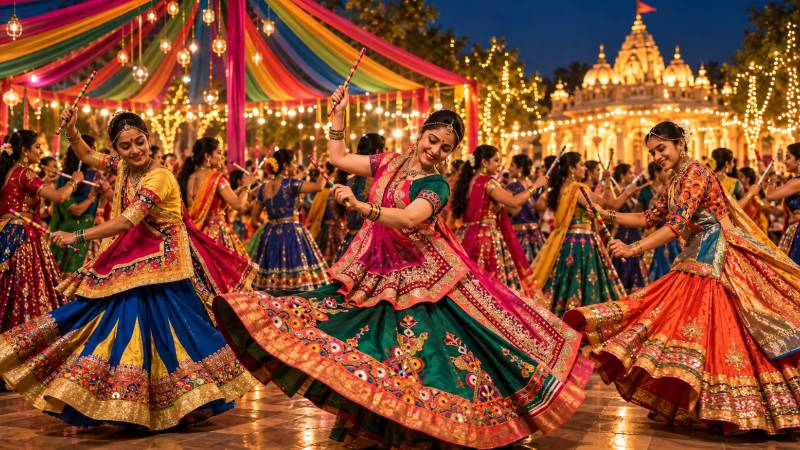
Among the most visually attractive aspects of Navratri are Garba and Dandiya Raas, traditional dances particularly associated with Gujarat. During Garba, participants dressed in colourful traditional attire move rhythmically in circular formations, often around a lamp or another symbol of divine presence. The circle has acquired symbolic associations with continuity, renewal, and the recurring cycles of existence. Dandiya Raas involves dancers striking decorated wooden sticks together in carefully coordinated movements, accompanied by music and rhythmic patterns. These celebrations bring together people of different ages and backgrounds, transforming religious observance into an experience of collective cultural participation. They also demonstrate that worship, artistic expression, and social interaction need not exist in separate compartments. Music, movement, dress, and community participation become interconnected elements of a shared cultural experience. Although their significance remains rooted in particular religious and regional traditions, their visual appeal has attracted attention far beyond the communities in which they originated.
A society's commitment to tolerance is not adequately demonstrated by the freedom enjoyed by its majority population alone. It must also be judged by the security and dignity afforded to those whose religious beliefs differ from those of the majority.
Pakistan's Hindu community also observes Navratri with devotion and enthusiasm, particularly in Sindh, where Hindu religious and cultural traditions have deep historical roots. Karachi, Hyderabad, Mirpurkhas, Umerkot, and Tharparkar are among the areas where Hindu communities maintain religious institutions and celebrate traditional festivals. Temples become centres of worship, families gather for prayers, and communities participate in cultural activities associated with the occasion. These celebrations are significant not merely as expressions of religious devotion but also as reminders of Pakistan's complex and diverse cultural inheritance. The history of Sindh cannot be understood adequately without acknowledging the contributions of its Hindu communities to commerce, education, architecture, literature, philanthropy, and the arts. Many of these contributions preceded the creation of Pakistan and continue through the lives of citizens who regard this country as their homeland. Their festivals therefore belong not to an alien cultural landscape but to the broader social history of the region.
Navratri's association with feminine strength deserves particular attention in the context of contemporary debates about gender equality. The representations of Goddess Durga embody courage, protection, and the ability to confront forces of oppression. Yet the symbolic elevation of women does not automatically translate into their social emancipation. Across South Asia, women continue to experience obstacles in education, employment, inheritance, political participation, and personal security. The contradiction between reverence for feminine ideals and unequal treatment of living women is not confined to any single religious community. Similar inconsistencies can be observed wherever societies celebrate motherhood, dignity, or feminine virtue while denying women autonomy and equal opportunity. The more meaningful lesson of such symbolism may therefore lie in encouraging reflection upon social behaviour rather than treating religious celebration as sufficient evidence of equality. A society's commitment to women's dignity should ultimately be measured through access to education, protection under the law, economic participation, and the freedom to make meaningful decisions about their own lives.
The relationship between Navratri and seasonal change also offers an interesting connection between culture and the natural sciences. Traditional festivals in agrarian civilisations frequently developed around the agricultural calendar, harvest cycles, and transitions between seasons. For communities whose livelihoods depended upon rainfall, sunlight, temperature, and the fertility of the soil, seasonal changes carried enormous practical and emotional significance. Modern physics and astronomy explain the annual progression of seasons primarily through the Earth's axial tilt and its revolution around the Sun. Agricultural science, in turn, examines how seasonal variations influence crop growth, water availability, and food production. Cultural traditions address another dimension of this experience: how human communities interpret natural cycles through ceremony, memory, and symbolism. Science can explain why seasons change, while anthropology and history help explain why societies have celebrated these changes in different ways. These approaches need not compete, because they are concerned with distinct aspects of human experience.
As the nine nights of Navratri draw to a close, the lamps are gradually extinguished, the music falls silent, traditional costumes are carefully stored away, and families return to their everyday routines. Yet the deeper cultural value of a festival need not disappear with its conclusion. It may endure in a strengthened sense of community, a renewed appreciation of tradition, or a more generous understanding of those who hold different beliefs. If a neighbour becomes more respectful of another neighbour's religious practices, if a student discovers something previously unknown about the country's cultural heritage, or if citizens recognise that their own freedom is strengthened rather than diminished by the protection of others' freedoms, the festival will have contributed something meaningful to the wider society. Such achievements may be less visible than colourful processions or illuminated temples, but their consequences can be far more enduring.
Ultimately, Navratri reminds us that human beings have developed different spiritual traditions through which they seek meaning, reassurance, moral guidance, and connection with the world around them. The challenge for a diverse society is not to erase these differences but to ensure that they do not become barriers to dignity, friendship, or justice. There is a simple physical truth that offers a fitting metaphor. Whether a lamp burns in a temple, a candle illuminates a church, or a light shines in the courtyard of a mosque, the fundamental physical nature of light remains the same. Photons carry no religious identity, speak no particular language, and recognise no national boundaries. Human beings assign cultural and spiritual meanings to the light they encounter. Perhaps this elementary scientific observation can inspire a modest but valuable social lesson: we do not need to extinguish another person's lamp in order to keep our own burning.
As Pakistan's Hindu community celebrates Navratri, it is appropriate to extend sincere good wishes for peace, happiness, and prosperity. More importantly, the occasion invites us to reflect upon the kind of society we wish to build: one in which religious diversity is neither feared nor exploited, where education replaces ignorance, and where every citizen can participate in national life with dignity and confidence. The nine nights may end, but the light of mutual respect should remain.