

Rohi is the land that reunites me with my beloved;
May it forever flourish, verdant and green.
Khawaja Ghulam Fareed
I remember one of the pleasant days at the end of February 1985 when I accompanied the country’s leading Urdu writers; Muhammad Khalid Akhtar, Ahmed Nadeem Qasmi, Jamila Hashmi, Ashfaq Ahmed and Bano Qudsia on a visit to Derawar Fort. The writers gathered at Bahawalpur at the invitation of the Arts Council of the city. The Arts Council had arranged a literary gathering in the honour of Muhammad Khalid Akhtar to appreciate his literary works.
It was my first ever journey into the captivating landscape of Cholistan. Among the writers was Jamila Hashmi, who had beautifully portrayed the landscape and spirit of Rohi in her novella Rohi. The novella brought the desert to life as a vivid and living character. The desert attracts you.The site of the glittering golden sand dunes is a unique experience. But above all, it instills a sense of mystery. It brings out the mystery of your existence and you feel yourself just a speck in the vastness of the universe.
For Aldous Huxley, one of my favourite essayists, desert is not a barren geographical landscape. It is a place of silence, solitude, mystery and spiritual revelation. “It challenges our ordinary perception of reality.” I had the same feelings while passing through Rohi. As our destination was Derawar Fort, I did not know much about its history and I was not aware of the historical importance regarding the ancient Hakra River that flowed nearby. Later in life while leafing through the pages of history of Bahawalpur State I came to know its importance. The fort had been wrested from the Bhatti rulers of Jaisalmer by the Daudputra Abbasis in the eighteenth century. Derawar served as the capital or principal seat of the early Abbasi rulers for approximately 14–15 years, from 1733 to 1747–1748.
Derawar Fort was more than a military fortress: its strategic location connected the Indian subcontinent with Central Asia, protected caravan routes and helped shape the economy and authority of the region.
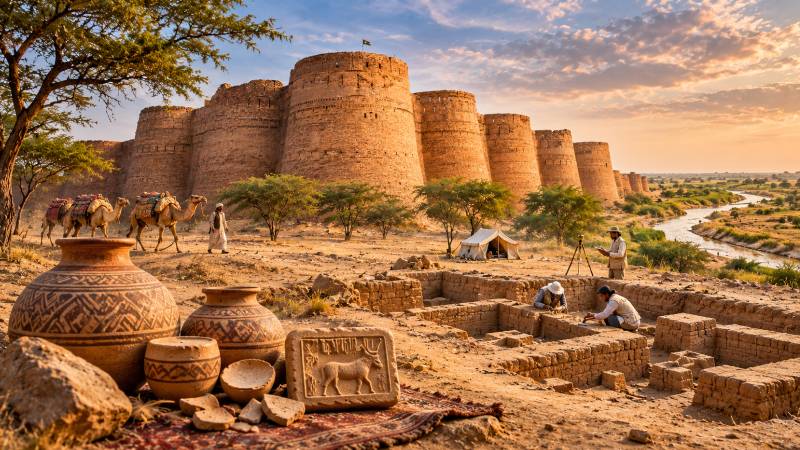
Historically the surroundings of Derawer fort had settlements related to the ancient Hakra River before the fort was built in the 9th century. “Archaeological evidence suggests the prehistoric and Bronze Age communities across Cholistan.” It was an agrarian settlement and was conducive to the development of early civilization. Hakra civilisation , in fact, engendered the urban civilisation of Harappa and the Indus civilisation. According to UNESCO’s description of Derawar and the desert forts of Cholistan, “settlements existed along the Hakra from approximately 4000 BCE, although the chronology of the river’s decline remains a subject of archaeological and geological investigation.”
The Derawer fort had a strategic importance as it connected the Indian subcontinent with Central Asia and other regions. It protected caravan routes and it helped the rulers to maintain their authority over the region. It played an important role in the economy of Cholistan. So, it didn’t only serve the purpose of a military fortress but had other strategic roles to play as well. Historian Samia Khalid emphasizes that owing to its strategic location “the fort became the strongly contested territory between the rulers of Jaisalmer and the Daudputra Abbasis.”
Archaeological investigations suggest that Cholistan was once an important centre of prehistoric settlement. Dr Muhammad Rafique Mughal’s, who conducted extensive archaeological surveys in Cholistan between 1974 and 1977, findings changed our perspective of the history of the region. The Hakra civilisation dates back to 3500–3000 BCE, whereas the mature Harapan civilisation flourished between 2500–1900 BCE. The region is mostly barren now but it was once the cradle of historic civilisation.And the culture of its numerous prehistoric communities gave rise to the great urban civilisation of the Indus.
The striking pottery, settlements, craft activities and evidence of pastoral and agricultural life related to Hakra culture substantiate that Cholistan played an important role in the early history of the Indus civilization. One of his most important findings was the discovery of an idiosyncratic ceramic tradition known as Hakra Ware. “This pottery included handmade vessels, incised decorations, mud-appliqué pottery and other characteristic forms.” All this evidence bears testimony to the fact that the region had a civilization of its own, which served as a precursor to other great civilizations. It is the mere Abracadabra of the mountebanks calling themselves historians that Harapa was the first cradle of civilization in the subcontinent.