

Our thirst burns like the scorching heat of the Thal;
Let us soak our chunri, our kameez, and its hem by the river — Aziz Shahid
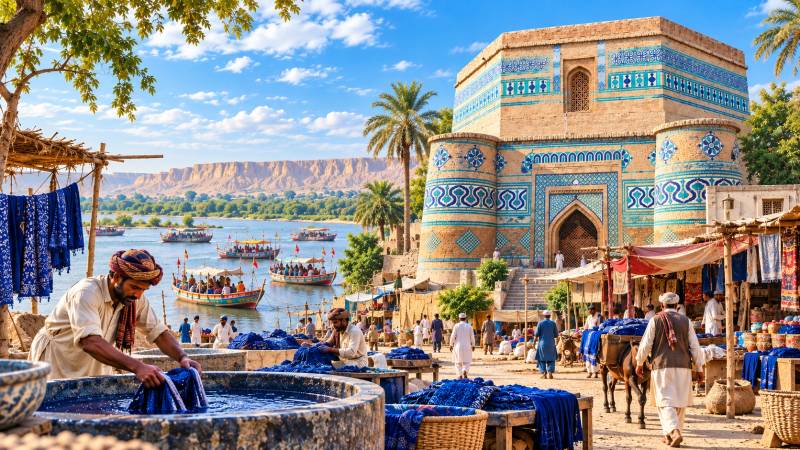
Before entering the land of indigo, the mighty Indus, like an ancient deity, welcomes you, and its history reverberates through the centuries. You can see brightly coloured boats drifting on the water across its broad bed. They are the floating homes of the nomadic Kehal tribe. They spend their lives on the river. I still remember the charm of the winter evening that I cherished on its banks and beside its lakes. I hail from Dera Ghazi Khan district but I landed there in November,1989, for the first time. It was shocking to see the historic city in such a dilapidated condition. Seeing the city in such a terrible state brought these lines from Macbeth to mind.
What are these, So wither’d and so wild in their attire,
That look not like th’ inhabitant o’th’earth, And yet are on’t
My first thought was: what had happened to this storied city ? Where had all its glories gone? Once it was a great trade center on the right bank of the mighty Indus and now it looked as though someone had plundered and laid it in waste.The place seemed abandoned and uncared for. The legend had it that it was the city of flowers once.
The region has a history spanning thousands of years. Important Buddhist ruins , discovered at Mound Dillu Roy, indicate that the wider region was governed by various Hindu and Buddhist powers almost 2000 years ago . Following the Arab conquest of Sindh and Multan the people of the wider region of Dera Ghazi Khan embraced Islam in the early 8th century. Later, Sufi movements , traders and Baloch migration brought this religion for the populace in large numbers.
The city was founded probably around 1474-1484 by the Baloch chief Haji Khan Mirani and named after his son , Ghazi Khan Mirani I , who died in 1494. The old settlement was near the right bank of the River Indus. The intermittent floods damaged it , and it was eventually abandoned. The new planned town was built in 1910-1911. The British colonial administration laid it out in “ a gridiron pattern, with broad , straight roads, rectangular blocks and two major open spaces.”
The region’s economic deprivation is not accidental; research suggests that it has been shaped by policies that have failed to deliver inclusive development across Punjab’s districts.
After vanquishing Multan in 1818 , Maharaja Ranjit Singh conquered Dera Ghazi Khan in around 1819-1820. Here the story takes a somewhat confusing turn: the Nawab of Bahawalpur enters the picture, playing a role in the collection of revenue from the Dera Ghazi Khan region. Mahraja Ranjit Singh gave “in form” the region as a tributary to the Bahawalpur State from about 1820 to 1831. Whereas, the State of Bahawalpur and Sikhs were at loggerheads.The Nawab had friendly relations with the British, who were actively engaged in a protracted conflict with the Sikhs. I tried to delve into the rationale of this intriguing arrangement but failed miserably. In 1831 the Lahore darbar asked Jean-Baptiste Ventura to take direct possession of Dera Ghazi Khan.
During British rule the district became highly important to the British for trade, strategic, political and administrative reasons. It was a gateway to Balochistan and later gained importance for the adventures of the “great game.” The district of Dera Ghazi Khan had fertile land, and during the colonial period, it was served by an extensive network of canals. Well irrigation was also widely used, particularly for growing rabi crops.
Trade conducted via the river Indus was quite profitable. During the 19th century , indigo was one of Dera Ghazi Khan’s most valuable commercial crops. Indigo was transported by boat along the Indus River to Sukkur and markets in Sindh. From there, it could be carried to Karachi or Bombay for sale and export. Indigo was processed locally to produce the blue dye widely used by the textile industry. In British India, Dera Ghazi Khan district was self-sufficient economically and produced surplus food for the rest of the country.
After the partition, the elite, mostly Baloch Sardars, looked up to the Center for the consolidation of their power. They are also particular not to bring the development projects in the area for they are mindful of the fact that such projects would bring prosperity in the region and their control over their subjects would be loosen. Dera Ghazi Khan had the worst period of its history when a well known Sardar was elected as District Nazim during Musharraf’s reign. God knows where the funds disappeared. Perhaps the proverbial cat had been entrusted with guarding the milk. The city was falling into ruins; development was simply out of the question. Moreover, many people believe that Takht Lahore, with the help of the local elite, has kept this region poor and backward. Many development projects were planned for the area, but their funds were later cut or taken back. Critics say that some of this money was spent in Central Punjab instead. This has created a strong feeling among the people that their region has been ignored and denied its fair share. This condition illustrates what scholars call horizontal inequality: persistent inequality between culturally or regionally identified groups. So, Dera Ghazi Khan presents a striking example of regional neglect. Ghulam Mohey-ud-Din et al in their research article, “ Is Economic Growth Inclusive in Punjab, Pakistan? A District Level Assessment Using the Complex Index” highlight that the region’s economic deprivation is not accidental ; it results from deliberate and discriminatory policies.