

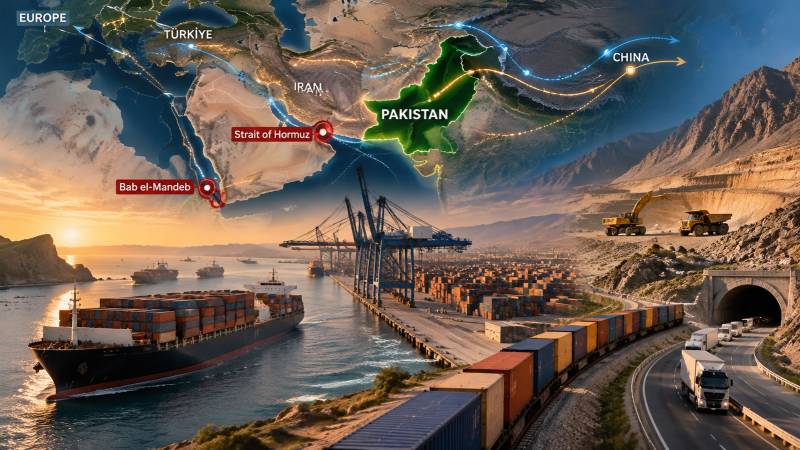
Global supply chains remain dangerously concentrated around a handful of maritime chokepoints, turning these critical routes into leverage points in geopolitical disputes. As governments scramble to de-risk trade, one opportunity remains largely overlooked: a land–sea gateway at the heart of Eurasia—Pakistan. The maritime security landscape of the Middle East has reached a breaking point, triggered by the 2026 Iran war and the subsequent paralysis of the Strait of Hormuz. As Tehran’s closure of the Strait of Hormuz, has disrupted global energy supplies, driving crude prices toward historic highs and triggering a global supply shock. This eastward crisis mirrors the volatility to the west, where access to the Red Sea via the Gulf of Aden and the Bab el-Mandeb corridor— a route for $1 trillion in annual goods remains under constant threat. Iranian-backed Houthi attacks on commercial shipping, Israel’s controversial recognition of Somaliland has drawn sharp pushback from the African Union and the EU, while renewed tensions between Ethiopia and Eritrea over Red Sea access threaten regional stability. Furthermore, the deepening rivalries between Saudi Arabia and the UAE has fractured the Gulf coalition, leaving the world’s most vital maritime corridors vulnerable.
Strategically located at the crossroads of Central Asia’s mineral wealth, West Asia’s energy resources, South and East Asia’s manufacturing hubs, and the Indian Ocean’s shipping lanes, Pakistan could play a pivotal role as a regional trade and logistics connector. Its development has long been constrained by political rivalries, weak governance, and dependence on external aid. The Pakistan Economic Gateway (PEG) concept reframes this dynamic: instead of a passive recipient, Pakistan could become an active provider of connectivity, linking Eurasia, Africa, and Australia into a seamless trade network.
The urgency is growing. Instability along key maritime routes from the Strait of Hormuz to Bab el-Mandeb has underscored the fragility of global supply chains. At the same time, the energy transition is driving sustained demand for critical minerals such as copper, lithium, and rare earths. Pakistan holds substantial but underdeveloped mineral reserves, particularly in Chagai, and recent entry by international firms such as Barrick Gold signals improving commercial viability. Flagship projects like Reko Diq—expected to rank among the world’s largest copper-gold mines—present a rare opportunity to anchor long-term, capital-intensive investment.
With predictable regulation, secure logistics, and export-oriented infrastructure, these assets could integrate Pakistan into high-value supply chains for electric vehicles, grid infrastructure, and renewables—transforming mineral endowments into durable economic and strategic returns.
With predictable regulation, secure logistics, and export-oriented infrastructure, these assets could integrate Pakistan into high-value supply chains for electric vehicles, grid infrastructure, and renewables—transforming mineral endowments into durable economic and strategic returns. For Western economies, Pakistan could offer a practical and scalable option for supply-chain diversification. Overland routes such as a Pakistan–Iran–Turkey–Europe (PITE) corridor linking the Tethyan Copper Belt to the European Union in under three days or maritime exports via deep-sea ports like Gwadar and Karachi could reposition Pakistan to a pivotal logistics and processing hub. More than a transport solution, this would create secure, regulated corridors for commodities essential to the global energy transition, aligning commercial incentives with strategic resilience and decarbonization objectives.
Political tensions in South Asia remain the main obstacle. Yet history shows trade can advance despite friction. The European Coal and Steel Community, for instance, integrated industries making conflict materially more difficult. Pakistan could adopt a similar strategy: technical standardization, customs-supervised transit, and infrastructure coordination could facilitate trade flows even amid border tensions, much as China and India maintain commercial ties despite strategic competition.
The challenges are real. Regional volatility from India-Pakistan tensions to instability in Myanmar and Iran complicates overland connectivity. Domestic issues, including governance, regulatory credibility, and security, also matter. These risks call for pragmatism, not paralysis. By embracing a strategy of multi-alignment, Pakistan can navigate these pressures, moving beyond the binary choices of the past. Notably, Iran remains one of the region’s most functional transit routes, underscoring the potential for trade even amid complex geopolitics. The stakes extend far beyond Islamabad. The South Asian littoral—from the Gulf of Oman to the Bay of Bengal will shape global economic and strategic balances in the twenty-first century. As supply chains fragment and great powers compete, the question is not whether new gateways will emerge, but where.
If Pakistan fails to define itself as one, others will shape the region’s connectivity on their terms. For policymakers around the world, this requires a rethink. Seeing Pakistan only with a security lens risks overlooking its potential as a stabilizing economic connector. For Pakistan, the choice is clear: remain a corridor on someone else’s map—or become the Pakistan Economic Gateway the world increasingly relies on.